NIH SBIR Application Guide: ICs & Aims

NIH SBIR Application Guide: How the Program Actually Works in 2026
NIH is the largest single funder in U.S. SBIR (over $1.2 billion per year in awards) and the most opaque program for first-time applicants. The reasons are structural: NIH SBIR is not one program but 27 quasi-independent programs run by the institutes and centers (ICs), each with its own funding priorities, paylines, and program officers. The proposal that wins is the one that's targeted at the right IC, submitted to a study section whose reviewers can evaluate it, and structured around the page that matters most — the Specific Aims.
This guide walks through how NIH SBIR is actually structured, how to pick the right IC and engage its Program Officer, how study section assignment works and why it matters, the Specific Aims page (which a meaningful share of reviewers read in detail and the rest skim before deciding), the simplified review framework that took effect in 2025, and what NIH commercialization reviewers specifically want to see.
Key Takeaways
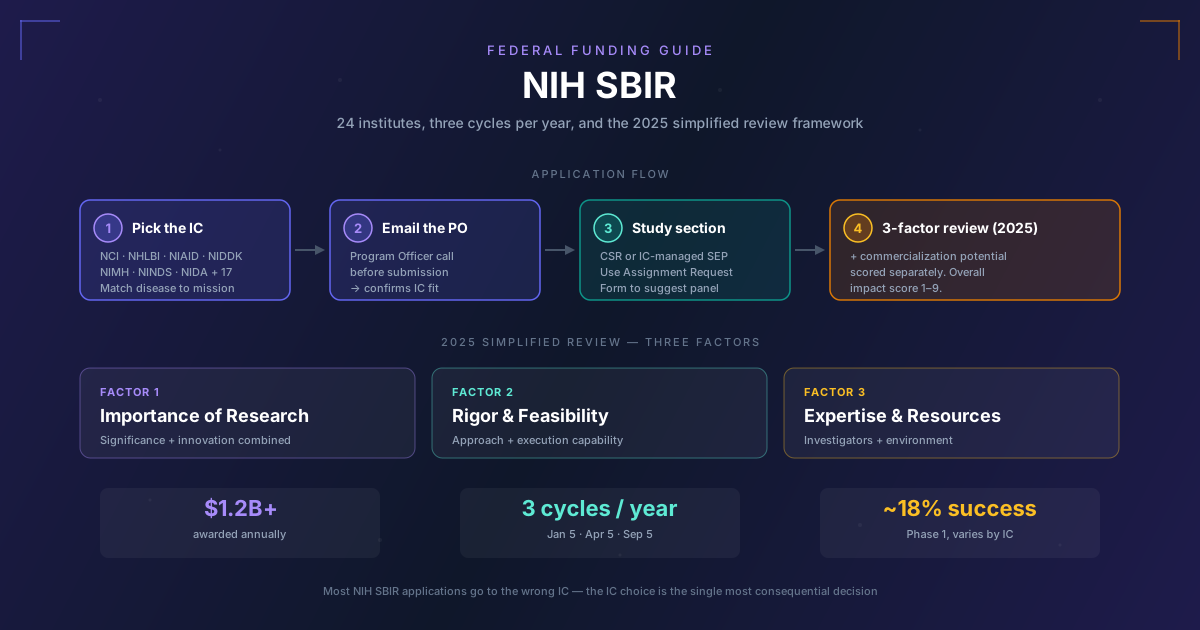
- NIH SBIR is not one program — it's 24 quasi-independent institute and center programs, each with its own priorities, paylines, and program officers.
- Three submission cycles per year (typically Jan 5, Apr 5, Sep 5). Three solicitation types: omnibus, Program Announcement (PA), and Request for Applications (RFA).
- Calling the Program Officer before submission is the highest-leverage action — PO conversations confirm IC fit, study section likelihood, and budget appropriateness.
- The Specific Aims page is the most-read page in the application. Treat it as the document, not as a summary.
- NIH simplified peer review in 2025 to three factors: Importance of Research, Rigor & Feasibility, and Expertise & Resources — plus commercialization potential scored separately for SBIR.
If you're considering NIH SBIR, or you've been declined and want to understand why, the mechanics below are the ones that decide outcomes.
How Is NIH SBIR Structured?
NIH SBIR is administered by the SEED (Small Business Education and Entrepreneurial Development) office and executed by 24 of NIH's 27 institutes and centers. Each participating IC sets its own funding levels, priorities, and program-specific guidance, layered on top of common NIH-wide rules.
Three Solicitation Types
Almost every NIH SBIR opportunity is one of three things:
Omnibus solicitations (PA-25-300 series). General SBIR funding announcements that accept proposals across broad scientific areas. Most NIH SBIR applications are submitted to the omnibus. Three submission cycles per year (typically January 5, April 5, and September 5, though dates shift periodically).
Program Announcements (PA). IC-specific announcements that signal particular interest in a topic area. PAs share the omnibus's three-cycle schedule but provide more guidance about the kind of work the IC wants to fund.
Requests for Applications (RFA). Targeted solicitations with specific topics, set-aside funds, and a single application deadline. RFAs are scored separately from omnibus applications, often with paylines that are more favorable.
The path matters: an applicant whose work fits a current RFA should typically apply to the RFA rather than the omnibus, because the funding set-aside and separate scoring usually produce better odds.
The 24 Participating Institutes and Centers
| IC | Focus | Annual SBIR spend (approx.) |
|---|---|---|
| NCI | Cancer | $200M+ |
| NHLBI | Heart, Lung, Blood | $150M+ |
| NIAID | Allergy, Infectious Disease | $130M+ |
| NIDDK | Diabetes, Digestive, Kidney | $110M+ |
| NIMH | Mental Health | $90M+ |
| NINDS | Neurological Disorders, Stroke | $90M+ |
| NIDA | Drug Abuse | $70M+ |
| NIA | Aging | $70M+ |
| NEI | Eye | $50M+ |
| NICHD | Child Health, Human Development | $50M+ |
| ...others (NIDCD, NIEHS, NIAMS, NIAAA, NIGMS, etc.) | Various | $20M–$50M each |
The IC choice is the single most consequential decision in NIH SBIR application strategy. The same technology might be a strong fit for NCI's drug development priorities and a weak fit for NHLBI's medical device priorities — and applying to the wrong IC means competing against work the IC's program officers don't believe in.
How Do You Pick the Right IC and Engage the Program Officer?
Most NIH SBIR applications go to the wrong IC. Here's the structured way to pick.
Step 1: Match Your Disease/Mechanism to the IC's Mission
Every IC has a specific disease or research domain. The IC's website lists its current funding priorities, recent SBIR awards, and program officer contacts. If your technology targets a specific disease, search NIH RePORTER for recent SBIR awards on that disease — the IC that funded those awards is your likely fit.
Step 2: Identify the Most Aligned Program Officer
Each IC has multiple program officers (POs), each managing a portfolio of grants in a specific subdomain. Search recent SBIR awards in your area, and identify the PO listed on the most relevant ones. This is the person you need to reach.
Step 3: Email the PO Before Submission
This is the highest-leverage action in NIH SBIR application strategy. POs are explicitly allowed and encouraged to discuss potential applications with PIs before submission. A typical exchange:
- Send a brief email (under 150 words) describing your technology, the IC mission fit, and one or two specific questions
- Attach a 1-page concept document (Specific Aims draft is ideal)
- Request a 20-minute phone call
POs cannot tell you whether you will be funded. They can tell you:
- Whether the topic fits the IC's current priorities
- Whether your specific aims align with what reviewers will value
- Which study section is likely to evaluate the application
- Whether the budget is reasonable for the IC
Applications submitted without ever talking to a PO win at substantially below average rates. Applications where the PI had a substantive pre-submission conversation with the PO win at substantially above average rates. The math holds across ICs.
How Does NIH Study Section Assignment Work?
Once submitted, an NIH SBIR application is routed to a study section — a panel of peer reviewers who evaluate the science. Two routes:
Standing study sections are managed by the Center for Scientific Review (CSR) and have stable membership across cycles. Many SBIR applications go to CSR-managed Special Emphasis Panels (SEPs) specifically organized to review small-business applications.
IC-managed Special Emphasis Panels are organized by individual ICs (or by NIH SEED for cross-cutting topics). Reviewer composition is curated for each panel by the IC's scientific review officer (SRO).
The Assignment Request Form (ARF) (submitted with the application) lets the applicant suggest preferred study sections, request avoidance of specific reviewers (e.g., due to conflict of interest), and recommend IC assignment. The Division of Receipt and Referral (DRR) makes the final assignment, but well-justified ARF requests are usually honored.
Why study section matters: reviewer composition determines how the application is evaluated. A medical device application reviewed by a study section composed of pure biologists may receive a poor "approach" score because the reviewers don't fully evaluate the engineering. The same application reviewed by a panel with engineering and clinical expertise may score substantially higher.
The implication: identify the right study section before submission, and use the ARF to request it.
What Goes on the NIH SBIR Specific Aims Page?
A single page in the NIH SBIR application gets more reviewer attention per word than the rest of the document combined: the Specific Aims page.
Some reviewers read the Specific Aims and skim the rest. Others read the full application but use the Specific Aims as the anchor against which everything else is evaluated. Either way, a weak Specific Aims page is a fatal weakness — the rest of the application can be strong, but reviewers who lose confidence on the Aims page often score the application down across all factors.
A strong Specific Aims page contains, in order, on one page:
- Premise (3-5 sentences). What's known, what gap exists, what the central problem is. This is where you establish that the work matters.
- Critical barrier or unmet need (2-3 sentences). The specific obstacle the science or product must overcome. Frame this as a barrier to a clinical or scientific advance, not as an internal company problem.
- Central hypothesis or product concept (2-3 sentences). What you propose to do, what mechanism or approach you'll use. For SBIR, this often includes a product description.
- Specific Aims (1-3 numbered aims). Each aim is one sentence stating what you will do, followed by 2-4 bullets describing the experimental approach and expected outcomes.
- Impact/significance (2-3 sentences). The expected outcomes if the aims are achieved, framed in terms relevant to the IC's mission and commercial viability.
The Specific Aims page is the only part of the application that should be drafted, redrafted, and shown to outside readers (advisors, prior reviewers, prospective POs) multiple times before submission. Treating it as a routine summary section is the single most common reason competitive proposals lose.
What Is the 2025 Simplified Review Framework?
NIH simplified its peer review framework in January 2025. The legacy framework (Significance, Innovation, Approach, Investigators, Environment) has been replaced with three factors:
Factor 1 — Importance of the Research. Combines the legacy "Significance" and "Innovation" criteria. Reviewers ask: does this research matter to the field, and does it propose something genuinely new?
Factor 2 — Rigor and Feasibility. Combines the legacy "Approach" criterion plus elements of "Investigators" and "Environment" related to whether the proposed work can actually be executed. Reviewers ask: is the methodology sound, and can this team execute the plan?
Factor 3 — Expertise and Resources. What remains of "Investigators" and "Environment." Reviewers ask: does the team and institutional setting support the work?
Each factor is scored 1-9 (1 = exceptional, 9 = poor). The overall impact score (1-9) is the reviewer's holistic assessment, not a numerical combination of the factor scores.
For NIH SBIR specifically, two additional considerations apply:
Commercialization potential. Evaluated separately from the three scientific factors. A weak commercialization plan can sink a scientifically strong application. (See The SBIR Commercialization Plan: Template + 5 Examples for the full framework.)
Small business viability. Reviewers assess whether the small business is structured to commercialize the technology — team capabilities, prior commercialization track record, plausible path to revenue.
The implication of the simplified framework: write to all three factors explicitly. Don't assume reviewers will infer one factor's information from another factor's section. The Research Strategy section should signal importance early, then transition to rigor and feasibility, then close with expertise and resources.
How Are Human Subjects, IRB, and Vulnerable Populations Handled?
NIH SBIR applications involving human subjects have specific clearance requirements at submission, not just at award. Common pitfalls:
Determination of human subjects research. Applications must declare whether human subjects research is involved. The threshold is set by HHS regulation , not every clinical adjacency triggers human subjects requirements, but many do. When in doubt, treat the work as human subjects research and complete the relevant sections.
IRB approval timeline. For Phase 1 applications, IRB approval is generally not required at submission — but a plan for obtaining it must be described. For Phase 2, IRB approval at submission is often expected, especially for studies that will enroll subjects during the project period.
Inclusion of women, minorities, and children. NIH requires applications to address recruitment plans for women, minorities, and children. Single-sex or single-population studies require explicit scientific justification.
Single IRB requirement. Multi-site clinical research generally requires a single IRB of record, which must be identified in the application. Single IRB arrangements add coordination overhead and should be planned for in the budget.
Clinical trials specifically. Applications proposing clinical trials must include a separate Protection of Human Subjects section, recruitment and retention plan, and inclusion enrollment report. Misclassifying a clinical trial as "research" (or vice versa) is a common reason for return without review.
For broader medical device commercialization context, see our Medical Device Guide: Prototype to 510(k).
What Are the Common Biosketch and Budget Gotchas?
The NIH biosketch and budget are heavily formalized. Several specific points that catch first-time applicants:
Biosketch
The NIH biosketch is 5 pages maximum and uses a specific format:
- Section A: Personal Statement (highlights of relevance to this application)
- Section B: Positions, Scientific Appointments, and Honors
- Section C: Contributions to Science (3-5 narrative contributions, each with 4 representative publications)
- Section D: Scholastic Performance (for trainees only)
The Contributions to Science section is unique to NIH. Each contribution is a narrative paragraph (not a publication list) describing a coherent body of work and its impact. For SBIR PIs from industry, contributions can include commercialization achievements, products developed, and IP , not just publications.
Budget
NIH SBIR Phase 1 uses a modular budget when total direct costs are at or below $250K/year and certain other conditions are met. Phase 2 typically requires a detailed budget.
Common budget mistakes:
- Including PI time below the IC's minimum (NIH requires at least 1 calendar month of PI effort for SBIR)
- Subaward indirect cost calculations done incorrectly (subaward IDC is a passthrough item with specific rules)
- Equipment over the IC's threshold without explicit justification
- Consultant fees treated as personnel costs instead of "other" costs
- Travel budgets that don't tie to specific aims (reviewers notice this)
NIH SBIR Phase 1 has a published cap (currently $325K total costs, with most IC awards landing closer to $275K-$300K). Phase 2 cap is $2.1M total costs over 2 years, with some ICs offering higher amounts for specific topics.
How Should You Approach NIH SBIR Resubmission?
NIH allows one resubmission (A1) per application. The resubmission rules:
- Must be submitted within 3 cycles of the original
- Must include a 1-page Introduction summarizing how reviewer concerns were addressed
- Cannot be submitted to a different IC than the original (with rare exception)
- After A1 is declined, no further resubmission of the same application is permitted
Strong resubmissions address every reviewer critique substantively. Weak resubmissions defend the original approach against the critique. Reviewers are explicit that they expect to see the application changed in response to their feedback — defending the original is a near-guaranteed second decline.
A common pattern: A0 (original) is declined with a borderline score (e.g., 35-45 impact score for an IC with a payline of 25). A1 addresses critiques and is funded. This is the modal path for many NIH SBIR awardees. Don't treat a first decline as failure.
For broader background on SBIR phase structure and what happens at each stage, see SBIR Phase 1 vs 2 vs 3: A Stage-by-Stage Guide.
Frequently Asked Questions
How many submission cycles does NIH SBIR have per year?
Three. The standard SBIR omnibus due dates are January 5, April 5, and September 5 each year, though specific RFAs may have different deadlines. Applications submitted by the deadline are reviewed at the cycle's study section meeting (typically 4-6 months later) and decisions are issued 9-12 months after submission.
What is the NIH SBIR success rate?
Across all ICs and topics, NIH SBIR Phase 1 success rates have historically run in the 16-22% range, with substantial variation by IC and topic. RFAs typically have higher success rates than omnibus applications due to set-aside funds.
Can a university researcher be the PI on an NIH SBIR?
Only if the researcher commits primary employment (>50%) to the small business at the time of award. For tenured faculty who want to keep their academic appointment, STTR is the appropriate program. (See SBIR vs STTR: Which One Should You Apply For?.)
What is the NIH SBIR Phase 1 award amount?
Most NIH SBIR Phase 1 awards land between $275K and $325K total costs for 9-12 months. Specific ICs and topics may award higher amounts ($500K+) for capital-intensive Phase 1 work. The current SBA cap is $314K, though waivers permit higher amounts for certain topics.
Do NIH SBIR applications require human subjects approval at submission?
For Phase 1 SBIR, IRB approval is typically not required at submission but must be obtained before subject enrollment. For Phase 2, IRB approval at submission is generally expected for projects that will enroll subjects in the project period. The exact requirement depends on the specific IC and topic.
What is the NIH biosketch "Contributions to Science" section?
Section C of the NIH biosketch describes 3-5 narrative contributions to science, each with up to 4 representative publications. Unlike a traditional CV, each contribution is a paragraph describing a coherent body of work and its impact. For SBIR PIs from industry, contributions can include commercialization achievements and patents alongside publications.
Can I apply to multiple NIH ICs simultaneously?
Yes, but applications cannot be funded by multiple ICs simultaneously for the same work. The Division of Receipt and Referral assigns each application to a primary IC; secondary IC interest can be noted but doesn't multiply your odds.
Ready to Build a Fundable NIH SBIR Commercialization Story?
NIH SBIR rewards scientifically strong proposals — but funds them based on a commercialization plan that survives the panel's commercial-criterion scrutiny. The market analysis, competitive landscape, and customer discovery synthesis that determine fundability are the same regardless of IC.
Commercify builds that work tailored to NIH SBIR review criteria and to your specific IC's priorities.
Build your NIH SBIR commercialization strategy with Commercify →
Read next: The Complete SBIR/STTR Guide · The SBIR Commercialization Plan: Template + 5 Examples · Lab to Market: Gene Therapy's $50M Exit