Lab to Market: Gene Therapy's $50M Exit

From Lab to Market: A University Biotech Success Story
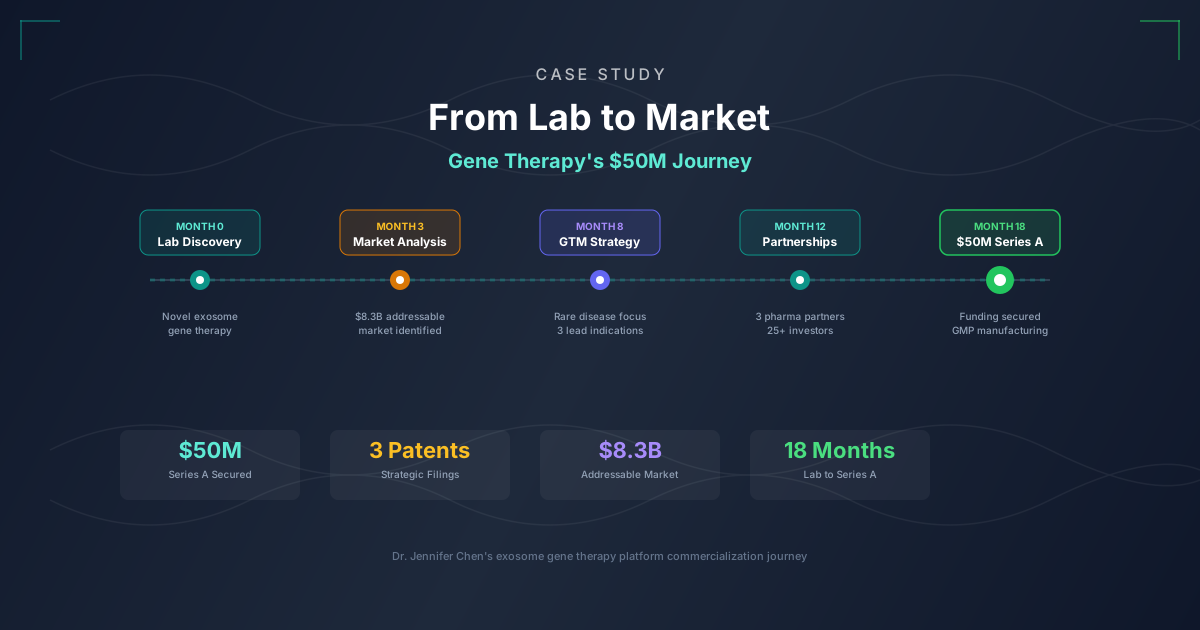
Dr. Jennifer Chen's team took an engineered-exosome gene therapy platform from the lab to a $50M Series A in just 18 months by treating commercialization as a parallel workstream to their science rather than an afterthought. They used AI-powered market analysis to compress a year-long strategic planning process into weeks, then selected a startup route, focused on rare disease applications, validated the strategy with an expert network, and pivoted from oncology to rare diseases based on data. The key lessons: start commercialization planning during the research phase, embrace AI tools to synthesize market intelligence, sharpen the value proposition, build strategic relationships early, and stay agile enough to pivot on market feedback.
The biotech industry faces a well-documented commercialization gap: promising research discoveries frequently stall in the transition from academic lab to viable commercial product. For gene therapy in particular, the path is fraught with regulatory complexity, manufacturing challenges, and the difficulty of communicating scientific value to non-technical investors. According to industry analyses, fewer than one in ten university-originated biotech innovations ever reach the market. This makes success stories especially instructive for researchers navigating the same treacherous journey. Today, we share the remarkable story of how Dr. Jennifer Chen and her team transformed their novel gene therapy platform from a promising research project into a $50M Series A success in just 18 months.
The Broader Biotech Commercialization Landscape
The gene therapy sector has experienced extraordinary growth over the past decade, with approved therapies commanding premium pricing and drawing significant venture capital interest. Yet the road from laboratory proof-of-concept to approved therapeutic remains one of the longest and most capital-intensive in all of biotech. University research teams often possess deep scientific expertise but lack the commercial acumen, industry networks, and strategic frameworks necessary to navigate this journey effectively. The convergence of AI-powered commercialization tools and a maturing gene therapy market has created a new window of opportunity for academic innovators willing to approach commercialization systematically.
Several macro trends are reshaping how biotech innovations move from bench to bedside. Regulatory agencies have introduced expedited pathways for breakthrough therapies, particularly in rare diseases where unmet medical need is acute. Meanwhile, venture capital firms have become more sophisticated in evaluating early-stage biotech assets, placing greater emphasis on clear commercialization roadmaps alongside scientific merit. For research teams that can articulate a compelling market narrative backed by rigorous analysis, the funding environment has never been more receptive.
The Innovation: Beyond Traditional Gene Therapy
Gene therapy delivery has long been constrained by the limitations of viral vectors, including immunogenicity concerns, limited cargo capacity, and manufacturing complexity. Dr. Chen's team developed an innovative approach using engineered exosomes that sidesteps many of these challenges, representing a potential platform shift in how genetic medicines reach target cells. The significance of this work extends beyond a single therapeutic application, as platform technologies that address fundamental delivery challenges tend to attract outsized commercial interest from both investors and pharmaceutical partners.
Dr. Chen's team developed a revolutionary approach to gene therapy delivery, using engineered exosomes to overcome the limitations of traditional viral vectors. By leveraging the body's own intercellular communication mechanisms, their platform offered a fundamentally different delivery paradigm, one that could potentially address multiple therapeutic areas from a single technology base. Their innovation promised:
- Enhanced targeting precision
- Reduced immune response
- Improved scalability
- Lower manufacturing costs
The Commercialization Challenge
Despite the technology's clear scientific merit, the team encountered a set of obstacles that are remarkably common among university spinouts. The gap between laboratory validation and commercial viability is not primarily a scientific problem but rather a strategic one. Many research teams underestimate the complexity of translating technical advantages into a market-ready value proposition, particularly in a sector as heavily regulated and capital-intensive as gene therapy. Understanding and addressing these challenges early is what separates the innovations that reach patients from those that remain confined to academic publications.
Despite the technology's evident potential, the team faced a set of interconnected commercialization hurdles that, left unaddressed, could have delayed market entry by years:
- Unclear market positioning
- Complex regulatory pathway
- Manufacturing scalability concerns
- Limited industry connections
- Competitive patent landscape
Accelerating Time to Market with AI-Powered Strategy
Traditional commercialization consulting engagements can take months to deliver actionable recommendations, and they often rely on static market data that becomes outdated quickly. Dr. Chen's team chose a different approach, leveraging AI-powered market analysis to compress what would typically be a year-long strategic planning process into weeks. The ability to rapidly synthesize market intelligence, competitive landscapes, and regulatory considerations allowed the team to make data-driven decisions at each critical juncture rather than relying on intuition or anecdotal guidance from advisors. This approach is particularly valuable in gene therapy, where the competitive landscape shifts rapidly as new clinical trial results, regulatory decisions, and funding announcements continuously reshape the market. Speed of strategic iteration, not just speed of scientific discovery, has become a critical competitive advantage for biotech spinouts.
Using Commercify's AI-powered platform, Dr. Chen's team:
-
Conducted Comprehensive Market Analysis
- Identified a $8.3B addressable market
- Mapped 23 potential competitors
- Discovered 3 unique market opportunities
-
Optimized Commercialization Pathway
- Selected startup route over licensing
- Identified key strategic partners
- Developed clear regulatory strategy
-
Generated Go-to-Market Strategy
- Focused on rare disease applications
- Prioritized 3 lead indications
- Created compelling value proposition
-
Validated with Expert Network
- Received feedback from 15 industry experts
- Refined business model
- Strengthened pitch deck
Key Success Factors
Beyond the specific tools and tactics, several underlying principles distinguished Dr. Chen's approach from the many biotech commercialization efforts that falter. The team treated commercialization not as an afterthought to their scientific work but as a parallel workstream deserving equal rigor and discipline. They combined the analytical power of AI-driven insights with the qualitative judgment that comes from deep domain expertise, creating a feedback loop that continuously refined their strategy as new information emerged. Notably, the team assembled a cross-functional advisory group early in the process, bringing together regulatory specialists, manufacturing experts, and commercial strategists alongside their core scientific team. This interdisciplinary approach ensured that technical decisions were always evaluated through a commercial lens, and that commercial assumptions were grounded in scientific reality.
-
Data-Driven Decision Making
- Used AI to analyze 500+ market reports
- Evaluated 50+ potential applications
- Identified optimal pricing strategy
-
Rapid Iteration
- Tested 5 business models
- Refined pitch deck 12 times
- Adapted strategy based on real-time market feedback
-
Strategic Networking
- Connected with 25+ potential investors
- Built relationships with 3 pharma partners
- Engaged key opinion leaders
Results That Speak Volumes
The outcomes achieved by Dr. Chen's team illustrate what becomes possible when rigorous science meets disciplined commercialization strategy. Each milestone below represents not just an achievement in isolation but a strategic building block that reinforced the others. Securing Series A funding, for instance, was enabled by the credibility that came from an established pharma partnership and a clearly articulated regulatory pathway. This interconnected approach to milestone planning is something that AI-driven strategy tools are particularly well-suited to optimize.
Within 18 months of using Commercify:
- Secured $50M Series A funding
- Filed 3 strategic patents
- Established pharma partnership
- Built world-class team
- Set up GMP manufacturing
- Initiated IND-enabling studies for lead indication
The speed at which these milestones were achieved is particularly noteworthy. In the conventional biotech timeline, securing Series A funding alone can take twelve to twenty-four months from the point of initial investor engagement. By arriving at investor conversations with a comprehensive, data-backed commercialization strategy already in hand, Dr. Chen's team compressed the fundraising timeline dramatically.
Lessons for Research Innovators
The principles underlying Dr. Chen's success are broadly applicable to any researcher contemplating the commercialization journey. While every technology and market context is different, certain strategic imperatives recur across successful university spinouts. The following lessons distill the most transferable insights from this case study, each grounded in specific actions the team took and the reasoning behind them.
-
Start Early Begin commercialization planning during the research phase, not after publication. Dr. Chen's team initiated market analysis while still optimizing their exosome platform, which allowed them to align their research priorities with commercial opportunities. Early engagement with the market also informed their patent strategy, ensuring they filed claims that covered commercially relevant applications rather than just the broadest possible scientific scope.
-
Embrace AI Tools Leverage technology to accelerate market analysis and strategy development. The volume of data relevant to biotech commercialization, spanning scientific literature, patent filings, clinical trial databases, regulatory guidance, and market reports, is simply too vast for any team to process manually. AI-powered platforms can synthesize these disparate data sources into actionable intelligence in a fraction of the time, enabling faster and more confident decision-making.
-
Focus on Value Proposition Clearly articulate the problem you are solving and why your solution is unique. Dr. Chen's team learned early that investors and partners respond not to technical specifications but to a compelling narrative about patient impact, market need, and competitive differentiation. They refined their value proposition through iterative testing with diverse stakeholder audiences until it resonated equally with scientific advisors, venture capitalists, and potential pharma partners.
-
Build Strategic Relationships Network with industry experts, investors, and potential partners early. The team devoted significant effort to relationship building well before they needed funding, which meant that when they did launch their Series A process, they were approaching warm contacts with established credibility rather than cold-calling venture firms. Industry conferences, advisory board formation, and structured expert consultations all played a role.
-
Stay Agile Be ready to pivot based on market feedback and opportunities. The team's original business plan centered on a broad oncology application, but market analysis revealed that rare diseases offered a faster regulatory pathway and less competitive pressure. This strategic pivot, informed by data rather than gut instinct, proved to be one of the most consequential decisions in the entire commercialization journey.
The Future of Research Commercialization
The landscape of research commercialization is shifting fundamentally as AI-powered tools become more capable and accessible. The traditional model, where researchers hand off their innovations to tech transfer offices that then spend months or years seeking licensees, is giving way to a more dynamic approach in which researchers themselves can drive the commercialization process with data-driven confidence. This democratization of commercial strategy means that the next generation of breakthrough therapies may reach patients faster than ever before.
Dr. Chen's success demonstrates how AI-powered tools are transforming the commercialization landscape. By combining cutting-edge research with strategic commercialization support, academic innovations can reach the market faster and with higher success rates.
"Commercify's AI platform gave us clarity and confidence in our commercialization strategy. What could have taken years of trial and error was accomplished in months." - Dr. Jennifer Chen
Frequently Asked Questions
What are the key steps from lab to market in biotech?
Dr. Chen's team followed a clear sequence: conduct comprehensive market analysis, optimize the commercialization pathway by choosing a startup route over licensing, generate a focused go-to-market strategy centered on rare disease applications, and validate the plan with an expert network. They then pursued patents, partnerships, GMP manufacturing, and IND-enabling studies in parallel.
How long does biotech commercialization take?
In Dr. Chen's case, the team reached a $50M Series A within 18 months. By contrast, conventional biotech timelines can require twelve to twenty-four months just to secure Series A funding from the point of initial investor engagement. Arriving at investor conversations with a data-backed commercialization strategy already in hand compressed that fundraising timeline dramatically.
How is biotech commercialization funded?
For Dr. Chen's team, funding came through a $50M Series A round. Securing that investment was enabled by the credibility built from an established pharma partnership and a clearly articulated regulatory pathway. Before launching the Series A process, the team connected with 25 or more potential investors and built relationships well in advance of needing capital.
How can AI accelerate biotech commercialization?
AI-powered market analysis let Dr. Chen's team compress a year-long strategic planning process into weeks. The platform synthesized market intelligence, competitive landscapes, and regulatory considerations, analyzing more than 500 market reports and evaluating over 50 potential applications, so the team could make data-driven decisions at each critical juncture rather than relying on intuition or anecdotal advice.
Should a research team license its technology or start a company?
Dr. Chen's team chose the startup route over licensing after optimizing their commercialization pathway through AI-powered analysis. Platform technologies that address fundamental delivery challenges tend to attract outsized commercial interest, and building a company allowed the team to capture that value directly while identifying key strategic partners and developing a clear regulatory strategy.
Why focus on rare diseases in gene therapy commercialization?
The team's original plan centered on a broad oncology application, but market analysis revealed that rare diseases offered a faster regulatory pathway and less competitive pressure. Regulatory agencies have introduced expedited pathways for breakthrough therapies in rare diseases where unmet medical need is acute, making this data-informed pivot one of their most consequential decisions.
Ready to Accelerate Your Innovation?
If you're a researcher looking to commercialize your innovation, see plans & pricing for Commercify today. Our AI-powered platform can help you:
- Analyze your market opportunity
- Develop your commercialization strategy
- Connect with industry experts
- Accelerate your path to market
Join the growing community of successful innovators who are transforming research into real-world impact. Whether you are working in gene therapy, medical devices, or computational tools, the principles that drove Dr. Chen's success can be adapted to your specific technology and market context.