SBIR Phase 1 vs 2 vs 3: Stage-by-Stage Guide

SBIR Phase 1 vs Phase 2 vs Phase 3: A Stage-by-Stage Guide
The SBIR program's three-phase structure looks straightforward on paper. Phase 1 funds feasibility. Phase 2 funds development. Phase 3 funds commercialization. Each phase de-risks the technology a little more, and successful companies graduate from one to the next over a 5-7 year arc.
The reality is messier. Phase 1 wins are common; Phase 2 wins from a Phase 1 award are not. The transition between Phase 2 and commercial revenue often takes longer than the Phase 2 award itself funds. And "Phase 3" doesn't actually fund anything — it's a contracting status, not a check.
This guide walks through what each SBIR phase funds, what reviewers expect at each stage, the Valley of Death between Phase 1 and Phase 2, the supplement programs (Phase 2B, CAP, TABA, STRATFI/TACFI) that bridge the gaps, and a realistic timeline from first Phase 1 application to commercial product.
Key Takeaways
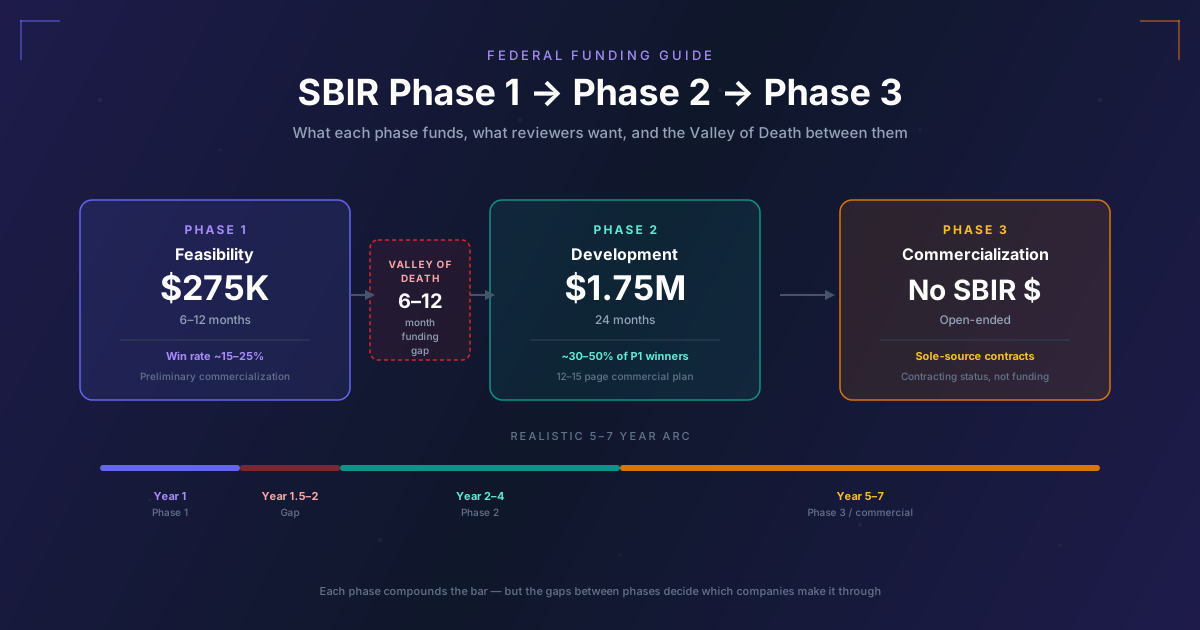
- Phase 1 funds feasibility (~$275K, 6–12 months). Phase 2 funds full R&D and prototyping (~$1.75M, 24 months). Phase 3 has no SBIR funding — it's a contracting status.
- Win rates compound: ~20% of applicants win Phase 1; ~40% of Phase 1 winners win Phase 2; ~25% of Phase 2 winners reach meaningful commercialization in 7 years.
- The Valley of Death is the 6–12 month funding gap between Phase 1 ending and Phase 2 starting — the most common reason promising Phase 1 awardees never reach Phase 2.
- Phase 2 supplements (Phase 2B, CAP, TABA, STRATFI/TACFI) can scale a $1.75M Phase 2 award to $15M+ with matched private investment.
- For first-time applicants, plan a 5–7 year arc from initial Phase 1 application to commercial revenue.
If you're an SBIR applicant trying to plan a 5-year commercialization strategy, this is the article that puts the funding mechanics in their place.
What Are the Three SBIR Phases at a Glance?
| Dimension | Phase 1 | Phase 2 | Phase 3 |
|---|---|---|---|
| Purpose | Feasibility / proof of concept | Full R&D and prototype | Commercialization |
| Typical award | $275K (varies $50K–$500K by agency) | $1.75M (varies $750K–$2M, higher for special topics) | No SBIR funding |
| Duration | 6–12 months | 24 months (Phase 2B can extend) | Open-ended |
| Win rate | ~15–25% (varies by agency) | ~30–50% of Phase 1 awardees | N/A — contracting status |
| Deliverable | Feasibility study, preliminary data | Working prototype, pilot data | Commercial product or service |
| Commercialization plan | Preliminary (2–5 pages) | Full (12–15 pages, agency-specific) | Already executing |
| Required to enter Phase 2 | Successful Phase 1 (with rare Direct-to-Phase 2 exception) | — | Successful Phase 2 |
Two things to notice. First, Phase 3 doesn't have a typical award size because Phase 3 isn't SBIR funding — it's a contracting status that lets a company sell its Phase 2 technology to the U.S. government on a sole-source basis. Second, the win rates compound: of 100 Phase 1 applicants, perhaps 20 will win Phase 1, and of those 20, perhaps 8 will win Phase 2. That filter is severe and worth planning around.
What Does SBIR Phase 1 Actually Fund?
Phase 1 funds the question: is this technology technically feasible, and is it worth a much larger Phase 2 investment? Current Phase 1 caps and program rules are published on sbir.gov.
What Phase 1 Funds
A typical Phase 1 budget covers:
- Principal investigator time (PI must commit at least 1 calendar month, often more)
- One or two technical staff
- Materials and supplies
- A small amount for equipment under the agency's cap
- Travel to meet with the agency or potential customers
- Indirect costs at the company's negotiated or de minimis rate
The award is small enough that you can't build the full product. The deliverable is usually a feasibility study or pilot-scale demonstration that proves the technical risk is manageable.
What Reviewers Want From Phase 1
Phase 1 review focuses on three questions:
- Is the science sound? Will the proposed work actually answer the technical question?
- Is the team capable? Does the PI and the small business have the skills to execute?
- Does the technology have commercial potential? This is where the preliminary commercialization plan matters , not as deep as Phase 2's, but reviewers want to see a plausible path to market.
Phase 1 commercialization plans are short (2-5 pages depending on the agency) and forgive thinner customer discovery. By Phase 2 the bar rises substantially. (See The SBIR Commercialization Plan: Template + 5 Examples.)
Direct-to-Phase 2 (D2P2)
A subset of agencies allows companies to skip Phase 1 and apply directly to Phase 2 if they can show equivalent feasibility was demonstrated outside the SBIR program (with non-SBIR funding). NIH's CRP (Commercialization Readiness Pilot) and certain NSF and DoD topics offer this pathway. It's competitive and requires strong existing data.
What Is the Valley of Death Between Phase 1 and Phase 2?
The most expensive gap in the SBIR program is the one between Phase 1 ending and Phase 2 starting.
A typical Phase 1 award lasts 9-12 months. Phase 2 proposals are typically due 3-6 months before Phase 1 ends. Phase 2 awards arrive 6-12 months after submission. The math: a company that does everything right faces a 6-12 month funding gap between Phase 1 ending and Phase 2 starting.
During this gap:
- The Phase 1 team often disbands
- The PI may return full-time to academic or other work
- Equipment and lab access lapses
- Commercial momentum stalls
Several mechanisms exist to bridge this:
Phase 2 Supplements and Bridge Programs
Phase 1 No-Cost Extensions. Most agencies allow Phase 1 to be extended by 3-6 months without additional funding, preserving the team and infrastructure while Phase 2 is reviewed.
Phase 1-to-Phase 2 Transition Programs. Some DoD components offer bridge funding (Phase I.5, transition support) to keep teams intact between Phase 1 end and Phase 2 start.
Non-SBIR Bridge Funding. State-level programs, university gap funds, and angel investors are common sources of $50K-$250K to bridge the gap. The funding is dilutive (in the case of angels) or restricted (in the case of state programs), but it preserves continuity.
Strategic Customer Engagement. Some Phase 1 awardees use the gap to do customer discovery work that strengthens the Phase 2 commercialization plan. This is the highest-value use of the time.
The companies that handle the Valley of Death well treat it as a strategic phase, not an unfortunate gap. They plan for it from Month 3 of Phase 1.
What Does SBIR Phase 2 Fund?
Phase 2 funds the question: can the feasibility result be developed into a working prototype with a credible path to commercial deployment?
What Phase 2 Funds
A Phase 2 budget is roughly 6-8x the size of a Phase 1 budget and supports:
- An expanded technical team (typically 3-7 people)
- A working prototype or pilot system
- Clinical, regulatory, or field testing as required
- Manufacturing process development
- Beta customer or end-user engagement
- IP protection (often a small but real share of budget)
The expected deliverable is a prototype that's ready for the next funding stage — commercial sales, additional grants, or follow-on investment.
What Reviewers Want From Phase 2
Phase 2 reviewers want more than technical promise. They want evidence that the company has done (and not just planned) the work that turns research into a product:
- Customer discovery completed, not promised
- Letters of Intent or Support from real prospective customers
- A 12-15 page commercialization plan that survives industry-panel scrutiny
- A team that includes commercial talent, not just researchers
- An IP position that's filed, not just intended
- A clear Phase 3 path: who's going to buy the product, and what milestones gate that purchase
The most common Phase 2 declination is not technical. It's a commercialization plan that reviewers don't believe. (Details in the Commercialization Plan guide.)
Phase 2B and Continuation Awards
Once a Phase 2 is funded, several supplements can extend or accelerate it:
Phase 2B (NIH SBIR only). Additional $500K-$1M for projects requiring extended development before commercial readiness. Available for selected NIH SBIR/STTR awards on a competitive basis.
Commercialization Accelerator Program (CAP) and Niche Assessment Program (NAP). NIH-funded business assistance bundled with Phase 2 awards. Doesn't add to the budget directly but provides $40K-$50K of in-kind consulting on commercialization.
TABA (Technical and Business Assistance). Up to $50K (Phase 1) or $100K (Phase 2) for technical/business mentoring. All agencies offer this; most awardees underuse it.
STRATFI / TACFI (DoD AFWERX). Strategic and Tactical Funding Increase awards that match private investment dollar-for-dollar, scaling Phase 2 awards from $1.75M to as much as $30M+ for promising defense applications. Requires private investor commitment.
Phase 2 Enhancements / Supplements (DoD, NSF). Many agency components offer additional funding for Phase 2 awardees that secure matching private investment or strategic partnerships.
A founder who understands these mechanisms can extract substantially more SBIR-related funding than the headline $1.75M Phase 2 number suggests.
What Is SBIR Phase 3 Really?
Phase 3 is the most misunderstood phase in the SBIR program. It is not a funded phase. The SBIR program does not award Phase 3 grants. There is no "Phase 3 application."
What Phase 3 is: a contracting status that allows a company to sell or further develop SBIR-derived technology to the U.S. government without going through full competitive procurement.
Specifically, Phase 3 lets the federal government:
- Award sole-source contracts to the Phase 2 awardee for SBIR-derived work
- Procure SBIR-derived products without competitive bidding
- Use simplified contracting mechanisms (FAR Part 12, OTAs in some cases)
Phase 3 contracts can be substantially larger than Phase 2 awards — multi-million-dollar production contracts are common in DoD, NASA, and large NIH-funded health applications. But the company has to find and win those contracts; the SBIR program does not deliver them.
The Phase 3 commercial pathway depends on the funding agency:
DoD Phase 3. The clearest path. Phase 3 contracts flow through programs of record, prime contractors, or direct government procurement. The Phase 2 commercialization plan should already name the specific Phase 3 vehicle. DoD also offers OTAs (Other Transaction Authority) for accelerated Phase 3 procurement.
NIH Phase 3. Less structured. Phase 3 typically means commercial sales to providers, payers, or licensing to pharma/medtech. NIH Phase 3 contracts to the awardee are rare; the commercialization typically happens through private market sales.
NSF Phase 3. NSF does not directly award Phase 3 contracts. Phase 3 commercialization happens through private market sales, partnerships, and follow-on private capital.
NASA Phase 3. Hybrid: NASA does directly contract with Phase 2 awardees for mission integration, and Phase 3 also flows through prime contractors.
The Phase 3 success rate is impossible to quantify cleanly because "success" varies. By the federal government's published definitions, roughly 20-30% of Phase 2 awardees achieve "commercialization" within 7 years of Phase 2 award — measured by either commercial sales or follow-on government contracts.
How Long Is the Realistic SBIR Arc?
A complete SBIR journey from first Phase 1 application to meaningful commercial revenue typically runs 5-7 years for first-time applicants. Here's the realistic timeline:
| Year | Stage | What's happening |
|---|---|---|
| Year 0 | Phase 1 prep | Identify agency and topic, build company, draft proposal (3-6 months) |
| Year 1 | Phase 1 award + execution | 9-12 months of feasibility work |
| Year 1.5 | Phase 2 proposal | Submit during Phase 1, 3-6 months pre-end |
| Year 2 | Funding gap | Bridge funding, customer discovery, IP work |
| Year 2-4 | Phase 2 execution | 24 months prototype + commercial prep |
| Year 4-5 | Phase 2B / supplements | Optional extensions, follow-on private investment |
| Year 5-7 | Phase 3 / commercial | Sole-source contracts, commercial sales, or licensing |
Companies that compress this timeline (D2P2, parallel agencies, early follow-on funding) reach commercial revenue in 3-4 years. Companies that hit the Valley of Death hard, or whose technology requires regulatory clearance, take 7-10 years.
The planning implication is significant: SBIR is a multi-year strategic commitment for both the company and its non-SBIR funding partners. Treating each phase as an isolated grant cycle is the most common reason promising Phase 1 awards never reach Phase 3.
How Commercify Helps Across the SBIR Arc
The commercial elements that determine SBIR success (market sizing, competitive analysis, customer discovery synthesis, commercialization plan structure) are work that compounds across phases. The market analysis you build for Phase 1 deepens for Phase 2 and becomes the foundation for the Phase 3 transition story.
Commercify is built to make that compounding work explicit. The platform produces defensible market sizing, structured competitive landscapes, and commercialization plan content tailored to each agency's review criteria — applicable from Phase 1's preliminary plan through Phase 2's full plan and into Phase 3 sales materials.
For more on the full SBIR/STTR program, including agency selection, eligibility, and proposal mechanics, start with our complete SBIR/STTR guide.
Frequently Asked Questions
What is the typical SBIR Phase 1 award amount in 2026?
The SBA's published Phase 1 cap is $314,000 as of the most recent adjustment, though most agencies award closer to $275K. Some specialized programs (NIH UB1, certain DoD topics) award up to $500K. NSF's Phase 1 typical award is $275K.
How long does the Phase 1 to Phase 2 transition take?
Plan for 9-15 months from Phase 1 end to Phase 2 funding receipt: 3-6 months between Phase 2 submission and Phase 1 end, plus 6-9 months of review and contracting. Most successful Phase 2 applicants submit before Phase 1 ends.
Can I skip Phase 1 and apply directly to Phase 2?
Sometimes. NIH offers Direct-to-Phase 2 (D2P2) on selected topics for companies that can demonstrate Phase 1-equivalent feasibility from non-SBIR sources. Several DoD components and NSF offer similar pathways for specific topics. The D2P2 success rate is lower than the standard Phase 1-to-Phase 2 path.
Is Phase 3 actually funded by SBIR?
No. Phase 3 is a contracting status, not a funded program. It allows federal agencies to award sole-source contracts and simplified procurement to companies with SBIR-derived technology, but the SBIR program itself does not write Phase 3 checks.
What is Phase 2B and who is eligible?
Phase 2B is an NIH-specific supplement that provides additional $500K-$1M for selected Phase 2 awardees who need extended development before commercial readiness. Eligibility is competitive and requires demonstrated progress on the original Phase 2 work.
What is STRATFI and TACFI?
Strategic Funding Increase (STRATFI) and Tactical Funding Increase (TACFI) are DoD AFWERX programs that match private investment dollar-for-dollar to scale Phase 2 awards to $15M-$30M+ for promising defense applications. They require a private investor commitment in matching size.
How long does the whole SBIR journey take?
For first-time applicants, plan 5-7 years from initial Phase 1 application to meaningful commercial revenue. Compressed timelines (3-4 years) are achievable with D2P2, parallel-agency strategies, and early follow-on private investment. Extended timelines (7-10 years) are common for regulated industries (medical devices, pharma, defense systems).
Ready to Plan Your Multi-Phase SBIR Strategy?
A winning SBIR strategy doesn't optimize for Phase 1 — it optimizes for the full arc. The market analysis, competitive landscape, and customer discovery work you do in Phase 1 should compound through Phase 2 and into Phase 3 sales.
Commercify builds the commercialization-side work that determines SBIR success at every stage, tailored to each agency's review criteria.
Build your SBIR commercialization strategy with Commercify →
Read next: The Complete Guide to SBIR/STTR Funding · The SBIR Commercialization Plan: Template + 5 Examples · Researcher's Guide to Raising Your First $1M