SBIR vs STTR: Which One Should You Apply For?

SBIR vs STTR: Which One Should You Apply For?
For most applicants, SBIR and STTR look like the same program. They share the same SBA oversight, the same phase structure (Phase 1 → Phase 2 → Phase 3), similar award amounts, and the same DSIP / agency portals. Both are non-dilutive federal funding for small businesses commercializing innovation.
The differences are small (three or four specific rules) but they decide which program is structurally easier to apply for, which fits a university researcher's situation, and which avoids conflict-of-interest problems that can stall an inventor-founder.
This guide walks through the side-by-side comparison, the PI employment rule that changes everything for academic founders, the 30% nonprofit research partner requirement, IP allocation differences, which agencies offer both programs, and a decision tree for choosing the right one.
Key Takeaways
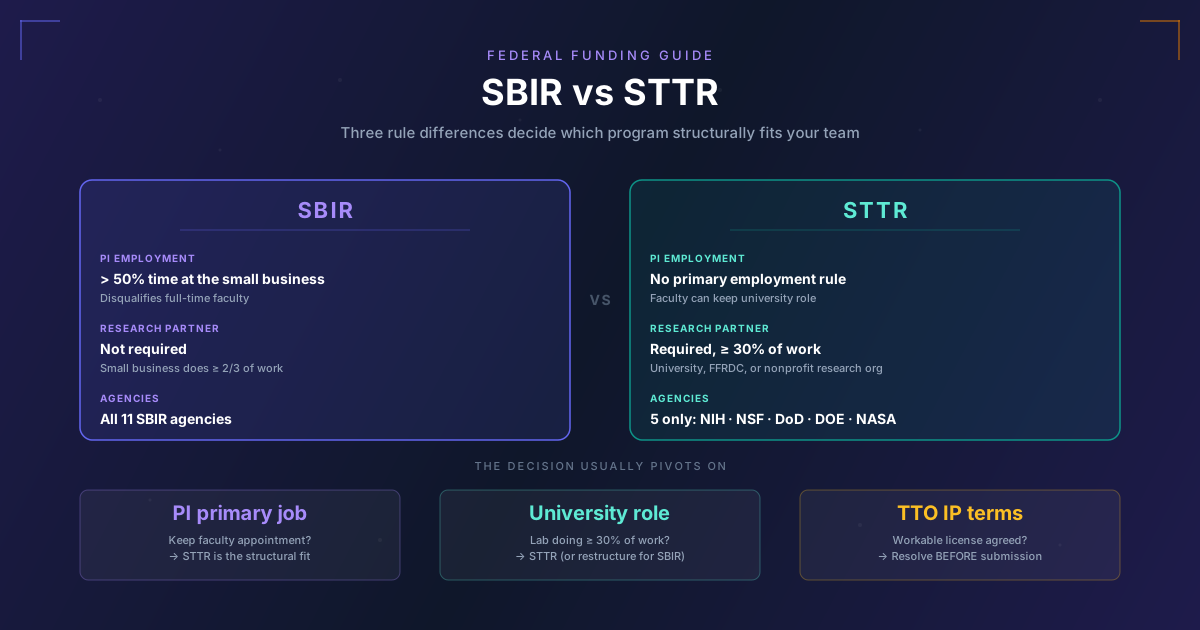
- SBIR and STTR have similar award amounts and phase structures, but three rules drive the program choice: PI primary employment, the 30% nonprofit research partner requirement, and IP allocation negotiation timing.
- SBIR requires the PI to be primarily employed (>50% time) by the small business. STTR has no such requirement — tenured faculty can serve as PI.
- STTR requires at least 30% of work performed by a qualifying nonprofit research institution (university, FFRDC, or qualifying nonprofit). SBIR doesn't require any research partner.
- All 11 SBIR agencies offer SBIR. Only 5 (NIH, NSF, DoD, DOE, NASA) offer STTR.
- For STTR, the small business and the research partner must negotiate and document IP allocation in writing BEFORE proposal submission. Get the TTO terms resolved first.
If you're a researcher trying to decide between starting a Phase 1 application as SBIR or STTR, this is the article to read first.
What's the Short Answer for SBIR vs STTR?
For most applicants, the decision comes down to one question: does a university (or other nonprofit research institution) need to do meaningful work on the project, and does the PI need to keep their academic appointment?
- Apply for STTR if the answer is yes to either condition.
- Apply for SBIR if the small business can do all the work in-house and the PI is willing to commit primary employment to the small business.
The rest of this article is the structured version of that answer — when the heuristic fits, when it doesn't, and the specific rules behind it.
How Do SBIR and STTR Compare Side by Side?
| Dimension | SBIR | STTR |
|---|---|---|
| Required research partner | None (small business may use consultants and subawardees) | Yes — a nonprofit research institution (university, FFRDC, or qualifying nonprofit research org) |
| Minimum work share — small business | ≥ 2/3 of Phase 1 work; ≥ 1/2 of Phase 2 work | ≥ 40% of all phases |
| Minimum work share — research partner | No minimum (may be 0%) | ≥ 30% of all phases |
| PI primary employment | Must be primarily employed (> 50% time) by the small business at time of award and during the project | NO requirement — PI can be primarily employed by the small business OR the research partner |
| IP allocation | Defaults to small business (subject to negotiation with any subawardees) | Must be negotiated and agreed in writing between the small business and the research partner BEFORE proposal submission |
| Participating agencies | 11 federal agencies | 5 federal agencies (NIH, NSF, DoD, DOE, NASA) |
| Phase 1 award amount | Up to ~$314K (varies by agency) | Up to ~$314K (varies by agency) |
| Phase 2 award amount | Up to ~$2.1M (varies; some higher for special topics) | Up to ~$2.1M (varies; some higher for special topics) |
| Phase 3 mechanics | Same — contracting status, not funded by the program | Same |
| Proposal length and structure | Agency-specific (similar across both programs within each agency) | Same as SBIR, plus the research partner agreement and IP allocation documentation |
The two structural differences that actually drive the SBIR-vs-STTR decision are the PI employment rule and the required research partner. Everything else is similar.
What Is the PI Employment Rule That Changes Everything?
Of all the SBIR/STTR rules, the most consequential one for university researchers is the principal investigator's primary employment requirement.
SBIR. The PI must have their primary employment (more than 50% of total time) with the small business at the time of award and throughout the project period. If you're a tenured professor or full-time research scientist at a university, you cannot maintain your academic appointment full-time and serve as the PI on an SBIR award.
STTR. No primary employment requirement. The PI can be a full-time faculty member at the university research partner. Or a full-time employee of the small business. Or anywhere in between.
For a tenured researcher who wants to commercialize their lab's work without leaving the university (which is the modal situation in many academic commercialization paths) STTR is structurally the only viable program.
Some workarounds exist for SBIR:
- Reduce university appointment to under 50% for the duration of the project (often impossible for tenured faculty)
- Take a sabbatical and commit primary time to the small business (limited duration, often impossible to time with proposal cycles)
- Have a different person serve as PI on the SBIR while the inventor serves as a consultant or co-investigator (loses the inventor as the primary scientific authority on the proposal)
None of these workarounds are clean. For researchers who want to keep their academic role, STTR is the right answer.
How Does the 30% STTR Research Partner Requirement Work?
STTR requires that at least 30% of the work be performed by a qualifying nonprofit research institution. "Qualifying" means:
- A U.S. nonprofit college or university
- A U.S. nonprofit research institution (e.g., a research hospital with nonprofit status)
- A Federally Funded Research and Development Center (FFRDC) — for-profit FFRDC operators do not qualify
The 30% is a minimum, not a target. STTR projects can give the research partner more than 30%, but the small business must always perform at least 40%. (The remaining 30% can be allocated to either party or to additional subawardees.)
The research partner must be identified in the proposal, must agree in writing to the partnership, and must have a formal agreement with the small business covering the work plan, the IP allocation, and the budget split. Agencies want to see the partnership formally constituted before the proposal is submitted , not "we'll figure it out if we win."
For university researchers, the 30% partner is usually the researcher's own lab. The small business funds the lab to do specific tasks; the lab does the work using its existing infrastructure and personnel; the small business commercializes the resulting technology.
How Does IP Allocation Differ Between SBIR and STTR?
The IP rules between SBIR and STTR are subtly different but commercially significant.
SBIR. Default ownership of subject inventions (Bayh-Dole inventions arising from the project) is with the small business performing the work. If subawardees or consultants are involved, IP is allocated by agreement with each subawardee.
STTR. The small business and the research partner must negotiate and agree on IP allocation before proposal submission, and the agreed-upon allocation must be documented in writing. Common allocation patterns:
- Small business owns all IP, research partner gets a paid-up license for research use only
- Small business owns all IP, research partner gets the right to a royalty share on commercial use
- Joint ownership with a clear commercialization lead and revenue-sharing formula
- Field-of-use split: research partner owns IP outside the commercial field; small business owns IP within the commercial field
For university researchers, the IP allocation negotiation typically goes through the university's tech transfer office (TTO). TTOs have institutional policies (sometimes inflexible) about what they will and won't accept. A research partner whose TTO insists on a 50/50 ownership split with a 5% royalty on net sales may be unworkable for a commercial startup; a research partner whose TTO offers a clean exclusive license with milestone payments is workable.
The implication: IP negotiation with the TTO should happen before the SBIR/STTR proposal decision, not after. If the TTO won't agree to commercially viable IP terms, STTR may be off the table — and the researcher needs to decide whether to take leave from the university and pursue SBIR instead.
For more on the underlying federal IP framework, see our Bayh-Dole Act guide. For broader IP strategy, Patent to Product: The IP Strategy Playbook covers the layered IP positioning that supports commercialization.
Which Agencies Offer SBIR vs STTR?
All 11 federal SBIR agencies offer SBIR. Only 5 of them (those with extramural R&D budgets above $1 billion) are required to offer STTR. The federal SBIR/STTR program portal at sbir.gov lists current solicitations across all participating agencies.
| Agency | SBIR | STTR | Notes |
|---|---|---|---|
| NIH (Health and Human Services) | ✓ | ✓ | STTR is heavily used in biomedical research |
| NSF | ✓ | ✓ | STTR pairs naturally with NSF's academic constituency |
| DoD | ✓ | ✓ | STTR used selectively; varies by component |
| DOE | ✓ | ✓ | STTR active in energy research |
| NASA | ✓ | ✓ | STTR active in space science |
| USDA | ✓ | ✗ | SBIR only |
| EPA | ✓ | ✗ | SBIR only |
| Department of Education | ✓ | ✗ | SBIR only |
| Department of Homeland Security | ✓ | ✗ | SBIR only |
| Department of Commerce (NIST, NOAA) | ✓ | ✗ | SBIR only |
| Department of Transportation | ✓ | ✗ | SBIR only |
If your target agency is in the bottom group (USDA, EPA, DoEd, DHS, Commerce, DOT), STTR is not available — you must apply as SBIR. If your target agency is in the top group, you can choose, and the decision returns to the PI-employment and research-partnership questions.
How Does STTR Affect Conflict-of-Interest for Faculty Inventors?
A specific commercial scenario where the SBIR-vs-STTR choice matters: a tenured faculty member who has invented technology in their university lab, licensed it from the university to a small business they founded, and now wants to win federal R&D funding to develop it commercially.
The SBIR path requires the faculty member to commit primary employment to the small business — meaning they either reduce university time to under 50%, take leave, or hand off PI duties to someone else. Each option creates friction with the university and may run afoul of internal conflict-of-interest (COI) policies that restrict how much commercial work tenured faculty can do.
The STTR path allows the faculty member to keep their full university appointment, serve as PI on the STTR while employed by the university, and have the small business (perhaps founded as a vehicle to commercialize the technology) perform the commercial development work. The university's COI policies typically have well-established procedures for STTR partnerships, including disclosure requirements and management plans that satisfy both the university and the funding agency.
The structural alignment between STTR and university COI policies is one reason STTR is heavily used in biomedical and academic research commercialization, even when the technology and team could plausibly do all the work without a university partner.
For background on the broader university commercialization context, see our Researcher's Commercialization Playbook and Complete Guide to Licensing University IP.
How Do You Choose Between SBIR and STTR? A Decision Tree
For a small business considering SBIR vs STTR, the choice comes down to five sequential questions:
-
Is the target agency in the SBIR-only group (USDA, EPA, DoEd, DHS, Commerce, DOT)? → Apply for SBIR. STTR is not available.
-
Does the PI need to maintain primary employment at a university? → Apply for STTR. SBIR's primary-employment rule disqualifies the PI.
-
Will a university (or other qualifying nonprofit) perform meaningful work on the project — at least 30% of total effort? → Apply for STTR. The university role is structurally required.
-
Has the university TTO agreed to commercially viable IP terms with the small business? → STTR is workable. Proceed. → If TTO terms are unworkable: rethink the partnership or apply as SBIR with the small business performing all work internally.
-
Otherwise: → Apply for SBIR. Simpler structurally, no required research partner, default IP allocation to the small business.
The two decision points that catch most first-time applicants by surprise are the PI primary-employment rule (step 2) and the TTO IP negotiation (step 4). Both should be resolved before the proposal is drafted, not during.
How Commercify Helps Across Both Programs
The technical proposal structure, agency-specific commercialization plan requirements, and review criteria are largely identical between SBIR and STTR. The work of building a defensible market sizing, competitive analysis, and customer discovery synthesis is the same regardless of which program you apply to.
Commercify produces this commercialization-side work for either path, tailored to the specific agency's review structure. For STTR applications specifically, it also helps clarify the small-business vs. research-partner role split so reviewers see two clearly delineated contributions rather than a blurred partnership.
For the complete program overview, see our SBIR/STTR Complete Guide. For the Phase II commercialization plan specifically, see The SBIR Commercialization Plan: Template + 5 Examples.
Frequently Asked Questions
Can I apply to both SBIR and STTR with the same project?
You can submit similar proposals to both programs at the same agency, but they cannot be funded simultaneously , and most agencies will not award both for the same work. Applying to both is most common when an applicant is uncertain which program will fit (and is willing to take whichever offers an award), but it doubles the proposal-writing effort.
Does STTR require a specific university, or can I choose?
You choose. STTR requires that the research partner be a qualifying nonprofit research institution, but you can partner with any institution that qualifies and agrees. For a university researcher commercializing their lab's work, the natural choice is their own institution — but if the institution's TTO terms are unworkable, you can pursue partnership with a different institution that offers more workable terms.
Is the award amount the same between SBIR and STTR?
Yes, within an agency. The SBA sets the same caps for SBIR and STTR Phase 1 and Phase 2 awards. Specific agencies sometimes award different amounts within those caps, but the program limits are equivalent.
Can a university be the prime applicant on STTR?
No. STTR requires a for-profit small business as the prime applicant. The university (or other qualifying nonprofit) is the research partner / subawardee, not the prime. For researchers without an existing small business, the typical path is to form a startup before submitting the STTR proposal.
Which is more competitive — SBIR or STTR?
SBIR generally has higher application volume and lower acceptance rates, especially at NIH and NSF. STTR's smaller applicant pool sometimes (but not always) translates to a higher acceptance rate. Don't choose based on competitive math; choose based on which program structurally fits.
How does the PI's primary employment rule get enforced?
Agencies verify primary employment at the time of award and may require attestations during the project period. The 50%+ rule applies to total professional employment time across all employers , not just academic appointments. Splitting time across the small business and a university such that neither is "primary" is not compliant.
Can I switch from STTR to SBIR (or vice versa) between phases?
Generally no. The program designation typically continues from Phase 1 through Phase 2. A few agencies allow phase-to-phase changes under specific circumstances (e.g., research partner withdraws), but this is the exception. Decide between SBIR and STTR before the Phase 1 application.
Ready to Build a Winning SBIR or STTR Commercialization Plan?
Once you've chosen between SBIR and STTR, the commercialization-side work is the same: a defensible market analysis, structured competitive landscape, and customer discovery synthesis that survives the panel's commercialization-criterion scrutiny.
Commercify produces that work tailored to either program and to your specific target agency's review criteria.
Build your SBIR/STTR commercialization plan with Commercify →
Read next: The Complete SBIR/STTR Guide · SBIR Phase 1 vs 2 vs 3: A Stage-by-Stage Guide · The SBIR Commercialization Plan: Template + 5 Examples