SBIR Commercialization Plan: Template + 5 Examples

The SBIR Commercialization Plan: Template, Requirements, and 5 Examples That Got Funded
The single most-rewritten section of a funded SBIR Phase II application is rarely the technical narrative. It's the commercialization plan.
NIH reviewers score it. NSF gates Phase II on it. DoD program managers read it before they read your innovation section. And yet most first-time applicants (including brilliant scientists with publishable research) submit a commercialization plan that reads like a research summary with a market paragraph stapled to the back.
This guide walks through exactly what a winning SBIR commercialization plan looks like in 2026, what each agency actually requires, the seven components every plan needs, and five annotated excerpts from plans that won Phase II awards.
Key Takeaways
- NIH, NSF, and DoD all score the commercialization plan separately from technical merit — a weak plan can sink a scientifically strong proposal.
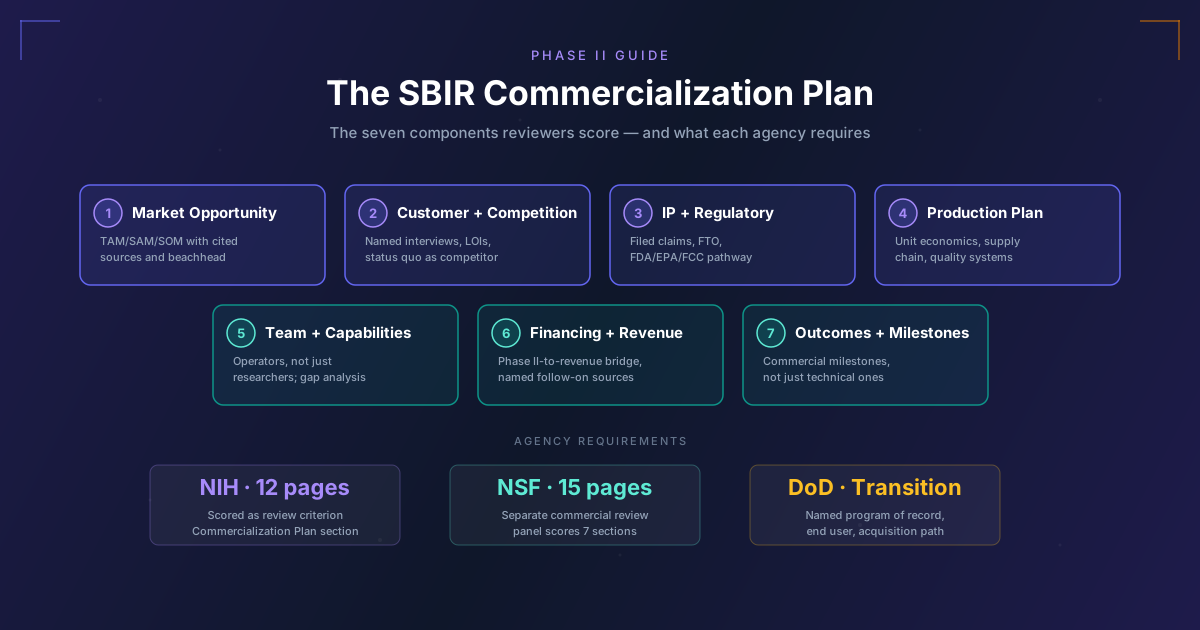
- NIH allows 12 pages; NSF allows 15 pages and uses a separate commercial review panel; DoD requires a named program of record or transition path.
- Every strong plan answers the same 7 questions: market opportunity, customer & competition, IP & regulatory, production, team, financing & revenue, and outcomes.
- The most common decline reason isn't weak science. It's the "we'll license to a major pharma/defense prime" line that signals no real customer discovery.
- Strong commercialization plans take 60-80 hours to write and should start at Phase I Month 3, not three weeks before the deadline.
If you've ever wondered why two technically similar Phase I awardees end up with different Phase II outcomes, the commercialization plan is usually where the gap opened.
Why Does the Commercialization Plan Decide Phase II?
The Small Business Innovation Research program exists to move technology to market, not to fund science. That phrase is in the program's authorizing legislation, and it's the lens every reviewer uses.
In Phase I, agencies are willing to fund a feasibility study with a thin commercialization story. By Phase II, the rules change. Reviewers want to see that you understand the path from prototype to revenue, that the market actually exists, and that someone (a customer, a strategic partner, a follow-on investor) is willing to pull your technology forward.
Here's what that looks like across agencies:
- NIH scores commercialization potential as one of the explicit review criteria for SBIR Phase II. Weak plans correlate with low overall impact scores even when the science is strong.
- NSF requires a separate Commercialization Plan document (up to 15 pages) at Phase II, reviewed by panelists with industry backgrounds in addition to the technical panel.
- DoD components ask for a transition plan that names the specific program of record, acquisition pathway, or end user that will adopt your technology after Phase II.
- DOE, NASA, and USDA all require commercialization plans of varying lengths, but all share the same underlying expectation: show us the path to revenue.
If your Phase I deliverable included a "preliminary commercialization plan" (and most do), your Phase II plan is the version where you prove you've actually done customer discovery, validated a market, and assembled the team to execute. Treating it as a paperwork exercise is the most common reason strong technical applications get declined.
What Does Each Agency Require?
The commercialization plan is one section name with five different agency interpretations. Before you write a word, confirm which one applies to your submission.
NIH SBIR/STTR Commercialization Plan
Length: Up to 12 pages (Phase II). Phase I requires a shorter preliminary version.
Required elements (per the current NIH SBIR/STTR Phase II application guide):
- Value of the SBIR/STTR project, expected outcomes, and impact
- Company overview and capabilities
- Market opportunity, customer, and competition
- Intellectual property protection
- Finance plan
- Production and marketing plan
- Revenue stream
NIH reviewers explicitly evaluate "the strength of the commercialization plan and the likelihood that the technology will reach the market." Weak commercialization plans pull down the overall impact score even when the research plan is strong.
NSF SBIR Commercialization Plan
Length: Up to 15 pages (Phase II Commercialization Plan, submitted separately from the project description). NSF's America's Seed Fund program guidance describes the seven required sections in detail.
NSF uses a structured outline that maps to seven required sections, each scored individually:
- Market opportunity
- Company and team
- Product and competition
- Intellectual property
- Financing
- Revenue projection
- Outcomes and impact
NSF panels include "Commercialization Reviewers" (industry practitioners) separate from the technical reviewers. A common pattern: technical panel rates the science highly, commercial panel flags weak market evidence, and the application is declined.
DoD SBIR/STTR Transition Plan
Length: Varies by component (Army, Navy, Air Force, SOCOM, MDA, DARPA, OSD).
DoD calls this the "Phase III plan" or "transition plan" rather than commercialization plan, and the requirements differ in one critical way: you must name the specific government end user, program of record, or acquisition pathway. Naming a generic market ("DoD logistics") is a disqualifier in many components. Component-specific BAA guidance is published through the DoD SBIR/STTR Innovation Portal (DSIP).
Look for guidance in the component-specific BAA, the topic description, and the TPOC's office hours.
DOE, NASA, USDA, and Others
DOE requires a Commercialization Plan as part of the Phase II application package, with similar structure to NIH. NASA requires both a Commercialization Plan and a Briefing Chart that summarizes it. USDA emphasizes producer/farmer end-user adoption. The federal SBIR program portal at sbir.gov catalogs current solicitations across all participating agencies.
If you're submitting to two agencies in parallel (which is allowed and often advised), you'll need to tailor each plan to the agency's review criteria, not just submit identical copies.
What Are the 7 Components Every Strong Plan Includes?
Strip away the agency-specific formatting and every effective SBIR commercialization plan answers the same seven questions. We'll walk through each with the questions reviewers are actually asking and the failure mode to avoid.
1. Market Opportunity
The reviewer's question: Is the market real, large enough to matter, and reachable in a reasonable timeframe?
What to include:
- Total Addressable Market (TAM), Serviceable Addressable Market (SAM), and Serviceable Obtainable Market (SOM) — with cited sources
- Market growth rate and the driver behind it
- Segmentation of the market: who is the first customer, the second, the third
- Customer pain points, ideally quantified ("hospitals spend $X per year on this problem")
- The trigger that creates urgency — a regulation, a technology shift, a cost pressure
Common failure: Citing a $50B TAM with no SAM/SOM breakdown. The number is impressive but it tells the reviewer you haven't thought about who actually writes the first check.
If you need a defensible market-sizing approach, our market sizing for emerging tech categories guide walks through the bottoms-up method that holds up to scrutiny.
2. Customer and Competition
The reviewer's question: Have you talked to actual customers, and do you understand the alternatives they're using today?
What to include:
- Named customer discovery interviews — how many, what segments, what you learned
- Letters of Support or Letters of Intent from prospective customers (these matter a lot)
- A competitive matrix that includes the status quo as a competitor (doing nothing is a competitor)
- Why your solution wins on the dimensions customers actually use to decide
- Switching costs and adoption barriers — and how you'll overcome them
Common failure: Listing competitors without explaining why customers would switch. Reviewers see "feature X is better" claims constantly. They want to see "we interviewed 27 customers and they told us their current workflow breaks because of Y, which our approach eliminates."
NSF's I-Corps program exists specifically to teach this discipline. If you haven't done formal customer discovery, do it before Phase II, even if it delays your submission by a cycle.
3. Intellectual Property and Regulatory Path
The reviewer's question: Can you actually own and defend this, and is there a regulatory wall you haven't thought about?
What to include:
- Issued patents, pending applications, and trade secrets — with filing dates and jurisdictions
- Freedom-to-operate analysis (or plan to conduct one)
- For university-derived technology: licensing terms with the TTO, including field-of-use and milestones
- Regulatory pathway (FDA 510(k), De Novo, PMA; EPA registration; FCC certification; etc.) with realistic timelines
- A plan for the IP gap between Phase II completion and commercial launch
Common failure: "We have provisional patents pending." That's a one-year placeholder, not a strategy. Reviewers want to see the conversion plan, the continuation strategy, and the FTO analysis.
For background on building a defensible IP position, see our Patent to Product IP strategy playbook.
4. Production and Manufacturing Plan
The reviewer's question: Can this actually be made at scale, by whom, at what cost?
What to include:
- Where the product will be manufactured (in-house, contract manufacturer, foundry)
- Unit economics at low volume and at scale, with assumptions
- Supply chain dependencies — single-source materials, restricted exports, long-lead components
- Quality systems required (ISO 13485 for medical, AS9100 for aerospace, cGMP for pharma)
- Capital requirements to reach commercial production
Common failure: A bill of materials with no supplier names and no scaling assumptions. If your prototype costs $40,000 to build today and you need to sell it for $5,000, the reviewer needs to see the path to that cost reduction.
5. Team and Capabilities
The reviewer's question: Does this team have the commercial experience to execute, or only the technical chops?
What to include:
- Bios that emphasize commercial roles, not just academic credentials
- Specific gaps in the current team and how Phase II funding closes them
- Advisors and board members with relevant industry experience
- Prior commercialization track record (even adjacent track records help)
- For university spinouts: how the PI's time commitment to the company is structured
Common failure: A team page that reads like a faculty listing. Reviewers reading commercialization plans want to see operators, not just researchers.
6. Financing and Revenue Plan
The reviewer's question: Where does the money come from between Phase II ending and product revenue starting? And what does revenue look like at scale?
What to include:
- Revenue model (one-time sale, subscription, licensing, royalty, service contract)
- Pricing rationale tied to customer value, not cost-plus
- 5-year revenue projection with stated assumptions
- Financing plan covering the Phase II-to-revenue gap: follow-on grants, strategic partners, angel/VC, customer pre-orders, debt
- Specific named follow-on funding sources, not "we'll raise a Series A"
Common failure: A hockey-stick revenue projection with no underlying unit assumptions. If your year-5 revenue is $50M, the reviewer wants to know: how many customers, at what price, sold by whom?
7. Outcomes, Milestones, and Impact
The reviewer's question: How will I know if this Phase II investment worked?
What to include:
- Specific, measurable milestones tied to the Phase II timeline (every 6 months)
- Commercial milestones, not just technical ones (first customer, first revenue, FDA clearance, distribution agreement)
- Long-term societal/economic impact aligned to the agency's mission
- A clear definition of what Phase III success looks like
Common failure: Milestones that all live in the technical narrative. Commercial milestones need their own row.
What Do Funded SBIR Commercialization Plans Look Like?
The following excerpts are composite examples that combine recurring patterns from funded NIH, NSF, and DoD Phase II plans we've reviewed with founders. They are illustrative, not direct copies of submitted documents.
Example 1: NIH SBIR Phase II — Market Opportunity (Medical Device)
"The U.S. addressable market for early-stage detection of [condition] consists of approximately 4,200 community hospitals and 1,100 academic medical centers conducting an estimated 2.1M screening procedures annually (CMS, 2024). At our planned $180 reimbursement per test and 60% market penetration over 7 years, the U.S. SOM is $227M annually. Our beachhead segment is the 320 academic medical centers with established [program type] programs, where we have completed customer discovery with 41 institutions. Of these, 18 have signed Letters of Intent contingent on FDA 510(k) clearance, the milestone we will reach in Phase II Month 18."
Why it works: Specific numbers, cited source, beachhead segment with discovery data, LOIs that convert to revenue, milestone-anchored.
Example 2: NSF SBIR Phase II — Customer and Competition (Industrial Software)
"We conducted 73 customer discovery interviews during NSF I-Corps and Phase I. Three patterns emerged. First, target customers do not buy software in this category — they buy outcomes. Second, the status quo is not a competitor; spreadsheets and tribal knowledge are. Third, switching cost is dominated by data migration, not training. Our pricing model (outcome-based with 6-month pilots) and onboarding architecture (read-only data ingestion from existing systems) are direct responses to these findings."
Why it works: Quantifies the customer discovery work, identifies real (not abstract) competition, ties product decisions to interview findings.
Example 3: DoD SBIR Phase II — Transition Plan (Defense Hardware)
"Our Phase III transition target is the U.S. Air Force [System X] program of record, Increment 3, with planned acquisition obligation in FY28. We have engaged with the [System X] PM office through three formal meetings since Phase I Month 4 and have a signed Memorandum of Understanding for technical evaluation following Phase II. Secondary transition paths include [System Y] (Navy) and an OTA with [DoD agency] for accelerated procurement of pre-production units in FY27."
Why it works: Names the program of record, gives specific fiscal year, documents engagement, includes secondary paths.
Example 4: NIH SBIR Phase II — IP and Regulatory (Diagnostic)
"Our intellectual property position consists of two issued U.S. patents (2024, 2025), one pending continuation, and two international applications under the PCT. Freedom-to-operate was assessed by [external firm] in Q1 2026 with no blocking art identified. The regulatory pathway is FDA De Novo, supported by a Pre-Submission meeting completed in March 2026. FDA's written feedback identified two clinical study design requirements, both addressable within the Phase II budget and timeline."
Why it works: Concrete IP portfolio with dates, FTO done by an external party, FDA engagement already in motion, specific feedback acknowledged.
Example 5: NSF SBIR Phase II — Financing Plan (Deep Tech)
"The Phase II budget covers technical milestones M1-M5 (Months 1-21). Bridging from Phase II completion to first commercial revenue requires approximately $2.4M over 14 months. This bridge will be funded through three committed sources: (1) a $1.0M Phase IIB supplement application supported by our matched investor commitment from [named seed fund] (LOI attached, Appendix C), (2) a $750K NSF Partnerships for Innovation grant in scope for our technology, and (3) $650K in customer pre-orders supported by three signed pilot agreements (Appendices D-F)."
Why it works: Specifies the gap precisely, names sources, attaches evidence, uses follow-on grants the agency has heard of and will recognize.
What Is the #1 Reviewer Red Flag (and How Do You Fix It)?
After reading hundreds of declined SBIR commercialization plans, one failure pattern shows up more than any other:
"We will license our technology to a major [pharma / defense prime / industrial] company at the end of Phase II."
This sentence almost guarantees a low commercialization score, for three reasons:
- It abdicates the commercialization plan entirely. SBIR exists to grow small businesses that commercialize technology, not to subsidize licensing transactions to incumbents.
- It signals you have not done customer discovery with the named licensees. If you had, you would describe the conversations, not the wish.
- It ignores the structural reality. Major incumbents rarely license unproven technology from a Phase II company without significant additional de-risking — usually requiring revenue traction, regulatory clearance, or both.
The fix isn't to remove licensing as a possibility. It's to position licensing as one path among several, validated by specific conversations with named potential partners, and contingent on milestones your Phase II will achieve. "Licensing to a strategic partner is one Phase III path; we have begun discussions with three companies (X, Y, Z) and the milestones they have indicated would trigger meaningful interest are A, B, and C" is a complete reframe.
Frequently Asked Questions
How long should an SBIR commercialization plan be?
NIH allows up to 12 pages for Phase II, NSF up to 15 pages. DoD components vary. Use the full page allowance — under-using it signals you don't have enough to say. Phase I preliminary commercialization plans are typically 2-5 pages depending on the agency.
Do I need Letters of Support for Phase I?
Phase I doesn't usually require Letters of Support, but a small number of strong LOIs from potential customers strengthens a Phase I commercialization narrative significantly. For Phase II, named LOIs are close to mandatory for a competitive application.
Can I reuse the same commercialization plan across multiple agencies?
The core market analysis and team sections transfer between agencies. The required structure, the section weightings, and especially the end-user/transition language do not. Plan to spend at least 8-10 hours retailoring a plan to a second agency.
How early should I start the commercialization plan for Phase II?
Begin customer discovery in Phase I Month 3, not Month 9. The plan itself takes 60-80 hours of writing across the team. Most successful Phase II applicants start the plan three months before the deadline.
Who should write the commercialization plan?
The CEO or commercialization lead, with input from the PI and any commercial advisors. PIs writing their own commercialization plans is the most common cause of weak plans — it's an operator's document, not a researcher's.
Does the commercialization plan count toward technical merit?
In most agencies the commercialization plan is scored separately from technical merit, but a weak commercialization plan can sink a technically strong proposal. Treat the two as equally important.
How Commercify Helps
Most SBIR commercialization plans fail in the same two places: a market analysis that doesn't survive panel scrutiny, and a competitive landscape built from a Google search rather than structured research.
Commercify's platform was built to address exactly those two gaps. It produces defensible bottoms-up TAM/SAM/SOM analyses, structured competitive matrices that include status-quo alternatives, and customer discovery templates aligned to the SBIR review criteria for each agency. For university researchers and first-time founders, it shortens the time to a fundable commercialization plan from weeks to days.
If you are writing a Phase II commercialization plan in the next solicitation cycle, the right time to start the market and competitive sections is now.
Ready to Build a Fundable Commercialization Plan?
Use Commercify to generate the market sizing, competitive analysis, and customer segmentation that your SBIR or STTR Phase II commercialization plan requires — tailored to the agency you're submitting to.
Start your commercialization plan with Commercify →
Want the broader context on SBIR/STTR? Read our complete guide to SBIR/STTR funding, or explore the researcher's guide to raising your first $1M for follow-on financing strategies after Phase II.