SBIR/STTR Guide: Win Your First Grant

The Complete Guide to SBIR/STTR Funding: How to Win Your First $2M Federal Grant
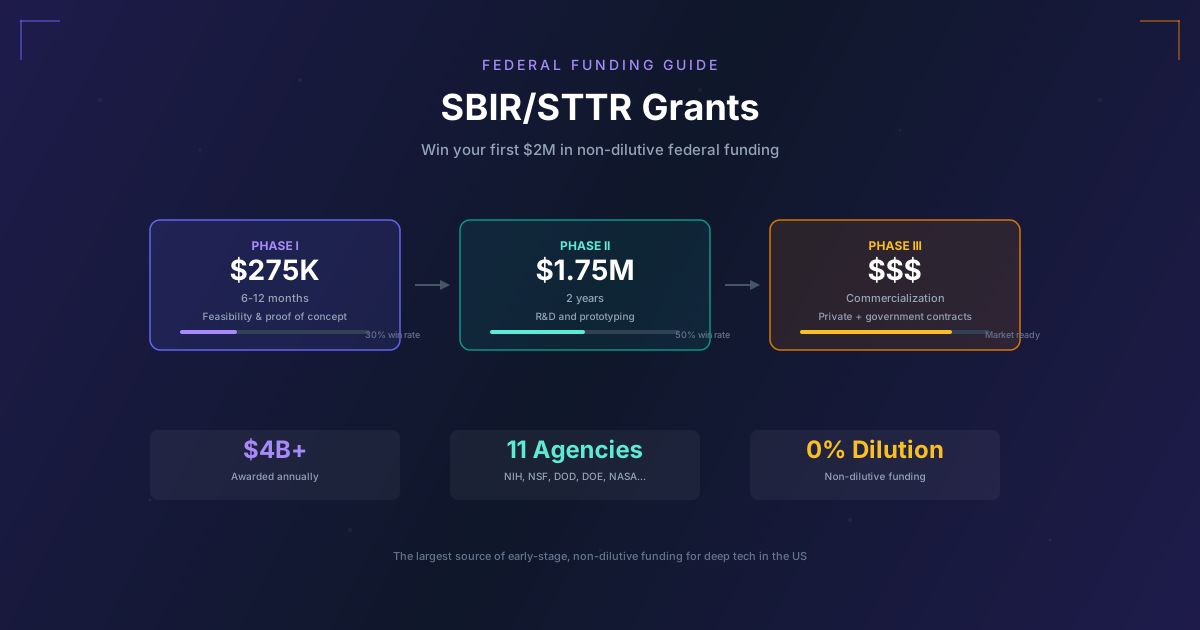
SBIR (Small Business Innovation Research) and STTR (Small Business Technology Transfer) are federal programs that provide early-stage, non-dilutive funding to U.S. small businesses developing innovative technologies. They are designed for university researchers, deep tech founders, and small businesses building breakthrough technology, and unlike venture capital they fund your work without requiring you to give up equity. They matter because they represent the largest source of early-stage non-dilutive funding for deep tech in the United States, with over $4 billion awarded annually across eleven participating agencies.
Every year, the U.S. federal government awards over $4 billion in grants to small businesses developing innovative technologies. Yet most researchers and early-stage founders have never heard of these programs—or assume they're too complex to pursue.
The Small Business Innovation Research (SBIR) and Small Business Technology Transfer (STTR) programs represent the largest source of early-stage, non-dilutive funding for deep tech innovation in the United States. Unlike venture capital, this funding doesn't require giving up equity. Unlike traditional grants, it's specifically designed to move technology from the lab to the market.
If you're a university researcher looking to commercialize your work, a deep tech founder seeking runway without dilution, or a small business developing breakthrough technology, SBIR/STTR funding could be your path from prototype to product.
This comprehensive guide covers everything you need to know: eligibility requirements, the difference between SBIR and STTR, how to find the right opportunities, and—most importantly—how to write proposals that win.
Understanding SBIR and STTR: What's the Difference?
Before diving into strategy, let's clarify what these programs actually are and how they differ.
The SBIR Program
The Small Business Innovation Research program was established in 1982 to stimulate technological innovation among small businesses while meeting federal research and development needs. Today, eleven federal agencies participate in SBIR, each setting aside a portion of their R&D budget for small business awards.
Participating Agencies and Their Focus Areas:
- National Institutes of Health (NIH): Life sciences, medical devices, diagnostics, therapeutics
- National Science Foundation (NSF): Fundamental science, advanced computing, AI/ML, materials
- Department of Defense (DOD): Defense applications, dual-use technologies, cybersecurity
- Department of Energy (DOE): Energy technology, advanced manufacturing, environmental science
- NASA: Space technology, aerospace, Earth science, materials
- USDA: Agricultural technology, food science, rural development
- EPA: Environmental technology, pollution prevention, sustainability
- Department of Education: Educational technology, learning science
- Department of Homeland Security: Security technology, first responder tools
- Department of Commerce (NIST): Standards, measurement science, manufacturing
- Department of Transportation: Transportation safety, infrastructure technology
To be eligible for SBIR funding, your company must be:
- A for-profit business organized in the United States
- More than 50% owned by U.S. citizens or permanent residents
- Fewer than 500 employees (including affiliates)
- The primary employment location of the Principal Investigator during the project
The STTR Program
The Small Business Technology Transfer program, established in 1992, is similar to SBIR but with one critical difference: it requires a formal partnership between a small business and a research institution.
The STTR Partnership Requirement:
Under STTR, you must partner with a nonprofit research institution—typically a university, federally funded R&D center, or nonprofit research organization. The research institution must perform at least 30% of the work, while the small business performs at least 40%.
This structure makes STTR ideal for university researchers who want to commercialize their work. The researcher can be affiliated with both the university (as the research partner) and the small business (as a founder or consultant), though specific conflict-of-interest policies vary by institution.
Five agencies participate in STTR:
- National Institutes of Health (NIH)
- National Science Foundation (NSF)
- Department of Defense (DOD)
- Department of Energy (DOE)
- NASA
SBIR vs. STTR: Which Should You Choose?
The decision depends on your situation:
Choose SBIR if:
- You're an independent startup without university ties
- Your Principal Investigator will work primarily at the small business
- You want more flexibility in how work is allocated
- Your technology has already been licensed from a university
Choose STTR if:
- You're a university researcher spinning out your work
- You need continued access to university facilities and equipment
- The research institution's involvement is critical to project success
- You want to maintain your academic position while launching a company
Many successful companies start with STTR (leveraging university resources and credibility) and transition to SBIR for later projects as they build internal capabilities.
The Three Phases of SBIR/STTR Funding
Both programs follow a phased funding structure designed to progressively de-risk technology as it moves toward commercialization.
Phase I: Establishing Feasibility
Funding: $50,000 - $275,000 (varies by agency) Duration: 6-12 months Purpose: Determine the scientific and technical merit and feasibility of the proposed innovation
Phase I is your opportunity to prove that your core concept works. Agencies aren't expecting a finished product—they want to see that you can achieve specific technical milestones that demonstrate feasibility.
What Success Looks Like:
- Proof-of-concept data validating your core hypothesis
- Preliminary results demonstrating technical feasibility
- Initial understanding of the path to commercialization
- Foundation for a compelling Phase II proposal
NIH Phase I Example: $275,000 for 6 months to demonstrate that a novel diagnostic approach can detect biomarkers with sufficient sensitivity and specificity to warrant further development.
NSF Phase I Example: $275,000 for 12 months to validate a new AI algorithm's performance on benchmark datasets and establish the technical foundation for a commercial product.
DOD Phase I Example: $50,000 - $250,000 for 6 months to demonstrate proof-of-concept for a dual-use technology with potential defense applications.
Phase II: Full Research and Development
Funding: $500,000 - $2,000,000 (varies by agency) Duration: 2 years Purpose: Continue R&D and begin developing a commercialization strategy
Phase II is where serious development happens. You'll refine your technology, build prototypes, conduct more extensive testing, and develop a concrete plan for bringing your innovation to market.
What Success Looks Like:
- Working prototype or beta product
- Validated performance data
- Clear understanding of manufacturing/scaling requirements
- Identified customers or partners
- Concrete commercialization plan with milestones
Important: Most agencies strongly prefer Phase II applicants who have successfully completed Phase I. Some agencies offer "Direct to Phase II" programs for companies with strong preliminary data, but these are competitive and not available from all agencies.
Phase II Enhancement/Matching Programs:
Several agencies offer additional funding if you can secure matching investment from third parties:
- NIH Phase IIB: Additional funding (up to $2M more) for projects with strong commercial potential
- NSF Phase IIB: Matching funds based on third-party investment
- DOD Phase II Enhancement: Additional funding matched by non-SBIR investment
These programs can effectively double your Phase II funding if you can demonstrate commercial traction.
Phase III: Commercialization (No SBIR Funding)
Funding: No SBIR/STTR funds—this phase uses private investment or non-SBIR government contracts Purpose: Move from R&D to commercial application and sales
Phase III is about transitioning your innovation into the market. This might mean:
- Commercial product sales
- Federal procurement contracts (agencies can sole-source to SBIR companies)
- Licensing agreements
- Additional private investment for scaling
The Phase III Advantage:
Companies that have successfully completed SBIR/STTR Phase II receive special consideration for federal contracts. Agencies can award sole-source contracts to SBIR companies for products developed under the program, bypassing normal competitive procurement—a significant advantage for companies selling to government customers.
Eligibility Requirements: Can You Apply?
Eligibility rules are strict, and misunderstanding them can result in disqualification. Here's what you need to know.
Small Business Requirements
Size: Your company (including all affiliates) must have fewer than 500 employees at the time of award. "Affiliates" includes parent companies, subsidiaries, and other entities under common control.
Ownership: The company must be more than 50% owned by:
- U.S. citizens or permanent resident aliens, OR
- Other small businesses that are themselves more than 50% owned by U.S. citizens or permanent residents
For-Profit Status: Your company must be organized as a for-profit entity. Non-profits cannot receive SBIR/STTR awards (though they can be STTR research partners).
Principal Investigator Employment: The PI must be primarily employed by the small business during the project. For STTR, this requirement is relaxed—the PI can be employed by either the small business or the research institution.
The Affiliation Trap: VC-Backed Companies
This is where many companies get tripped up. If your company has received venture capital investment, you may be affiliated with the VC fund's portfolio companies for size-determination purposes.
The SBA's Affiliation Rules:
Under SBA regulations, companies may be considered affiliates if:
- A VC fund owns or controls more than 50% of your company
- A VC fund has the power to control your company (through board seats, voting agreements, etc.)
- Your company is part of a "portfolio" of companies under common investment management
The Exception for Investment Companies:
To address this issue, the SBA created an exception: companies that are majority-owned by multiple venture capital operating companies, hedge funds, or private equity firms may still be eligible if certain conditions are met. The rules are complex and change periodically—consult with a lawyer or SBIR specialist if you have VC backing.
For University Researchers: Special Considerations
If you're a faculty member considering SBIR/STTR, you'll need to navigate several additional requirements:
Forming a Company: You'll need to form a separate small business entity. This is typically a Delaware C-corporation or LLC, though structure depends on your commercialization plans.
Conflict of Interest: Most universities have conflict-of-interest policies that govern faculty entrepreneurship. You'll likely need to disclose your involvement with the company and may face restrictions on the relationship between your university and company work.
IP Licensing: If your technology was developed at the university, you'll need to license it to your company. This negotiation can take time—start early. Universities typically receive equity and/or royalties in exchange for licensing.
PI Location: For SBIR, the PI must be primarily employed by the small business. This may require a leave of absence or reduced university appointment. For STTR, this requirement doesn't apply—one reason STTR is popular with faculty founders.
Finding the Right Funding Opportunity
With eleven agencies and thousands of solicitations per year, finding the right opportunity requires strategy.
Agency Selection: Matching Your Technology to Funders
Different agencies have different priorities, funding levels, and review cultures. Choose based on fit, not just funding amount.
National Institutes of Health (NIH):
- Focus: Life sciences, biomedical research, health applications
- Phase I: Up to $275,000 for 6 months
- Phase II: Up to $2,000,000 for 2 years
- Culture: Strong emphasis on scientific rigor; commercialization matters but science comes first
- Best for: Therapeutics, diagnostics, medical devices, digital health
National Science Foundation (NSF):
- Focus: Broad range of science and engineering disciplines
- Phase I: $275,000 for 12 months
- Phase II: $1,000,000 for 2 years
- Culture: Strong emphasis on innovation and broader impacts; expects customer discovery
- Best for: AI/ML, materials, quantum, advanced manufacturing, software
Department of Defense (DOD):
- Focus: Defense applications and dual-use technologies
- Phase I: $50,000 - $250,000 for 6 months (varies by component)
- Phase II: $500,000 - $2,000,000 for 2 years
- Culture: Mission-focused; direct path to government customer
- Best for: Cybersecurity, sensors, materials, communications, autonomy
Department of Energy (DOE):
- Focus: Energy technology, climate, advanced manufacturing
- Phase I: $200,000 - $256,000 for 12 months
- Phase II: $1,100,000 - $1,600,000 for 2 years
- Culture: Strong technical review; increasing commercialization emphasis
- Best for: Clean energy, storage, grid technology, advanced materials
Topic-Based vs. Open Solicitations
Agencies release funding opportunities in two ways:
Topic-Specific Solicitations: The agency defines specific technical topics they want to fund. Your proposal must address the stated topic directly. Topics are often written by program managers with specific needs—if your technology fits a topic, you have a clear "customer."
Open/Omnibus Solicitations: Some agencies (notably NSF and NIH) accept proposals on any topic within their mission. This gives you more freedom but means your proposal competes against a wider range of technologies.
Strategy: Topic-specific solicitations often have higher success rates because there's a demonstrated need. If your technology fits a published topic, that's usually your best opportunity.
Using SBIR.gov to Find Opportunities
The SBIR.gov website is your central resource for finding opportunities:
- Search Solicitations: Filter by agency, topic area, and keywords to find relevant opportunities
- Review Past Awards: See what's been funded before to understand agency priorities
- Track Deadlines: Set up alerts for solicitations in your area
- Research Competition: Analyze past awards to understand who you're competing against
Pro Tip: Study the abstracts of previously funded Phase I and Phase II projects in your area. This reveals what reviewers find compelling and helps you position your proposal.
Writing a Winning Proposal
Your proposal is everything. A breakthrough technology with a weak proposal will lose to an incremental improvement with excellent proposal writing.
Understanding What Reviewers Want
Different agencies use different review criteria, but most evaluate proposals on these dimensions:
1. Technical Merit / Innovation (25-40% of score)
- Is the proposed technology truly innovative?
- Does the approach address a significant problem?
- Is the technical approach sound?
- Are the objectives achievable within the proposed timeframe?
2. Commercial Potential (20-35% of score)
- Is there a real market for this technology?
- Does the company understand the path to commercialization?
- Is the market large enough to justify government investment?
- Does the team have commercial capabilities (or a plan to build them)?
3. Team Qualifications (15-25% of score)
- Does the team have the technical expertise to execute?
- Is the PI qualified to lead this project?
- Does the company have the resources and facilities needed?
- Are there appropriate advisors, partners, or consultants?
4. Broader Impacts / Agency Mission Alignment (10-20% of score)
- How does this technology serve the agency's mission?
- What are the broader societal benefits?
- How does this technology address national priorities?
The Proposal Structure
While formats vary by agency, most SBIR/STTR proposals include these elements:
Specific Aims / Technical Objectives (1 page)
This is your executive summary. Clearly state:
- The problem you're solving and why it matters
- Your proposed solution and what makes it innovative
- The specific objectives you'll accomplish in this phase
- How success will position you for future phases
Make this page compelling—it's the first thing reviewers read and often the most influential section.
Background and Significance (2-4 pages)
Establish the context for your work:
- What is the current state of the art?
- What are the limitations of existing approaches?
- Why is your approach different and better?
- What preliminary data do you have supporting feasibility?
Research Plan / Technical Approach (5-10 pages)
This is the heart of your proposal:
- Describe your technical approach in detail
- Break down work into specific aims with clear milestones
- Identify potential risks and mitigation strategies
- Explain how you'll measure success
- Provide a realistic timeline
Commercialization Plan (2-5 pages)
Don't neglect this section—it's increasingly important:
- Define your target market and size it credibly
- Explain your go-to-market strategy
- Identify potential customers, partners, or licensees
- Describe your competitive advantage and barriers to entry
- Outline your funding strategy beyond SBIR/STTR
- Include any evidence of customer interest (LOIs, interviews, pilots)
Team and Facilities (1-2 pages)
Demonstrate you can execute:
- PI qualifications and relevant experience
- Key personnel and their roles
- Company capabilities and track record
- Available facilities and equipment
- STTR: Describe the research institution and its role
Budget and Justification
Explain how you'll spend the money:
- Personnel (largest category for most projects)
- Equipment and supplies
- Subcontracts and consultants
- Travel (if needed for customer discovery, conferences)
- Indirect costs
Make sure your budget is realistic and well-justified. Reviewers are skeptical of budgets that don't match the proposed work.
Common Proposal Mistakes
Mistake 1: Too Much Science, Not Enough Business
Academic founders often write proposals that read like grant applications. SBIR/STTR is about commercialization—show that you understand the market and have a plan to reach it.
Mistake 2: Weak Commercialization Plan
"We'll license to big companies" is not a commercialization plan. Be specific about target customers, pricing, distribution, and how you'll achieve market traction.
Mistake 3: Overpromising on Technical Objectives
Reviewers know what's realistic. If your objectives seem too ambitious for the budget and timeline, they'll question your judgment. It's better to propose achievable milestones and exceed expectations.
Mistake 4: Ignoring the Review Criteria
Every agency publishes review criteria. Address each criterion explicitly. If reviewers can't find evidence of commercial potential in your proposal, they'll score it low on commercial potential—even if you have it.
Mistake 5: Poorly Justified Budget
Don't just list expenses—explain why each line item is necessary for project success. Reviewers are allocating taxpayer money; they want to see that you'll use it wisely.
Mistake 6: No Preliminary Data
While Phase I is proof-of-concept, reviewers want evidence that you're not starting from zero. Include any preliminary data, published papers, or prototype results that demonstrate feasibility.
After Submission: What to Expect
The Review Process
Review timelines and processes vary by agency:
NIH: 3-4 month review cycle with study section review. Results typically 5-6 months after submission.
NSF: Rolling submissions with review typically 4-6 months. Includes program officer review and mail/panel review.
DOD: Varies by component (Army, Navy, Air Force, DARPA, etc.). Some have rapid timelines (60 days for DARPA); others take 6+ months.
DOE: Typically 6-9 months from submission to award notification.
If You're Funded
Congratulations! Here's what happens next:
- Negotiations: The agency will contact you to finalize budget and project details
- Contracting: Sign the award agreement and complete required registrations (SAM.gov, etc.)
- Kickoff: Begin work and establish reporting schedule
- Reporting: Submit technical and financial reports as required (typically quarterly)
- Phase I to Phase II Transition: Start planning your Phase II proposal early
If You're Not Funded
Don't give up. The average SBIR/STTR awardee has been rejected multiple times before success.
Get Feedback: Most agencies provide reviewer feedback. Study it carefully to understand why your proposal wasn't selected.
Common Reasons for Rejection:
- Weak commercialization plan
- Technical approach didn't convince reviewers
- Objectives not achievable in proposed timeframe
- Poor fit with agency mission or topic
- Strong competition from better-prepared applicants
Resubmission Strategy:
- Address every reviewer criticism in your revised proposal
- Strengthen weak sections rather than just defending your original approach
- Consider whether a different agency or topic might be a better fit
- Seek feedback from successful awardees or SBIR consultants
Resources and Next Steps
Official Resources
- SBIR.gov: Central portal for all SBIR/STTR programs, solicitations, and resources
- Agency Websites: Each agency has an SBIR/STTR office with program-specific guidance
- SBA SBIR Road Tour: Free workshops and webinars on SBIR/STTR basics
Support Programs
- FAST (Federal and State Technology Partnership): State-level programs providing proposal assistance
- TABA (Technical and Business Assistance): Agencies can fund technical and business mentoring for awardees
- I-Corps: NSF program teaching customer discovery (often good preparation for SBIR)
Key Deadlines to Track
NIH: Three submission cycles per year (January, April, September) NSF: Ongoing submissions with specific windows DOD: Multiple cycles per year, varies by component DOE: Typically 2-3 solicitations per year
Start your planning at least 3-4 months before submission deadlines. Strong proposals take time.
Frequently Asked Questions
What is the difference between SBIR and STTR?
Both programs provide non-dilutive federal funding for innovative small businesses, but STTR requires a formal partnership with a nonprofit research institution such as a university. Under STTR, the research institution must perform at least 30% of the work and the small business at least 40%. SBIR has no partnership requirement and offers more flexibility in how work is allocated.
Who is eligible for SBIR funding?
To be eligible, your company must be a for-profit business organized in the United States, more than 50% owned by U.S. citizens or permanent residents, and have fewer than 500 employees including affiliates. The Principal Investigator must be primarily employed by the small business during the project. Nonprofits cannot receive awards, though they can serve as STTR research partners.
How much funding do SBIR and STTR phases provide?
Phase I typically provides $50,000 to $275,000 over 6 to 12 months to establish technical feasibility. Phase II provides $500,000 to $2,000,000 over two years for full research and development. Phase III, focused on commercialization, includes no SBIR or STTR funds and instead relies on private investment or non-SBIR government contracts.
Is SBIR funding non-dilutive?
Yes. SBIR and STTR are the largest source of early-stage, non-dilutive funding for deep tech innovation in the United States. Unlike venture capital, the funding does not require giving up equity in your company, and unlike traditional grants it is specifically designed to move technology from the lab to the market.
Should university researchers choose SBIR or STTR?
STTR is often the better fit for faculty founders because it does not require the Principal Investigator to be primarily employed by the small business, letting you maintain your academic position. STTR also supports continued access to university facilities and credibility. Many companies start with STTR and transition to SBIR for later projects as they build internal capabilities.
Can VC-backed companies receive SBIR awards?
It depends. Venture capital investment can make your company an affiliate of the fund's portfolio companies for size-determination purposes, which can affect eligibility. The SBA created an exception allowing companies majority-owned by multiple venture capital operating companies, hedge funds, or private equity firms to qualify if certain conditions are met. The rules are complex, so consult a lawyer or SBIR specialist.
Ready to Find Your SBIR/STTR Opportunity?
The SBIR/STTR programs offer a remarkable opportunity: non-dilutive funding specifically designed to move innovative technology from lab to market. With over $4 billion awarded annually, there's significant funding available—but capturing it requires strategy, preparation, and a compelling proposal.
Use our free SBIR/STTR Navigator tool to identify the best funding opportunities for your technology, understand eligibility requirements, and build a customized application timeline.