DoD SBIR Guide: Topics, TPOCs, and Winning Strategy

DoD SBIR Guide: Topics, TPOCs, and the Strategy That Actually Wins
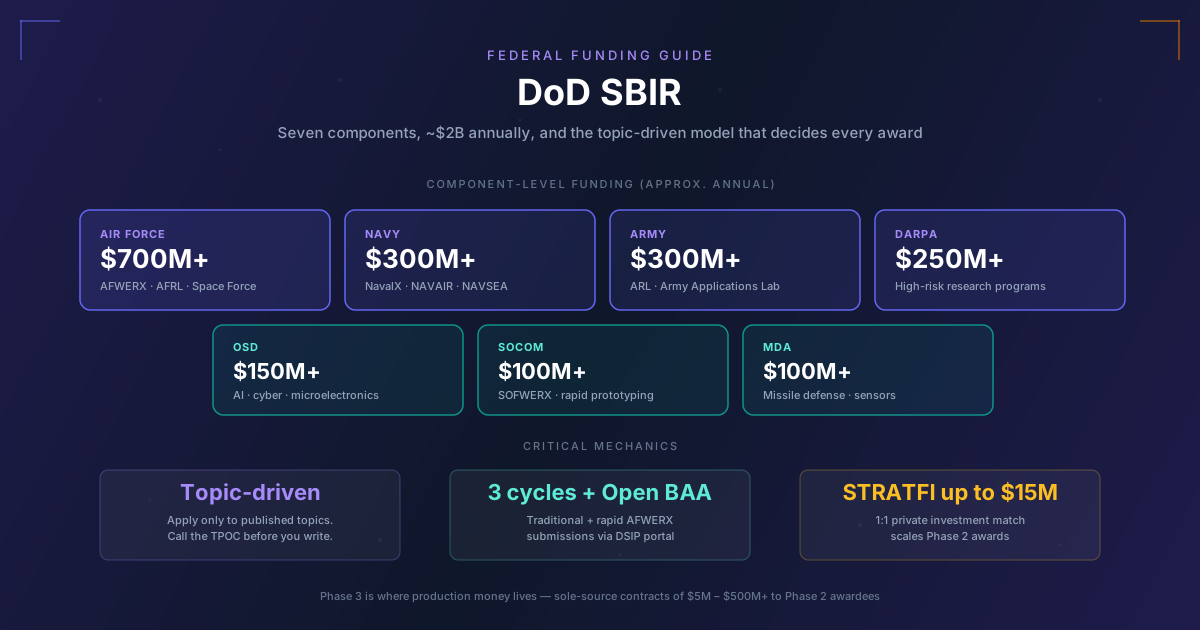
The Department of Defense awards more SBIR funding than any other federal agency (roughly $2 billion per year across its components) and it runs the program on completely different mechanics than NIH or NSF.
DoD SBIR is topic-driven rather than open. Awards flow through specific components (Air Force, Navy, Army, SOCOM, MDA, DARPA, OSD) that each set their own topics, cycles, and rules. The proposal that wins is almost never the one with the best science — it's the one that solves a specific problem the named topic author actually has, in a form their acquisition system can absorb. And unlike civilian SBIR, DoD's Phase 3 isn't just a contracting status — it's where serious production money actually flows.
This guide walks through how DoD SBIR is structured, how to find the right topic and component, why you must engage the Topic Point of Contact (TPOC) before you write a word of proposal, the STRATFI/TACFI supplement programs that scale Phase 2 into mid-eight-figure awards, and the transition paths (AFWERX, SOFWERX, NavalX) that actually move technology into production.
Key Takeaways
- DoD SBIR awards ~$2B/year across seven components (Air Force/AFWERX, Navy/NavalX, Army, DARPA, OSD, SOCOM/SOFWERX, MDA) — each runs its own program with separate topics, cycles, and rules.
- DoD SBIR is topic-driven, not open: you apply only to published topics that match an operational problem a program manager has.
- Calling the Topic Point of Contact (TPOC) before submission is the single highest-leverage action — DoD applicants who skip this step win at substantially below-average rates.
- STRATFI and TACFI supplements match private investment 1:1 to scale Phase 2 awards up to $15M+ for promising defense applications.
- Unlike civilian SBIR, DoD Phase 3 is where real production money lives — sole-source contracts of $5M–$500M+ to Phase 2 awardees through programs of record.
If you're considering DoD SBIR for the first time, or you've applied to civilian programs and assumed DoD would work the same way, the differences below are the ones that decide the outcome.
How Does DoD SBIR Differ From Civilian SBIR?
Three structural differences separate DoD SBIR from NIH, NSF, and other civilian programs.
1. DoD is Topic-Driven, Not Open
Civilian SBIR programs (especially NIH and NSF) accept proposals on any technology that fits the agency's broad mission. DoD does the opposite: each component publishes specific topics, written by program managers who have specific operational problems they want solved. You can only apply to a published topic, and your proposal must directly address that topic's stated problem.
This changes the work. In civilian SBIR, you bring your technology and find the agency interest. In DoD SBIR, you find the topic and adapt your technology to its specific problem. Companies that approach DoD with a "here's our tech, what topics fit?" mindset apply to too many topics with weak proposals. Companies that approach DoD with a "this topic perfectly fits our existing capability" mindset apply to fewer topics with much stronger proposals.
2. Components Run Independent Programs
The Department of Defense is not one SBIR program — it's a federation of component programs. Each major component runs its own SBIR with its own topics, cycles, evaluation criteria, and program managers:
| Component | Annual SBIR spend (approx.) | Focus |
|---|---|---|
| Air Force / Space Force (AFRL, AFWERX) | $700M+ | Aviation, space, autonomy, software, dual-use |
| Navy / Marine Corps (NavalX, NAVAIR, NAVSEA) | $300M+ | Maritime, shipboard systems, naval aviation, undersea |
| Army (ARL, Army Applications Lab) | $300M+ | Ground systems, soldier technology, networks |
| Defense Advanced Research Projects Agency (DARPA) | $250M+ | High-risk, high-reward research across all domains |
| Special Operations Command (SOCOM / SOFWERX) | $100M+ | Special operations technology, rapid prototyping |
| Missile Defense Agency (MDA) | $100M+ | Missile defense, sensors, kinetic systems |
| Office of the Secretary of Defense (OSD) | $150M+ | Cross-cutting initiatives (AI, cyber, biotech, microelectronics) |
| Defense Threat Reduction Agency (DTRA) | $40M+ | CBRN defense, threat reduction |
| Defense Logistics Agency (DLA), DHA, others | $50M+ | Logistics, medical, niche capabilities |
The implication: choosing the right component matters as much as choosing the right topic. The same technology might be a strong fit for an Air Force topic and a weak fit for a Navy topic with similar language, because the underlying acquisition program and end user are different.
3. Phase 3 Is Where Real Money Lives
In NIH or NSF, Phase 3 is mostly a label. In DoD, Phase 3 is where Phase 2 awardees can secure production contracts worth $5M-$500M+ on a sole-source basis, without competitive procurement. The DoD Phase 3 path is structurally built into the acquisition system, and the Phase 2 commercialization plan should already name the specific Phase 3 vehicle.
This makes DoD SBIR uniquely valuable for companies whose end customer is the U.S. government — but only if the Phase 1 and Phase 2 work is shaped to feed a real Phase 3 transition. (For background on phase mechanics generally, see SBIR Phase 1 vs 2 vs 3 explained.)
How Do DoD SBIR Solicitation Cycles and Open BAAs Work?
DoD SBIR historically ran on three solicitation cycles per year (sometimes called BAAs — Broad Agency Announcements):
- Cycle 1 (released ~December, closes ~February)
- Cycle 2 (released ~April, closes ~June)
- Cycle 3 (released ~August, closes ~October)
Each cycle publishes hundreds of topics across components. Topics are open for proposals for about 30 days during the announcement window. Read carefully — some topics include a pre-release period during which questions to the TPOC are allowed but proposals are not yet accepted.
In recent years, several DoD components have moved to Open BAAs that accept proposals continuously rather than on fixed cycles:
- Air Force Open Topics (AFWERX) — rolling submissions, decisions in weeks rather than months
- Navy Open BAA — continuous topics in specific technology areas
- SOCOM SOFWERX — non-traditional acquisition mechanisms with continuous engagement
Open BAAs typically have faster decision cycles (4-12 weeks vs. 6-9 months for traditional topics) and are designed to attract non-traditional defense contractors. If you're a small business that hasn't worked with DoD before, AFWERX Open Topics are often the most accessible entry point.
All topic announcements, regardless of cycle or BAA type, flow through the same portal: the DoD SBIR/STTR Innovation Portal (DSIP). DSIP is where you find topics, ask pre-submission questions, submit proposals, and track award status. Register early — the first-time registration process takes longer than first-time applicants expect.
How Do You Find the Right DoD SBIR Topic?
Most DoD SBIR proposals fail at topic selection, not proposal writing.
A good DoD SBIR topic for your company has four characteristics:
- Your existing capability already solves the stated problem (with adaptation, not from scratch)
- The TPOC is responsive to pre-submission questions
- The acquisition program behind the topic is real and funded , not aspirational
- The Phase 3 transition path is plausible — there's a named program of record or end user
Finding topics that meet all four takes time. The systematic approach:
Step 1: Scan DSIP Broadly
Filter DSIP topics by your technology area and the component. Read the topic descriptions , not just the title. The title is often misleading; the description reveals what the program manager actually wants.
Step 2: Identify 5-10 Candidate Topics
You want topics where the description maps cleanly to capabilities you already have. If you're stretching to fit, the topic is wrong for you.
Step 3: Read the Topic Author's Recent Publications and Awards
Topic authors are real people — typically a program manager, scientist, or engineer at the component's lab. Search their name, publications, and prior SBIR awards. Companies they've previously funded indicate the kind of work they value.
Step 4: Contact the TPOC
Every DoD SBIR topic lists a Topic Point of Contact. You must contact them. Not contacting the TPOC before submitting is the most common signal that a proposal is from a first-time applicant who doesn't understand the program. (More on this in the next section.)
Step 5: Narrow to 1-3 Topics for Real Proposals
A strong company applies to one or two topics per cycle with proposals tailored to each. A weak company applies to ten with templated proposals. Win rates correlate with the first approach.
Why Must You Call the TPOC Before Submitting?
The Topic Point of Contact is the single most important relationship in DoD SBIR.
The TPOC is the government employee (typically a program manager or principal scientist) who wrote the topic, will evaluate proposals, and will manage the resulting Phase 1 contract. They have specific operational problems they're trying to solve, specific past attempts that didn't work, and specific preferences about technical approach that aren't in the topic description.
The right way to engage:
- Email the TPOC during the pre-release window, before the topic is open for proposals. Introduce yourself briefly. State the topic number. Ask 2-3 specific technical questions that demonstrate you've read the topic carefully.
- Take a phone call if they offer one. Most TPOCs are willing to spend 15-30 minutes on a call with a serious applicant.
- Ask the right questions. "What's the current state of solutions you've seen?" "What technical approach would surprise you positively?" "What's the operational context the deliverable will live in?"
- Do not pitch your company. TPOCs will disengage immediately from sales pitches. The call is about their problem, not your capability.
DoD SBIR has formal rules limiting what TPOCs can tell you during pre-submission. They cannot give you feedback on a draft proposal. They cannot tell you what win themes to pursue. But they will, in practice, tell you what's important to them — which is the entire game.
Companies that submit DoD SBIR proposals without ever talking to the TPOC win at substantially below the average rate. Companies that have a 30-minute pre-submission call with the TPOC win at substantially above the average rate. The math is overwhelming, and yet first-time applicants routinely skip the call.
How Should You Position Dual-Use vs. Defense-Only Technology?
DoD SBIR includes both purely defense applications and dual-use technologies that have commercial markets in addition to defense applications. The two paths are evaluated differently.
Defense-only technology lives or dies on the strength of the DoD acquisition path. The commercialization plan focuses on the program of record, the end user (which warfighter, which command), the transition vehicle, and the contracting mechanism. There may be no commercial market at all — and that's fine for defense-only topics, but it means the entire commercial argument is "DoD will buy this in production volumes."
Dual-use technology can be commercialized into both defense and commercial markets. AFWERX explicitly prioritizes dual-use, and most OSD topics are dual-use by design. The commercialization plan should describe both markets credibly. Dual-use is generally easier to commercialize because the commercial market provides revenue (and follow-on investment) before DoD production volume.
A common positioning mistake: framing a clearly-defense-only technology as dual-use to broaden appeal. Reviewers see through this; the "commercial market" paragraph reads as unconvincing and weakens the entire commercialization plan. Be honest about which path applies and write to it.
What Are STRATFI and TACFI, and How Do They Scale Phase 2?
DoD (and specifically the Air Force through AFWERX) offers Phase 2 supplements that can scale a $1.75M Phase 2 into a much larger award.
STRATFI (Strategic Funding Increase). Up to $15M (3-year), matched 1:1 by private investment. Designed for technologies on a clear path to operational deployment.
TACFI (Tactical Funding Increase). Up to $1.5M (1-year), matched 1:1 by private investment. Designed for shorter, tactical investments to accelerate a specific technical milestone.
Both require:
- An existing Phase 2 award (active or recently completed)
- Private investment commitment in matching dollar amount
- A clear operational use case and transition path
The combined math is substantial: a company that wins a $1.75M Phase 2, raises $15M in private capital, and secures a STRATFI match ends up with $31.75M of effective funding for one technology. STRATFI/TACFI is one of the largest non-equity funding mechanisms in U.S. deep tech.
Other components offer similar supplements (NavalX, Army OTAs, SOCOM SOFWERX) under different names. The pattern is the same: bring a Phase 2 award and private investor commitment, get a matching supplement.
What Are the DoD SBIR Transition Paths?
DoD SBIR is uniquely strong at Phase 3 transition because the transition paths are structurally built into the acquisition system. The main paths are AFWERX (Air Force), SOFWERX (SOCOM), NavalX (Navy and Marine Corps), the Army Applications Lab, and DARPA's program-driven model.
AFWERX (Air Force)
AFWERX runs the largest Open Topics program in DoD SBIR, with rapid-cycle Phase 1 awards (~$75K, 3 months) feeding standard Phase 2 awards and STRATFI/TACFI supplements. AFWERX explicitly targets non-traditional defense contractors and prioritizes commercially mature technology adapted for defense use. Transition vehicles include direct Air Force procurement, Space Force procurement, and OTAs with Air Force commands.
SOFWERX (SOCOM)
SOFWERX uses non-traditional acquisition mechanisms (assessments, prize challenges, rapid prototyping events) to identify and accelerate technology. Companies that perform well in SOFWERX events often skip directly to Phase 2 or Phase 3 contracts. SOCOM's small size and acquisition flexibility makes it the fastest DoD path from technology to operational deployment.
NavalX (Navy and Marine Corps)
NavalX manages the Naval Innovation Network and runs continuous engagement with non-traditional vendors. The Navy and Marine Corps use SBIR to feed specific platform programs (DDG-51, F-35, MV-22, ship-based autonomy) where the Phase 3 vehicle is the platform program of record.
Army Applications Lab and Army Futures Command
Army Applications Lab (AAL) and Army Futures Command (AFC) drive technology transition into Army programs. AAL specifically focuses on bridging the SBIR-to-acquisition gap for soldier-facing technology.
DARPA's Different Model
DARPA SBIR is structurally different from other components. DARPA program managers fund SBIR work that directly supports DARPA-led programs (radical R&D programs with 3-5 year arcs). The Phase 3 transition is typically into the next DARPA program or to a service component, not direct production. DARPA SBIR is for companies whose research aligns with a specific DARPA program, not for general-purpose defense applications.
How Do You Build a Winning DoD SBIR Commercialization Plan?
The commercialization plan for a DoD SBIR proposal differs from civilian SBIR in three specific ways:
- Name the Phase 3 program of record, end user, and acquisition pathway. Generic "DoD will use this" claims are an instant disqualifier in most components.
- Show how Phase 2 will demonstrate operational readiness. TRL progression alone isn't enough — reviewers want to see the path from Phase 2 deliverable to fielded capability.
- Address dual-use credibly if the topic allows it, but not by adding a fake commercial section to a defense-only technology.
The deeper structural elements (market sizing, competitive analysis, team capabilities, financing plan, IP) are similar to civilian SBIR. See The SBIR Commercialization Plan: Template + 5 Examples for the 7-component framework, including the DoD-specific transition language.
Frequently Asked Questions
What is the largest DoD SBIR component by funding?
The Air Force (including AFWERX and AFRL) is the largest DoD SBIR funder by annual obligation, with roughly $700M+ in SBIR spending per year. Air Force also runs the largest Open Topics program, making it the most accessible entry point for first-time applicants.
What is DSIP?
DSIP is the DoD SBIR/STTR Innovation Portal (www.dodsbirsttr.mil). It is the single entry point for all DoD SBIR/STTR topic announcements, proposal submissions, and award tracking across components.
Do I need a security clearance to apply for DoD SBIR?
No. The vast majority of DoD SBIR topics are unclassified. Some topics are restricted to U.S. citizens or require ITAR compliance, but most do not require a security clearance to apply. Later-phase work (especially Phase 3 transition into classified programs) may require clearances.
What is the difference between AFWERX Phase 1 and traditional Phase 1?
AFWERX Phase 1 (often called "Phase I Open Topic" or "STTR Phase I") awards are typically $75K-$100K for 3-4 months, much smaller than traditional Phase 1's $250K-$275K for 9-12 months. The smaller award funds feasibility scoping rather than full feasibility study. AFWERX Phase 1 winners then compete for standard Phase 2 awards.
Can a university be the prime applicant on DoD SBIR?
No. SBIR requires a for-profit small business as the prime applicant. STTR allows universities to be subawardees with at least 30% of the work. For university-led research, STTR is the more common pathway.
What is a TPOC?
TPOC is Topic Point of Contact — the government program manager or scientist who authored a DoD SBIR topic and is the primary technical evaluator. Engaging with the TPOC before submitting is the single highest-leverage action a DoD SBIR applicant can take.
How long does DoD SBIR Phase 1 review take?
Traditional cycle Phase 1 review takes 4-9 months from submission to award. AFWERX Open Topics and other Open BAA mechanisms can deliver decisions in 8-16 weeks. Phase 2 review takes 6-12 months in most components.
Ready to Position Your Technology for DoD SBIR?
Winning DoD SBIR requires more than a strong technical proposal — it requires a commercialization story tied to a specific Phase 3 transition path, and a market and competitive analysis that survives commercial-panel scrutiny.
Commercify builds the market sizing, competitive landscape, and transition-pathway content that turns a strong DoD SBIR technical idea into a fundable Phase 2 commercialization plan, tailored to the specific component and topic.
Build your DoD SBIR commercialization strategy with Commercify →
Read next: The Complete Guide to SBIR/STTR Funding · SBIR Phase 1 vs 2 vs 3: A Stage-by-Stage Guide · The SBIR Commercialization Plan: Template + 5 Examples