NSF SBIR Guide: Project Pitch to Phase II

NSF SBIR Guide: America's Seed Fund, Project Pitch to Phase II
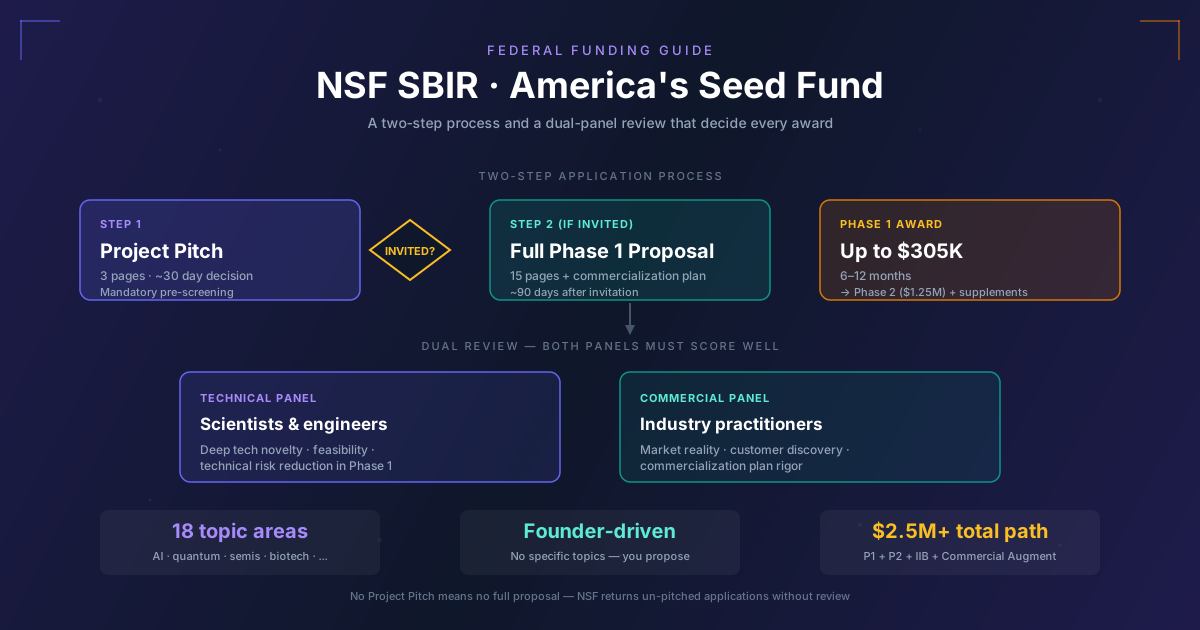
NSF SBIR (branded as America's Seed Fund) is structurally different from every other federal SBIR program. There's no list of specific topics to pick from. There's a mandatory pre-screening step that most applicants didn't know existed before they tried. The proposals are evaluated by two separate panels (one of scientists, one of industry practitioners) and a strong score on one is no defense against a weak score on the other.
The result is a program that's genuinely accessible to founders without a federal-funding track record, but only if you understand the two-step process and design your application around NSF's particular evaluation lens. First-time applicants who treat NSF SBIR like NIH SBIR submit full proposals without invitation and get returned without review.
This guide walks through how NSF SBIR is structured, the Project Pitch screening that determines whether you can even submit a full proposal, the 18 technical topic areas, NSF's "deep tech" criterion, the role of NSF I-Corps as a pre-SBIR signal, the dual technical-and-commercial review process, and the supplemental Phase IIB and Commercial Augment awards that scale Phase 2 funding.
Key Takeaways
- NSF SBIR (branded America's Seed Fund) is founder-driven, not topic-driven. You propose the technology; NSF decides whether to fund.
- Every NSF SBIR application starts with a mandatory 3-page Project Pitch. Without an "encouraged" Pitch outcome, full proposals are administratively returned without review.
- NSF reviews proposals with TWO panels: a technical panel of scientists, and a separate commercial panel of industry practitioners. Strong scores on one panel don't compensate for weak scores on the other.
- NSF funds deep tech across 18 topic areas. It does NOT typically fund SaaS, direct-to-consumer products, marketplaces, or incremental improvements to existing products.
- The combined NSF SBIR pathway (Phase 1 + Phase 2 + Phase IIB + Commercial Augment) can deliver $2.5M+ in total NSF funding when matched by private investment.
If you're considering NSF SBIR for the first time, or you submitted a Project Pitch and want to understand what reviewers are actually looking for, the mechanics below decide outcomes.
What Makes NSF SBIR Structurally Different?
Three structural differences set NSF SBIR apart from NIH, DoD, and the other federal SBIR programs.
1. Founder-Driven, Not Topic-Driven
NIH SBIR is organized around 24 institutes that each fund work aligned with their disease or research domain. DoD SBIR publishes hundreds of specific topics every cycle, each written by a program manager with a specific operational need. NSF SBIR does neither.
NSF accepts proposals across 18 broad technical topic areas (Artificial Intelligence, Biotechnology, Advanced Materials, Energy Technologies, Quantum, Robotics, Semiconductors, and so on) but does not publish specific topics within them. The applicant proposes the technology, identifies the market, and explains why both are worth NSF's investment. NSF's interest is in funding technically novel, commercially viable deep tech, regardless of whether anyone at NSF specifically asked for it.
This is structurally similar to a pre-seed venture pitch. Founders bring the idea; NSF decides whether the idea fits its program priorities.
2. Two-Step Process: Project Pitch First, Full Proposal Only If Invited
Every NSF SBIR Phase 1 application starts with a Project Pitch — a 3-page document that NSF uses to decide whether a full proposal is even welcome. Project Pitches are reviewed within ~30 days. Decisions come in three categories:
- Encouraged — the applicant is invited to submit a full Phase 1 proposal
- Discouraged but allowed — the applicant can submit a full proposal but is signaled that fit is weak
- Not allowed — the applicant cannot submit a full proposal in this cycle
Filing a full proposal without an "encouraged" Project Pitch outcome is a strong negative signal to reviewers. Filing without any Project Pitch is procedurally not allowed — the proposal will be returned without review.
The Project Pitch step is unique among federal SBIR programs. It serves NSF by filtering out poor-fit applications cheaply; it serves applicants (the smart ones) by saving the 60-80 hours of full proposal writing on a topic NSF doesn't want.
3. Dual Review Panels: Technical + Commercial
NSF SBIR Phase 1 (and Phase 2) proposals are evaluated by two separate panels:
- A technical panel of scientists and engineers in the relevant domain — similar to NIH study sections
- A commercial panel of industry practitioners (investors, operators, technology executives) who evaluate the commercialization plan and market opportunity
Both panels score the proposal independently. A strong technical panel review does not save a weak commercial panel review, and vice versa. The most common NSF SBIR decline pattern: high technical scores combined with commercial-panel skepticism about whether the team has done real customer discovery.
The implication for applicants: the commercialization narrative needs to be at the same caliber as the technical narrative, and it needs to be written for an industry audience. This is the focus of The SBIR Commercialization Plan: Template + 5 Examples.
Which 18 Technical Topic Areas Does NSF SBIR Fund?
NSF SBIR Phase 1 proposals are organized under broad technical topic areas. As of 2026, the current set:
| Topic area | Common applicant fit |
|---|---|
| Advanced Manufacturing | Manufacturing process and equipment innovations |
| Advanced Materials & Instrumentation | Novel materials, characterization tools |
| Artificial Intelligence | AI/ML algorithms, infrastructure, applications |
| Biological Technologies | Synthetic biology, bioprocessing, biomanufacturing |
| Biomedical Technologies | Medical devices, diagnostics, therapeutics (non-pharma) |
| Chemical Technologies | Catalysis, separations, novel chemistries |
| Distributed Ledger | Blockchain, distributed systems for trust |
| Educational Technologies | Learning science, ed-tech platforms |
| Energy Technologies | Energy generation, storage, transmission |
| Environmental Technologies | Pollution control, climate, remediation |
| Human-Computer Interaction | Interface design, accessibility, immersive |
| Information & Computing Technologies | Computing systems, software, networking |
| Nanotechnology | Nano-scale materials and devices |
| Photonics | Optics, lasers, optical computing |
| Quantum Information Technologies | Quantum computing, sensing, networking |
| Robotics | Hardware and software robotics platforms |
| Semiconductors | Chip design, fabrication, packaging |
| Space Technologies | Space-based hardware, services, instruments |
Each topic area has a current Program Director — an NSF staff scientist who runs the topic. Before submitting a Project Pitch, identify the Program Director for your topic and email them. NSF Program Directors are highly responsive and a brief pre-pitch exchange can clarify topic fit before the applicant invests time.
What Does NSF Mean by "Deep Tech"?
Across all 18 topic areas, NSF uses a consistent evaluation lens: deep tech that combines genuine scientific or technical novelty with a credible commercial opportunity.
In practice, "deep tech" at NSF means:
- The proposed work involves real technical risk that can be reduced by Phase 1 research
- The result is a defensible technical asset (a novel mechanism, algorithm, material, system architecture) , not a feature that any competent engineer could replicate
- The path from technical de-risking to commercial deployment is clear, even if the path is long
- The technology has a credible "moat" — IP, trade secret, time-to-replicate, or operational know-how that creates durable advantage
What NSF SBIR generally does not fund:
- Pure software-as-a-service applications without underlying technical novelty
- Direct-to-consumer products without a deep technical foundation
- Marketplaces and platforms whose value is network effects, not technology
- Incremental improvements to existing commercial products
- Pure research with no path to commercial deployment
This filter is enforced through the Project Pitch screening. Proposals that look like venture-funded startup ideas without the underlying deep tech are routinely discouraged or not allowed to submit. Proposals with strong technical novelty but no commercial path are also filtered out.
How Does NSF I-Corps Fit Into the SBIR Path?
NSF Innovation Corps (I-Corps) is NSF's customer discovery program. Teams complete a structured 7-week curriculum of 100+ customer interviews to validate or invalidate their commercial hypotheses.
For NSF SBIR specifically, I-Corps serves three purposes:
- It's structured customer discovery. NSF SBIR reviewers want to see that the team has done real customer interviews , not just market reports. I-Corps produces a documented record of this work.
- It's a fundability signal. A team that completed I-Corps demonstrates discipline around customer discovery before pitching for federal funding. Some NSF Program Directors explicitly view I-Corps participation as a positive signal.
- It funds itself. I-Corps teams receive $50K in grant funding for the customer discovery work, separate from any SBIR application. The work is paid for either way.
I-Corps is not required for NSF SBIR. Many successful SBIR awardees never did I-Corps. But for first-time SBIR applicants, especially those from academic backgrounds, I-Corps is the most efficient path to building the customer-discovery foundation that NSF's commercial review panel expects.
I-Corps participation typically takes 2-3 months elapsed time and produces customer discovery results that can be directly cited in the SBIR commercialization narrative.
For broader context on the early-stage capital landscape that complements NSF SBIR, see Researcher's Guide to Raising Your First $1M.
What Goes Into the NSF Project Pitch?
The Project Pitch is 3 pages maximum (some elements expand on the NSF portal, but the substantive content is 3 pages). It must include:
-
The technology innovation. What's the technical advance? What's genuinely new about it? Why couldn't a competent engineer or scientist replicate this with current public knowledge?
-
The technical objectives and challenges. What technical risks will Phase 1 reduce? What are the specific questions Phase 1 will answer?
-
The market opportunity. What problem does this solve, for whom, and how big is the market? Cite credible sources for any market sizing.
-
The company and team. Who is the small business? What's the relevant team experience? Why is this team positioned to commercialize this technology?
The Project Pitch is evaluated against the same dual lens as the full proposal: technical novelty and commercial viability. The 3-page constraint forces concision, which means every sentence must do work.
Common reasons Project Pitches are not allowed or discouraged:
- The technology described is not deep tech (insufficient technical novelty)
- The customer discovery is absent or implausible (no evidence the market exists)
- The team has no plausible commercial capability
- The fit with NSF SBIR's mission is unclear (might be better fit for another agency)
If the Project Pitch is "encouraged," the applicant has approximately 90 days to submit a full Phase 1 proposal. The full proposal expands every section of the Pitch to roughly 15 pages and adds the detailed Commercialization Plan, team biosketches, budget, and additional supporting documents.
What Does the NSF Phase 1 Proposal Include?
Phase 1 proposals submitted to NSF SBIR include:
- Project Description (15 pages). Technical objectives, approach, anticipated outcomes
- Commercialization Plan (separate document, 5 pages for Phase 1). Market opportunity, customer/competition, IP, team, financing
- References Cited
- Biographical Sketches (NSF format, 2 pages per key person)
- Budget and Budget Justification
- Current and Pending Support for the PI and key personnel
- Facilities, Equipment, and Other Resources
- Data Management Plan
The Commercialization Plan, even at 5 pages for Phase 1, is fully reviewed by the commercial panel. Phase 2 expands this to 15 pages with substantially more rigor on market sizing, competition, and revenue projection.
For the detailed Phase 2 commercialization plan structure, see The SBIR Commercialization Plan: Template + 5 Examples.
How Do Phase IIB and Commercial Augment Supplements Work?
NSF SBIR Phase 2 awards are up to $1.25M for 24 months (with some technology areas funded at $1M). Beyond the Phase 2 award itself, two supplemental mechanisms can scale total NSF SBIR-related funding substantially.
Phase IIB
A direct supplement to a Phase 2 award, intended for projects requiring extended development to reach commercial readiness. Phase IIB requires:
- An active Phase 2 award demonstrating strong progress
- A commercial partner (customer, strategic, or investor) providing matching investment
- A revised commercialization plan reflecting the extended scope
Phase IIB matches up to $500K of qualifying private investment 1:1, providing an additional $500K of NSF funding on top of the Phase 2 award.
Phase II Commercial Augment (CA)
A separate supplement that matches private investment more aggressively, intended for Phase 2 awardees with significant private capital momentum. Commercial Augment matches up to $1M of qualifying private investment at a 1:0.5 ratio (i.e., $1M of private investment can trigger $500K of NSF augment).
Both supplements require demonstrated private investment commitment, not just intent. The applicant must show signed term sheets or executed agreements before the supplement application is filed.
The combined math: a successful NSF SBIR pathway including Phase 2, Phase IIB, and Commercial Augment can result in total NSF funding of $2.5M-$3M+ on top of matched private investment. For deep tech founders, this is one of the largest non-dilutive funding paths available.
Frequently Asked Questions
What is the NSF SBIR Project Pitch?
The Project Pitch is a mandatory 3-page pre-screening document submitted before any full NSF SBIR Phase 1 proposal. NSF Program Directors review the Pitch within ~30 days and decide whether the applicant is "encouraged," "discouraged but allowed," or "not allowed" to submit a full Phase 1 proposal. Without an "encouraged" outcome, full proposals are administratively returned without review.
How often can I submit an NSF SBIR Project Pitch?
NSF accepts Project Pitches on a rolling basis with multiple windows per year. Specific windows shift periodically; check the current NSF SBIR Project Pitch page for active dates. A submitted Pitch that is not invited can be revised and resubmitted in a future window.
What is the NSF SBIR Phase 1 award amount?
NSF SBIR Phase 1 awards are up to $305K for 6-12 months. Most awards land between $275K and $305K. The Project Pitch invitation typically includes guidance on the appropriate budget range for the topic.
How is NSF SBIR different from NIH SBIR?
NIH SBIR is organized around specific institutes (NCI, NHLBI, etc.) with disease-specific priorities and three submission cycles per year. NSF SBIR is organized around broad technical topic areas with rolling Project Pitch screening and an additional commercial review panel. NIH applications are more biomedically focused; NSF applications cover all engineering and computational topic areas. See SBIR vs STTR: Which One Should You Apply For? for additional cross-agency framing.
Is NSF I-Corps required for NSF SBIR?
No. I-Corps is not required. However, I-Corps participation is viewed positively by NSF SBIR Program Directors and produces customer discovery results that directly strengthen the SBIR commercialization narrative. For first-time SBIR applicants, I-Corps is often the most efficient path to building the customer discovery foundation NSF reviewers expect.
What kind of technology does NSF SBIR fund?
Deep tech — technologies with genuine scientific or technical novelty and a credible commercial path. NSF SBIR generally does not fund pure software-as-a-service, direct-to-consumer products without technical depth, marketplaces, or incremental improvements to existing commercial products. The Project Pitch screening enforces this filter.
What is Phase IIB and how does it work?
Phase IIB is a supplemental NSF SBIR award that extends a Phase 2 award when matched by private investment. It provides up to $500K of additional NSF funding to match qualifying private investment 1:1. Commercial Augment is a separate, parallel supplement that matches private investment up to $1M at 1:0.5. Both require active Phase 2 awards and signed private investment commitments.
Ready to Build a Fundable NSF SBIR Application?
NSF SBIR rewards deep tech proposals with commercialization narratives that survive industry-panel scrutiny. The technical novelty needs to be real; the commercialization needs to be evidenced.
Commercify builds the market analysis, competitive landscape, and customer discovery synthesis that turns a strong technical idea into a defensible commercial story — designed specifically for the dual-panel review that decides NSF SBIR outcomes.
Build your NSF SBIR commercialization narrative with Commercify →
Read next: The Complete SBIR/STTR Guide · The SBIR Commercialization Plan: Template + 5 Examples · Researcher's Guide to Raising Your First $1M