Medical Device Guide: Prototype to 510(k)

The Medical Device Commercialization Guide: From Prototype to 510(k) Clearance
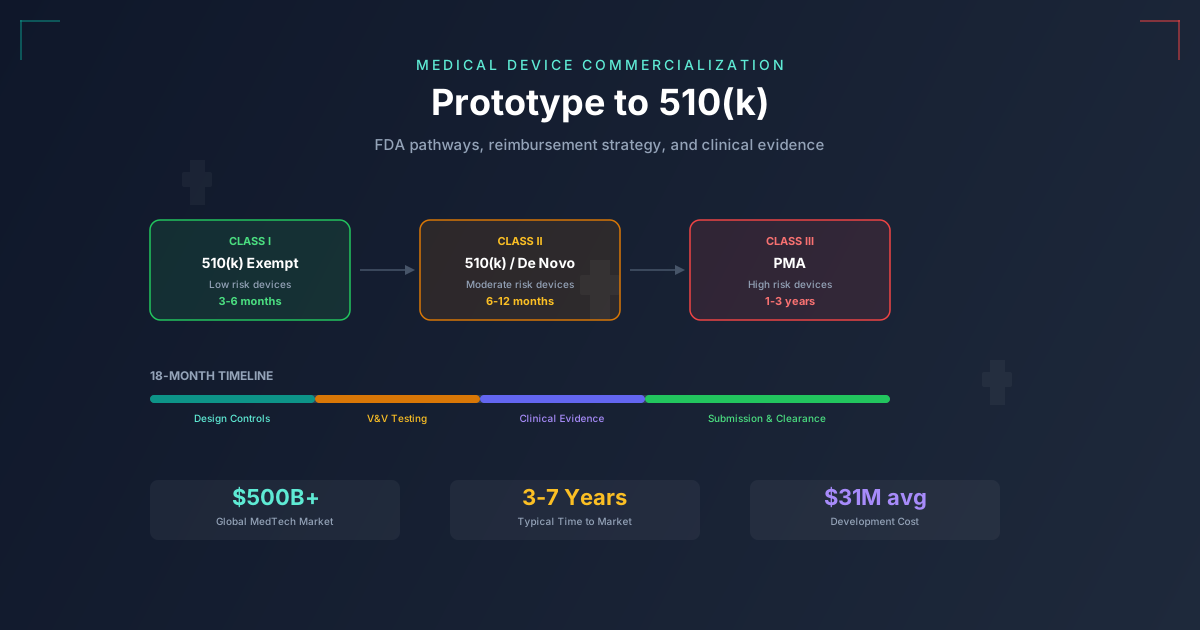
To commercialize a medical device, first determine your FDA risk classification (Class I, II, or III), then choose the regulatory pathway it dictates: the predicate-based 510(k) for moderate-risk Class II devices, the De Novo pathway for novel low-to-moderate risk devices with no predicate, or Premarket Approval (PMA) for high-risk Class III devices. From there, build your clinical evidence, implement a Quality Management System with design controls, plan manufacturing, and develop a reimbursement strategy in parallel. Most devices take years and millions of dollars, though a straightforward Class II device can move from working prototype to 510(k) clearance on an aggressive 18-month plan.
Bringing a medical device to market is one of the most complex commercialization challenges in technology. The combination of regulatory requirements, clinical evidence needs, reimbursement strategy, and manufacturing complexity creates a pathway that takes most devices years and millions of dollars to navigate. In an industry-sponsored Stanford survey of more than 200 medtech companies, the average cost from concept to market was about $31 million for a 510(k) product and $94 million for a PMA product (Makower et al., 2010).
Yet the opportunity is enormous. Medical devices are a large global market, and breakthrough technologies from university labs—diagnostic tools, therapeutic devices, surgical instruments, digital health solutions—have the potential to transform patient care.
This guide provides a comprehensive roadmap for medical device commercialization, from understanding FDA regulatory pathways to developing your reimbursement strategy to executing an 18-month timeline from prototype to clearance.
Whether you're a university researcher with a promising health technology, a startup founder developing a medical device, or a tech transfer professional supporting innovators, this guide will help you navigate the critical decisions that determine commercial success.
Understanding FDA Regulatory Pathways
Before you can sell a medical device in the United States, you need FDA authorization. The specific pathway depends on your device's risk classification and whether similar devices already exist on the market.
Device Classification: The Foundation of Your Strategy
The FDA classifies medical devices into three categories based on risk to patients:
Class I: Low Risk
- Examples: Bandages, tongue depressors, examination gloves
- Regulatory pathway: Most are exempt from premarket review
- Time to market: Minimal regulatory burden
- About 47% of medical devices fall in this class (FDA)
Class II: Moderate Risk
- Examples: Powered wheelchairs, pregnancy tests, contact lenses, surgical drapes
- Regulatory pathway: Usually requires 510(k) premarket notification
- FDA review goal: 90 FDA days for a 510(k), plus months of preparation
- About 43% of medical devices fall in this class (FDA)
Class III: High Risk
- Examples: Implantable pacemakers, heart valves, deep brain stimulators
- Regulatory pathway: Requires Premarket Approval (PMA)
- Time to market: typically years, because PMA usually requires clinical trials
- About 10% of medical devices fall in this class (FDA)
Understanding your classification is the first strategic decision. It determines your regulatory pathway, timeline, capital requirements, and clinical evidence needs.
The 510(k) Pathway: Predicate-Based Clearance
The 510(k) premarket notification is the most common pathway for new medical devices. It's based on demonstrating "substantial equivalence" to a device already legally marketed (the "predicate").
Key Requirements:
- Predicate Identification: Find a legally marketed device with the same intended use and similar technological characteristics
- Substantial Equivalence: Demonstrate your device is as safe and effective as the predicate
- Performance Testing: Conduct bench testing and sometimes clinical testing to support equivalence
- Design Controls: Document that you've followed quality system requirements (21 CFR Part 820)
- Labeling: Prepare compliant labeling including Instructions for Use
510(k) Types:
- Traditional 510(k): Standard pathway with full performance data
- Abbreviated 510(k): Uses FDA guidance documents or recognized standards to streamline review
- Special 510(k): For modifications to your own previously cleared device
Timeline and Costs:
- FDA review: 90 FDA days for a standard 510(k); calendar time is usually longer because the review clock stops while you answer FDA's questions
- Preparation time: plan for months of testing and documentation before submission
- FDA user fee: $28,653 standard, $7,163 for qualifying small businesses (FDA FY2027 MDUFA user fees)
- Total development cost: varies enormously with the device; budget for testing, quality system, and any clinical data, not just the filing
Strategic Considerations:
- Predicate selection is critical. The wrong predicate creates an uphill battle. The right predicate makes your submission straightforward.
- New technology often requires clinical data. If your device uses technology substantially different from the predicate, you may need clinical studies.
- Software can complicate matters. Software as a Medical Device (SaMD) and AI/ML-based devices face additional considerations.
The De Novo Pathway: For Novel Low-to-Moderate Risk Devices
If your device is low-to-moderate risk but has no valid predicate, the De Novo classification pathway provides an alternative to the more burdensome PMA process.
When to Consider De Novo:
- Your device is genuinely novel without marketed equivalents
- The device presents low-to-moderate risk to patients
- You cannot identify a suitable predicate for 510(k)
Key Requirements:
- Demonstrate the device meets the definition of Class I or Class II
- Provide performance data supporting safety and effectiveness
- Propose general and special controls that would apply to your device type
Timeline and Costs:
- FDA review goal: 150 FDA days for a De Novo request
- User fee: $191,020 standard, $47,755 for qualifying small businesses (FDA FY2027 MDUFA user fees)
- Total process: often a year or more including preparation
Strategic Advantage:
A successful De Novo creates a new device type—and your device becomes the predicate for future 510(k)s. This can provide competitive advantage as competitors must clear 510(k) with your device as predicate.
The PMA Pathway: For High-Risk Devices
Premarket Approval (PMA) is the most stringent regulatory pathway, required for Class III devices and representing the highest level of scientific review.
Key Requirements:
- Valid scientific evidence demonstrating safety and effectiveness
- Typically requires clinical trials with substantial patient enrollment
- Manufacturing information including process validation
- Full quality system documentation
- Complete labeling and promotional materials review
Timeline and Costs:
- FDA review: 180 days by statute; often much longer in practice with questions and advisory panels
- Clinical trials: commonly years, depending on device and endpoints
- Total development: tens of millions of dollars is common (the Stanford survey above averaged $94 million from concept to approval)
- User fee: $636,732 standard, $159,183 for qualifying small businesses (FDA FY2027 MDUFA user fees)
When PMA is Required:
- Life-sustaining or life-supporting implanted devices
- Devices that present potential unreasonable risk
- Class III devices without an alternative pathway
Strategic Considerations:
- Start clinical trial planning early—protocols need FDA agreement (pre-submission)
- Consider Breakthrough Device designation for expedited review
- Build relationships with FDA through pre-submission meetings
- PMA creates a higher barrier for competitors
Choosing Your Pathway: Strategic Decision Framework
| Factor | 510(k) | De Novo | PMA |
|---|---|---|---|
| Risk Level | Moderate | Low-Moderate | High |
| Predicate Exists | Yes | No | N/A |
| Clinical Data | Sometimes | Often | Always |
| FDA Review Goal | 90 FDA days | 150 FDA days | 180 days (often longer) |
| Relative Cost | Lowest | Moderate | Highest |
| Barrier to Competition | Low | Moderate | High |
Key Strategic Questions:
- Is there a valid predicate device? (If yes, likely 510(k))
- Is your device genuinely novel? (If yes and low-moderate risk, consider De Novo)
- Is your device high-risk or life-sustaining? (If yes, likely PMA)
- What clinical evidence is feasible? (May influence pathway choice)
- What is your competitive strategy? (Higher barriers may justify harder pathway)
Clinical Evidence Strategy
Understanding what clinical evidence you need—and how to generate it efficiently—is critical for regulatory success and commercial adoption.
Types of Clinical Evidence
Bench Testing (Non-Clinical):
- Performance testing under simulated conditions
- Biocompatibility testing per ISO 10993
- Electrical safety testing per IEC 60601
- Sterilization validation
- Software verification and validation
Preclinical Studies:
- Animal studies for safety and preliminary efficacy
- Cadaver studies for surgical devices
- Ex vivo testing with human tissue
Clinical Studies:
- First-in-human safety studies
- Pivotal trials for safety and efficacy
- Post-market clinical follow-up studies
Clinical Study Design for Medical Devices
Unlike pharmaceuticals, medical device trials have unique characteristics:
Challenges:
- Blinding is often impossible (patients and surgeons know what device is implanted)
- Sham surgery controls raise ethical concerns
- Learning curves affect outcomes as surgeons gain experience
- Device iterations during development complicate trial design
Strategic Approaches:
For 510(k) Devices:
- Focus on equivalence to predicate, not absolute efficacy
- Clinical data may not be required if bench testing demonstrates equivalence
- When clinical data is needed, smaller studies often suffice
For De Novo Devices:
- Clinical data typically required but not necessarily pivotal trials
- Focus on demonstrating reasonable assurance of safety and effectiveness
- Real-world evidence may supplement or replace traditional trials
For PMA Devices:
- Well-controlled pivotal trials with pre-specified endpoints
- Enrollment is usually far larger than for 510(k) studies, depending on device and indication
- Consider adaptive designs to improve efficiency
- Build in patient follow-up for durability data
FDA Pre-Submission Meetings
Before investing in clinical studies, get FDA feedback through the pre-submission (Pre-Sub) process:
When to Request a Pre-Sub:
- Before initiating clinical studies to agree on protocol
- Before submitting 510(k) to clarify testing requirements
- When uncertain about regulatory pathway
- For complex devices or novel technologies
How to Maximize Value:
- Submit specific, focused questions
- Provide enough context for FDA to respond substantively
- Propose your approach and ask if FDA agrees
- Follow up with additional questions as needed
Timeline:
- Submit Pre-Sub request with detailed questions
- FDA schedules meeting (typically 70-90 days from submission)
- Meeting occurs (teleconference or in-person)
- FDA provides written feedback
This is one of the highest-value activities in medical device development. Agreement with FDA before major investments reduces risk of rejection and expensive rework.
Design Controls and Quality System
FDA requires medical device manufacturers to implement a Quality Management System (QMS) per 21 CFR Part 820. Design controls are a core component.
Design Control Requirements
Design controls provide documented evidence that your device was developed systematically:
Design and Development Planning:
- Document your development process
- Establish milestones and reviews
- Assign responsibilities
Design Input:
- Document user needs and intended use
- Define design requirements (performance, safety, regulatory)
- Establish acceptance criteria
Design Output:
- Technical specifications and drawings
- Software source code and documentation
- Device master record
Design Verification:
- Testing to confirm design outputs meet design inputs
- Bench testing, analytical testing, software testing
- Documentation of test results
Design Validation:
- Testing to confirm device meets user needs
- Clinical studies or simulated use testing
- Human factors validation
Design Transfer:
- Documentation for manufacturing
- Process validation
- Production specifications
Design Review:
- Formal reviews at key milestones
- Cross-functional participation
- Action items tracked to closure
Design Changes:
- Change control procedures
- Impact assessment and re-verification/validation
- Documentation of changes
Human Factors and Usability
FDA places increasing emphasis on human factors engineering to ensure devices can be used safely and effectively:
Key Requirements:
- Use-related risk analysis
- Formative usability testing during development
- Summative (validation) usability testing before submission
- Documentation per FDA Human Factors guidance
Common Failure Points:
- Complex user interfaces with inadequate training
- Critical tasks without error prevention
- Devices used by patients without professional training
- High-stress environments affecting user performance
When to Start: Human factors should be integrated from early design, not addressed late in development. Discovering usability issues after design freeze is expensive and delays submissions.
Manufacturing and Supply Chain
Your device is only as good as your ability to manufacture it consistently. Manufacturing strategy directly impacts regulatory success and commercial viability.
Make vs. Buy Decisions
Most medical device startups outsource manufacturing, at least initially:
Contract Manufacturing Advantages:
- Established quality systems and regulatory compliance
- Capital efficiency (no factory investment)
- Scalability without major fixed costs
- Expertise in medical device manufacturing
In-House Manufacturing Advantages:
- Full control over quality and timeline
- Protection of proprietary processes
- Potential cost advantages at scale
- Faster iteration during development
Hybrid Approach: Many companies maintain control over critical or proprietary processes while outsourcing standard manufacturing steps.
Supplier Quality Management
Your quality system extends to your supply chain:
Requirements:
- Supplier qualification and approval
- Supplier audits and monitoring
- Incoming inspection procedures
- Change notification agreements
Critical Considerations:
- Single-source components create supply risk
- Component changes require change control
- International suppliers may face additional scrutiny
- Biocompatibility of materials must be verified
Sterilization Strategy
If your device requires sterilization:
Sterilization Methods:
- Ethylene Oxide (EO): Most common, works with most materials
- Gamma irradiation: Good for high-volume, materials must be compatible
- E-beam: Faster than gamma, surface/low-density applications
- Steam autoclave: For reusable devices
Validation Requirements:
- Sterilization process validation per ISO 11135 or 11137
- Parametric release qualification
- Periodic requalification
Strategic Considerations:
- Sterilization method affects packaging, materials, and shelf life
- Contract sterilization is common for startups
- Validation adds 3-6 months to timeline
Reimbursement Strategy
A cleared device that isn't reimbursed won't sell. Reimbursement strategy should begin early and run parallel to regulatory planning.
Understanding the Reimbursement Landscape
Key Stakeholders:
- Centers for Medicare & Medicaid Services (CMS): Sets policy for Medicare; influences commercial payers
- Commercial Payers: Private insurance companies with independent coverage decisions
- Hospital Administrators: Make purchasing decisions based on reimbursement
- Physicians: Influence purchasing but constrained by reimbursement
Types of Reimbursement:
Inpatient Hospital (MS-DRG):
- Fixed payment per diagnosis regardless of services
- New devices must fit within existing DRG payment
- High-cost devices may need New Technology Add-on Payment (NTAP)
Outpatient Hospital (APC):
- Payment per procedure category
- Similar challenges for new, expensive devices
- Transitional Pass-Through Payment available for qualifying devices
Physician Payment (CPT Codes):
- Payment for physician services
- May need new CPT code for novel procedures
- Existing code if procedure is comparable to established practice
Laboratory (CLFS):
- Payment for diagnostic tests
- May need new HCPCS code and pricing
- Local Coverage Determinations affect access
The Parallel Path: Coverage and Coding
Step 1: Assess the Current Landscape
- What codes exist for similar devices/procedures?
- What are current reimbursement rates?
- Are there coverage gaps or limitations?
Step 2: Develop Your Reimbursement Strategy
- Will existing codes work, or do you need new codes?
- What evidence do payers require for coverage?
- How will you demonstrate value to hospital administrators?
Step 3: Engage Early
- CMS Parallel Review: Joint FDA-CMS review for breakthrough devices
- Health economics evidence: Build cost-effectiveness data during clinical trials
- Stakeholder engagement: Meet with payers, hospitals, and physician societies
Step 4: Execute Post-Approval
- Apply for appropriate codes (CPT, HCPCS, ICD-10-PCS)
- Seek coverage from major payers
- Develop health economics messaging
Health Economics and Outcomes Research (HEOR)
Payers increasingly demand evidence of value, not just efficacy:
Types of Evidence:
- Cost-effectiveness analysis: Cost per quality-adjusted life year (QALY)
- Budget impact analysis: Total cost to health system
- Real-world evidence: Outcomes in actual practice
When to Start: Build health economics considerations into your clinical trial design. Capturing cost and utilization data during trials is far easier than retrospective analysis.
Key Endpoints to Consider:
- Length of hospital stay
- Reoperation/revision rates
- Complication rates
- Return to function/work
- Quality of life measures
The 18-Month Timeline: Prototype to 510(k) Clearance
For a typical Class II medical device, here's an aggressive but achievable timeline from working prototype to FDA clearance:
Months 1-3: Foundation
Regulatory Strategy:
- Finalize device classification
- Identify predicate devices (3-5 candidates)
- Prepare and submit Pre-Submission to FDA
- Begin design history file
Design and Development:
- Lock design concept and requirements
- Complete design input documentation
- Begin verification testing protocols
- Initiate human factors planning
Quality System:
- Establish QMS or partner with compliant manufacturer
- Document design controls
- Begin supplier qualification
- Plan biocompatibility testing
Clinical Strategy:
- Assess clinical evidence requirements
- Plan clinical studies if needed
- Identify clinical sites and investigators
- Begin IRB preparation
Months 4-6: Verification and Testing
Design Verification:
- Complete bench testing per protocols
- Execute biocompatibility testing (allow 12+ weeks)
- Complete electrical safety testing
- Complete software verification
Clinical Preparation:
- Finalize clinical protocol
- Submit to IRB
- Qualify clinical sites
- Manufacture clinical devices
Pre-Submission Feedback:
- Receive and incorporate FDA feedback
- Adjust testing or clinical plans as needed
- Refine submission strategy
Human Factors:
- Complete formative usability studies
- Refine labeling and user interface
- Plan summative validation
Months 7-12: Validation and Clinical
Design Validation:
- Complete human factors validation study
- Clinical study enrollment (if required)
- Design transfer to manufacturing
- Process validation
Manufacturing:
- First article inspection
- Establish production processes
- Finalize packaging and labeling
- Complete sterilization validation
Submission Preparation:
- Begin drafting 510(k) sections
- Compile test reports
- Prepare predicate comparison
- Draft labeling and indications
Months 13-18: Submission and Review
510(k) Submission:
- Complete submission package
- Internal review and quality check
- Submit to FDA (eSTAR format)
- Pay user fee
FDA Review:
- Acknowledgment and acceptance
- Substantive review begins
- Respond to any Additional Information requests
- Interactive review meetings if needed
Clearance and Launch Preparation:
- Receive 510(k) clearance letter
- Complete establishment and device listing
- Finalize manufacturing ramp-up
- Prepare commercial launch
Critical Path Considerations
Longest Lead Items:
- Biocompatibility testing: 12-16 weeks
- Sterilization validation: 12 weeks
- Clinical studies: Variable (3-12 months)
- FDA review: 90-180 days
Common Delays:
- FDA Additional Information requests
- Failed testing requiring design changes
- Supplier delays for critical components
- Clinical enrollment slower than expected
Risk Mitigation:
- Start long-lead items early
- Build contingency time into schedule
- Maintain regular FDA communication
- Plan for iteration based on test results
Common Pitfalls and How to Avoid Them
Pitfall 1: Wrong Predicate Selection
Problem: Choosing a predicate based on similarity rather than regulatory strategy leads to substantial equivalence challenges.
Solution: Analyze predicate candidates thoroughly. Consider intended use, technological characteristics, and the testing required to demonstrate equivalence. Get FDA feedback through Pre-Sub.
Pitfall 2: Underestimating Clinical Evidence Needs
Problem: Assuming bench testing alone will suffice when FDA expects clinical data.
Solution: Engage with FDA early to understand evidence expectations. Build clinical studies into your timeline and budget from the start.
Pitfall 3: Neglecting Human Factors
Problem: Discovering use errors late in development requires major redesign.
Solution: Integrate human factors from early design. Conduct iterative usability testing throughout development.
Pitfall 4: Quality System Gaps
Problem: Design control documentation is incomplete or doesn't meet regulatory requirements.
Solution: Establish QMS early. Document as you go—retroactive documentation is painful and often unconvincing.
Pitfall 5: Ignoring Reimbursement
Problem: Cleared device can't achieve commercial success because payers won't reimburse.
Solution: Analyze reimbursement landscape during development. Build health economics evidence into clinical trials. Engage with payers early.
Pitfall 6: Manufacturing Readiness Lag
Problem: Regulatory clearance achieved but manufacturing not ready for commercial scale.
Solution: Run manufacturing readiness in parallel with regulatory track. Design for manufacturability from the start.
Pitfall 7: International Planning Delay
Problem: Focused only on FDA, then scrambling to access European or other markets.
Solution: Consider international regulatory strategy early. EU MDR, MDSAP, and other requirements may influence design and testing decisions.
Beyond Clearance: Post-Market Requirements
Regulatory obligations continue after clearance:
Medical Device Reporting (MDR):
- Report deaths, serious injuries, and malfunctions
- Establish complaint handling procedures
- Train employees on reporting requirements
Corrections and Removals:
- Procedures for field corrections and recalls
- FDA notification requirements
- Root cause analysis and corrective action
Post-Market Surveillance:
- Monitor device performance in clinical use
- 522 Studies if required by FDA
- Adverse event trending
Continued Quality Compliance:
- Maintain QMS and design controls
- FDA inspection readiness
- Periodic design and manufacturing reviews
Frequently Asked Questions
What is the difference between 510(k) and PMA?
The 510(k) pathway is for moderate-risk Class II devices and clears them by demonstrating substantial equivalence to a legally marketed predicate device. PMA is the most stringent pathway, required for high-risk Class III devices, and demands valid scientific evidence of safety and effectiveness, typically through clinical trials with substantial patient enrollment.
How long does a 510(k) take?
FDA's review goal for a standard 510(k) is 90 FDA days, but calendar time usually runs longer because the clock stops while you answer FDA's questions. Before that, expect months of testing and documentation to prepare the submission.
When is the De Novo pathway used?
The De Novo classification pathway is used when a device presents low-to-moderate risk to patients but has no valid predicate for a 510(k). It offers an alternative to the more burdensome PMA process. A successful De Novo creates a new device type, and your device then becomes the predicate for future 510(k) submissions.
How long does medtech commercialization take?
Most medical devices take years and millions of dollars to navigate the full pathway. FDA's review goals are 90 FDA days for a 510(k), 150 for De Novo, and 180 days for a PMA, but preparation, testing, and clinical work take far longer, especially for PMA devices that need trials. A straightforward Class II device can reach 510(k) clearance on an aggressive 18-month plan.
How is medtech reimbursement handled?
Reimbursement involves coverage and coding decisions from CMS, commercial payers, hospital administrators, and physicians. Payment types include inpatient MS-DRG, outpatient APC, physician CPT codes, and laboratory CLFS. Strategy should start early and run parallel to regulatory planning, with health economics evidence built into clinical trials to demonstrate value to payers.
Why does predicate selection matter so much for a 510(k)?
Predicate selection is critical because the wrong predicate creates an uphill battle for demonstrating substantial equivalence, while the right one makes your submission straightforward. Choose based on regulatory strategy rather than mere similarity, weighing intended use, technological characteristics, and required testing. Getting FDA feedback through the Pre-Submission process helps validate your choice before you commit.
Navigate Your Regulatory Pathway
Medical device commercialization is complex, but it's a navigable path with the right strategy and execution. Understanding FDA requirements, building clinical evidence strategically, and planning for reimbursement from the start positions your device for regulatory and commercial success.
Use our Regulatory Pathway Navigator to assess which FDA pathway fits your device, understand the evidence requirements, and build a customized timeline for clearance or approval.