SBIR Success Rates by Agency, Phase, and Applicant Type

SBIR Success Rates by Agency, Phase, and Applicant Type
When founders ask "what are my chances of winning an SBIR award?", the answer they usually get is a single percentage — somewhere between 15% and 25% depending on who's quoting. That number is technically true and strategically misleading.
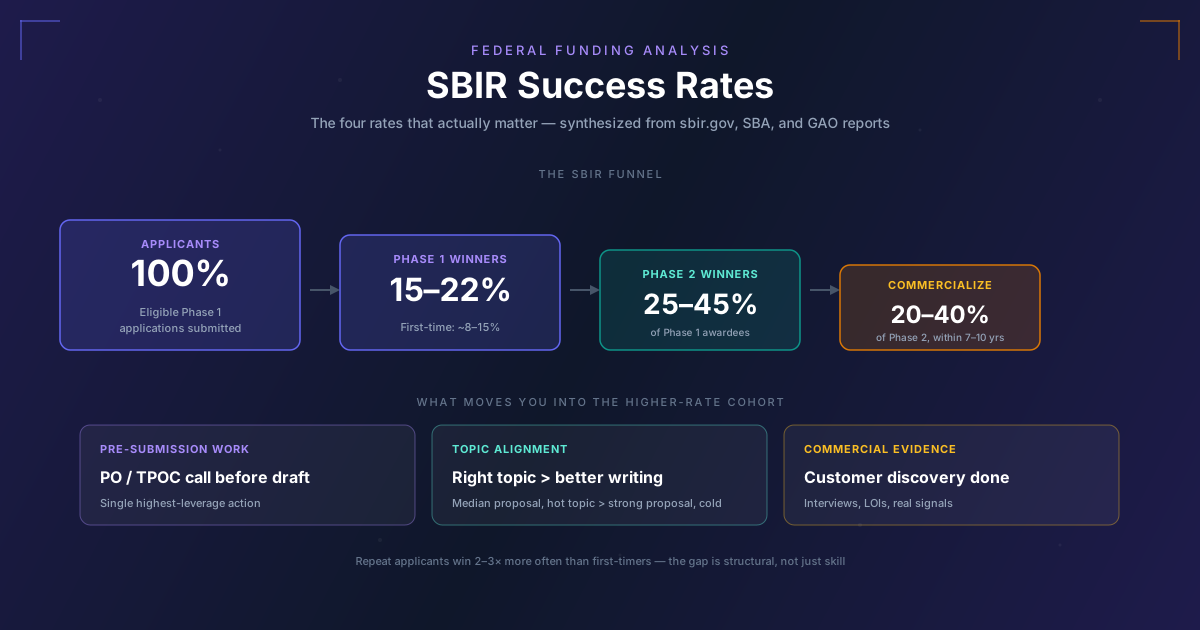
The single headline rate hides the four success rates that actually matter: Phase 1 win rate by agency and topic (which varies by 3-4x across agencies), Phase 1 to Phase 2 conversion (the more meaningful filter), long-term commercialization (the rate the program is ultimately judged on), and the first-time vs. repeat-applicant gap (the structural advantage that distorts everything else).
This article synthesizes what publicly available SBIR data — from sbir.gov, SBA annual reports, GAO analyses, and agency disclosures — tells us about each of these rates. The numbers below are drawn from publicly reported aggregates and are presented with attribution. Where specific year-over-year figures are needed, the underlying agency data is the authoritative source.
Key Takeaways
- The single "SBIR success rate" headline hides four rates: Phase 1 win rate (~15–22%), Phase 1-to-2 conversion (~25–45% of Phase 1 winners), long-term commercialization (~20–40% of Phase 2 winners), and the first-time vs repeat applicant gap.
- Phase 1 win rates vary by 3–4x across agencies — AFWERX Open Topics can run 25–50%, DARPA SBIR closer to 5–15%. Topic-level variance within an agency is even larger.
- Repeat SBIR winners win subsequent awards at 2–3x the rate of first-time applicants. First-time applicants likely face 8–15% Phase 1 odds despite published agency averages of 15–22%.
- Long-term commercialization runs 20–40% of Phase 2 awardees over 7–10 years, with DoD highest (sole-source contracts) and civilian agencies more variable.
- The pre-submission work (program officer call, topic alignment, customer discovery) moves applicants into a higher-rate cohort more reliably than proposal polish does.
If you're planning an SBIR strategy and want a realistic understanding of what to expect from the funnel, the numbers below are the starting point.
What Are the Four SBIR Success Rates That Matter?
When SBIR success rate is quoted as a single percentage, it usually means "Phase 1 acceptance rate at the agency you applied to during the cycle you submitted." That's one rate. There are four:
-
Phase 1 win rate. The percentage of Phase 1 applications funded. This varies by agency, by topic, by cycle, and by applicant type. Typical published averages: 15-22%.
-
Phase 1 to Phase 2 conversion rate. Of companies that win Phase 1, what percentage win a Phase 2 follow-on. Typically 30-50%, with substantial agency variation.
-
Long-term commercialization rate. Of companies that win Phase 2, what percentage achieve meaningful commercialization (sales, follow-on investment, sole-source contracts) within 7-10 years. Publicly reported figures cluster around 25-40%, again with agency variation.
-
First-time vs. repeat applicant gap. Repeat SBIR applicants (companies that have previously won) win at substantially higher rates than first-time applicants. This is the rate that distorts all the others.
Each rate is informative; together they describe the actual SBIR funnel, which is more demanding than the Phase 1 number alone suggests.
What Are SBIR Phase 1 Win Rates by Agency?
The headline Phase 1 win rate varies meaningfully across the eleven SBIR agencies. The figures below summarize publicly reported aggregate rates from recent SBA annual SBIR reports and individual agency dashboards.
| Agency | Reported Phase 1 success rate (approximate, recent years) | Notes |
|---|---|---|
| NIH | 15-22% | Varies substantially by IC; some institutes (NCI, NHLBI) more competitive than smaller ICs |
| NSF | 10-15% | Post-Project Pitch screening; invited proposals have higher success than the raw application rate suggests |
| DoD (Air Force / AFWERX) | 25-50% (Open Topics, Phase I lite) | Open Topic Phase I awards are smaller ($75-100K) and have rapid-cycle decisions; standard Phase 1 closer to civilian rates |
| DoD (traditional component topics) | 10-20% | Highly topic-dependent; some topics receive 30+ proposals, others receive 3 |
| DoD (DARPA) | 5-15% | Lower acceptance reflecting DARPA's high-risk, program-aligned funding model |
| DOE | 15-20% | Variable by topic and program office |
| NASA | 10-15% | Topic-driven, similar dynamic to DoD components |
| USDA | 15-20% | Smaller program, less competitive in absolute terms |
| Smaller agencies (EPA, DoEd, DHS, DOT, Commerce) | 15-25% | Wide variance; smaller applicant pools |
Three observations that the table understates:
Topic-level variance is enormous. Within a given agency, individual topics can have wildly different competitive dynamics. A DoD topic that receives 40 proposals and funds 4 has a 10% rate; a related topic in the same cycle might receive 3 proposals and fund 2 for a 67% rate. The headline agency average masks this.
Cycle effects. Phase 1 success rates fluctuate with the federal budget cycle. Continuing resolutions, agency budget reductions, and one-time funding boosts (e.g., infrastructure or CHIPS-related supplements) all move the headline number 3-5 percentage points year to year.
Topic alignment dominates. A weak proposal on a hot topic still loses; a strong proposal on an off-topic submission still loses. The single biggest predictor of Phase 1 success isn't proposal quality in absolute terms — it's proposal quality relative to topic fit. (See DoD SBIR Guide: Topics, TPOCs, and Winning Strategy for the topic-selection mechanics.)
What Is the Phase 1 to Phase 2 Conversion Rate?
Phase 1 to Phase 2 conversion is the more meaningful filter than Phase 1 itself, because Phase 2 is where the real R&D funding ($1M+) lives. Two rates matter at this stage.
Conversion application rate. Of companies that win Phase 1, what percentage apply for Phase 2. This is typically 50-70% — meaning a substantial minority of Phase 1 awardees never even apply for Phase 2. The most common reasons: the Phase 1 work showed the technology wasn't ready, the company pivoted away from the agency's interest, or the team disbanded during the Valley of Death gap.
Phase 2 acceptance rate (among applicants). Of those who apply, the acceptance rate is typically 40-60% — substantially higher than Phase 1 acceptance rates. Why? Because (1) the applicant pool is self-selected to companies whose Phase 1 work succeeded, and (2) agencies have committed to a Phase 1 awardee and want to see the work through.
Net Phase 1-to-Phase 2 conversion: Approximately 25-45% of Phase 1 awardees ultimately win Phase 2, depending on agency. Agencies with smoother bridge mechanisms (NIH's CRP, some DoD components' transition programs) have higher conversion; agencies with hard funding gaps have lower.
This rate matters because Phase 1 funding alone is rarely enough to fully commercialize a technology. A company that wins Phase 1 but never reaches Phase 2 has typically spent the Phase 1 award on feasibility work that the small business team can't follow through on at scale.
For the underlying phase mechanics, see SBIR Phase 1 vs 2 vs 3: A Stage-by-Stage Guide.
What Is the Long-Term Commercialization Rate?
The success rate that the SBIR program is ultimately judged on is whether Phase 2 awardees actually commercialize. This is the hardest rate to measure because "commercialization" has multiple definitions: commercial product sales, follow-on private investment, sole-source government contracts, IP licensing, acquisition by a larger company.
Publicly reported long-term commercialization rates, drawn from GAO reports and SBA's annual program evaluations, cluster around 20-40% within 7-10 years of Phase 2 award, depending on how commercialization is defined and which agency's portfolio is being measured.
DoD has the highest reported commercialization rates by some definitions, because the Phase 3 contracting status produces sole-source government contracts that are easy to track as commercial outcomes. Companies in the DoD SBIR pipeline can show meaningful Phase 3 contracts at higher rates than civilian-agency awardees.
NIH and NSF commercialization rates are typically lower in headline terms but capture different outcomes — clinical product launches, FDA approvals, licensing transactions with pharma or medtech companies. The 7-10 year horizon also matters more for biomedical commercialization, where regulatory paths add years.
Cross-cutting findings from public analyses include:
- Companies with prior SBIR experience commercialize at higher rates than first-time SBIR awardees
- Phase 2B / Commercial Augment / STRATFI awardees commercialize at substantially higher rates than companies that received only the base Phase 2 award
- Companies that completed I-Corps or equivalent customer discovery programs commercialize at higher rates
The implication: the headline Phase 1 rate is not the right thing to optimize for. The long-term commercialization rate is. Designing an SBIR application around the commercialization plan rather than just the technical plan is the structural way to land in the higher-commercialization-rate cohort.
For the commercialization plan structure that correlates with commercialization success, see The SBIR Commercialization Plan: Template + 5 Examples.
How Big Is the First-Time vs. Repeat Applicant Gap?
The most consequential success rate gap is between first-time SBIR applicants and companies with prior SBIR experience. Public analyses (including GAO and SBA reports) have consistently found a substantial gap.
Repeat winners win more. Companies that have previously won SBIR awards win subsequent Phase 1 awards at rates 2-3x higher than first-time applicants. This is partly skill (repeat applicants know how to write a strong proposal, engage the agency, navigate the registrations) and partly relationship capital (program officers know them; reviewers may have funded them before).
The "SBIR mill" pattern. A small number of companies have historically captured a disproportionate share of SBIR awards. Various analyses have found that ~5% of SBIR-winning companies receive ~25% of awards. This concentration triggered the benchmark requirements covered in our SBIR Eligibility guide — designed to prevent companies that consistently fail to commercialize from continuing to absorb SBIR funding.
Net implication for first-time applicants. A first-time SBIR applicant's actual Phase 1 win rate is likely lower than the published agency average (perhaps 8-15% in many agencies) because the agency average is inflated by the high win rate of repeat applicants.
This is the rate that's almost never quoted in SBIR overview articles, and it's the one first-time applicants most need to understand. The first SBIR application should be designed with realistic expectations: it's more likely to lose than to win, and the path to becoming a winner often includes one or two declined applications before a successful one.
The resubmission (A1 at NIH; similar mechanisms at other agencies) is structurally important precisely because of this. Many successful Phase 1 awardees were declined on their first attempt and funded on resubmission after addressing reviewer feedback. (See NIH SBIR Application Guide for the resubmission mechanics.)
Why Do Headline Rates Mislead First-Time Applicants?
Three structural reasons the headline SBIR success rate is misleading for first-time applicants:
1. The denominator includes ineligible and incomplete applications. Each cycle receives applications from companies that aren't eligible, have incomplete registrations, or are administratively returned without review. These count against the denominator, inflating the apparent acceptance rate among substantive applications. First-time applicants who fully meet eligibility and submit complete applications face stiffer competition than the headline implies.
2. The numerator includes resubmissions and repeat winners. Resubmitted applications (NIH A1, equivalent at other agencies) and applications from repeat winners are baked into the success rate. First-time fully-original applications win at lower rates.
3. Topic alignment matters more than the average suggests. An on-topic, well-aligned proposal in a hot area might face genuinely competitive odds (30-40% acceptance among aligned proposals). An off-topic or weakly-aligned proposal in a cold area might face near-zero odds regardless of quality. The headline average smooths over this variance.
The realistic planning assumption for a first-time SBIR applicant: 8-15% Phase 1 win rate on a first submission, 20-30% on a strong resubmission, with success substantially more likely on a topic genuinely aligned with the agency's priorities than on a topic chosen for proposal convenience.
What Should the Numbers Tell You About SBIR Strategy?
Synthesizing all four rates into strategic implications:
Optimize for the cohort with higher rates. First-time applicants who do the pre-submission work (engaging program officers (NIH POs, DoD TPOCs), completing I-Corps (NSF), choosing topics carefully, building documented customer discovery) move into a higher-rate cohort. The data consistently shows that the work done before submission predicts success more than the proposal text itself.
Apply to multiple agencies if eligible. With Phase 1 rates clustering around 10-20%, a single submission to a single agency has ~85% odds of failure. Two submissions to different agencies double the work but more than double the odds. (Applications cannot be funded simultaneously by multiple agencies, but they can be submitted in parallel.)
Plan for resubmission. Treat the first submission as a learning round, not the only round. Many successful SBIR awardees were declined on their first attempt. Reviewer feedback is the single most valuable input for the resubmission, and addressing it substantively is required.
Don't conflate Phase 1 success with commercialization success. A Phase 1 award is a feasibility study, not a business. Of Phase 1 awardees, most never reach Phase 2; of Phase 2 awardees, most never reach meaningful commercialization. Optimize the application (and the company) for the long-term commercialization outcome, not just the Phase 1 win.
For the broader SBIR program structure and where each of these rates sits in the funnel, start with The Complete SBIR/STTR Guide.
Frequently Asked Questions
What is the average SBIR Phase 1 success rate?
Across all agencies, published averages cluster between 15% and 22%. NIH, DOE, and smaller agencies tend toward the higher end; NSF and DARPA toward the lower end. DoD varies dramatically by component, with AFWERX Open Topics often higher and traditional component topics in line with civilian agency rates.
Are repeat SBIR winners more likely to win again?
Yes. Public analyses consistently find that repeat SBIR winners win subsequent awards at rates 2-3x higher than first-time applicants. SBA's benchmark requirements specifically address the concentration of awards in a small set of repeat-winning companies.
What percentage of Phase 1 awardees reach Phase 2?
Approximately 25-45% of Phase 1 awardees ultimately win Phase 2, depending on the agency. The path requires (1) deciding to apply for Phase 2 (only ~50-70% of Phase 1 awardees do) and (2) winning the Phase 2 application, which has higher acceptance rates than Phase 1 among applicants.
What is the long-term commercialization rate for SBIR awardees?
Publicly reported figures cluster around 20-40% of Phase 2 awardees achieving meaningful commercialization within 7-10 years. The definition of commercialization varies — DoD measures sole-source contracts, NIH measures FDA approvals and product launches, NSF measures private sales and follow-on investment.
Does an NSF Project Pitch invitation predict Phase 1 success?
Invited proposals have substantially higher Phase 1 success rates than the headline rate suggests, but invitation doesn't guarantee funding. The Project Pitch screening filters out poor-fit applications before they consume reviewer time. Invited applicants who write strong full proposals win at higher rates than the headline NSF rate suggests, but a meaningful share of invited applications still decline.
How much does proposal quality affect success rates?
Substantially, but not as much as topic alignment. A median-quality proposal on a perfectly aligned topic can outperform a strong proposal on a poorly aligned topic. The pre-submission work (choosing the right topic, engaging the right program officer, demonstrating customer discovery) predicts success more reliably than the polish of the written proposal.
Should I apply to multiple agencies in parallel?
If eligible, yes, with the caveat that applications cannot be funded simultaneously for the same work. Parallel applications increase the odds of an award while doubling the proposal-writing investment. Many experienced SBIR applicants pursue 2-3 agencies in parallel each cycle.
Ready to Move Into the Higher-Success-Rate Cohort?
The data is consistent: SBIR success correlates more with the pre-submission work (topic selection, program officer engagement, customer discovery, commercialization plan rigor) than with proposal polish. First-time applicants who do this work win at higher rates.
Commercify builds the commercialization-side foundation that moves applicants into the higher-rate cohort — market analysis, competitive landscape, and customer discovery synthesis tailored to each agency's review criteria.
Move your SBIR application into the higher-rate cohort with Commercify →
Read next: The Complete SBIR/STTR Guide · The SBIR Commercialization Plan: Template + 5 Examples · SBIR Phase 1 vs 2 vs 3: A Stage-by-Stage Guide