SBIR Eligibility: Rules & Disqualifiers (2026)

SBIR Eligibility: Requirements and Common Disqualifiers in 2026
Most SBIR application advice focuses on writing the proposal. Eligibility (whether your company can legally apply at all) gets a paragraph. That's backwards.
A surprising number of SBIR applications are returned without review because the applicant isn't actually eligible. The VC-owned company that assumed venture capital disqualified it (often wrong). The startup with foreign founders that assumed any non-U.S. ownership was fine (often wrong). The PI at a university who didn't realize SBIR required them to leave (often the case). The well-prepared applicant who hadn't completed SBA Company Registry registration in time (more common than you'd expect).
This guide walks through the three eligibility tests every SBIR applicant must pass, the VC-ownership rule that most applicants misunderstand, the foreign-influence restrictions tightened by the FY24 NDAA, the PI primary employment requirement, the two registrations you need before submitting, and the benchmark requirements that apply to repeat SBIR applicants.
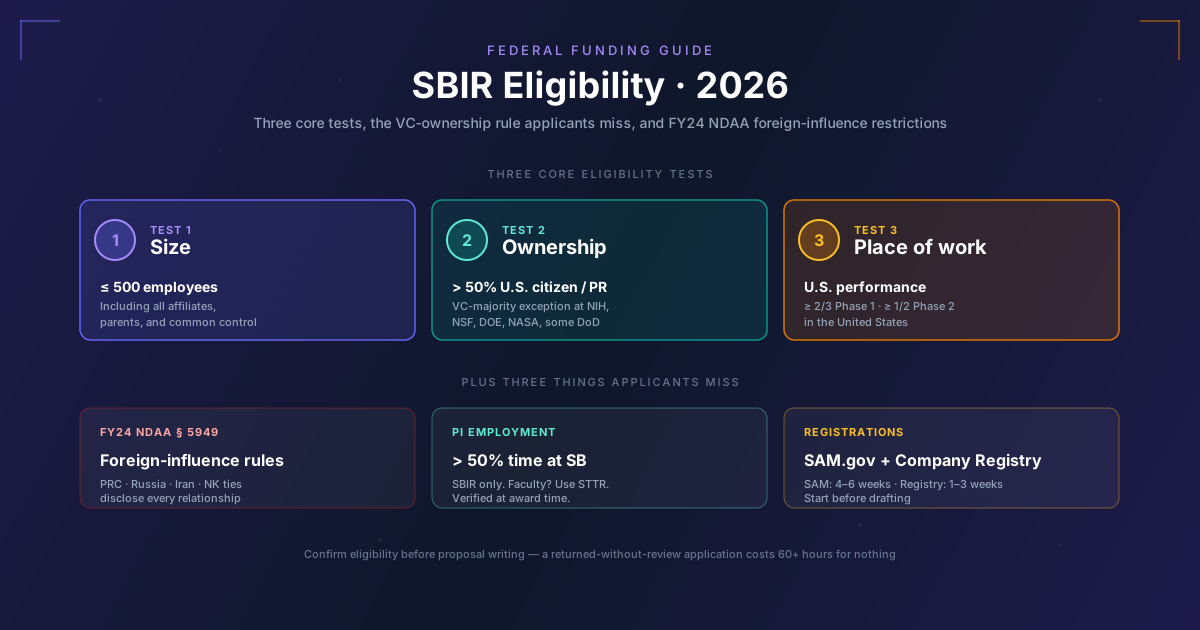
Key Takeaways
- Three core tests: 500-employee cap including affiliates, >50% U.S. citizen/permanent-resident ownership, and ≥2/3 of Phase 1 work performed in the U.S.
- VC-majority-owned companies CAN apply at NIH, NSF, DOE, NASA, and some DoD components — up to 25% of those agencies' SBIR awards. Other agencies require individual U.S. citizen majority.
- The FY24 NDAA Section 5949 added explicit foreign-influence restrictions on ties to countries of concern (PRC, Russia, Iran, North Korea) and expanded beneficial ownership disclosures.
- For SBIR (not STTR), the PI must be primarily employed (>50% time) at the small business at award time. This disqualifies most full-time faculty.
- Two registrations are required and take time: SAM.gov (4–6 weeks for first-timers) and SBA Company Registry (1–3 weeks). Start both before drafting.
If you haven't confirmed your eligibility, do that before drafting a single page of proposal.
What Are the Three Core SBIR Eligibility Tests?
Every SBIR applicant must pass three tests, set by the Small Business Administration (SBA) and applied uniformly across agencies.
Test 1: Size
The small business must have 500 or fewer employees, counting both the company and all affiliates. Affiliates are defined broadly: any entity that controls, is controlled by, or is under common control with the applicant.
The 500-employee threshold catches several edge cases first-time applicants miss:
- Investor portfolio affiliation. If a venture capital firm controls multiple companies that, together, exceed 500 employees, the SBA may aggregate them as affiliates.
- Parent companies. If the applicant is a subsidiary of a larger company, the parent's employee count is included.
- Common ownership. If the same individuals own controlling stakes in multiple companies, those companies may be affiliates.
Affiliation rules are technical and case-by-case. A company near the 500-employee threshold or with complex ownership should consult a federal contracting attorney before assuming eligibility.
Test 2: Ownership
The small business must be more than 50% owned and controlled by one or more U.S. citizens or permanent residents (lawful permanent residents holding green cards).
The default test is straightforward: count the equity holders, identify those who are U.S. citizens or green card holders, and confirm they collectively own more than 50% of the company.
Two important exceptions:
VC/HF/PE ownership exception. Under post-2011 SBIR reauthorization, certain agencies may award up to a specified percentage of SBIR funds to small businesses majority-owned by venture capital operating companies (VCs), hedge funds (HFs), or private equity firms (PEs). This exception applies only at participating agencies and only to a capped portion of their awards. We'll cover this in detail below.
Permanent resident ownership. Green card holders count as U.S. owners for SBIR purposes. Visa holders (H-1B, O-1, etc.) and individuals with pending green card applications generally do not count.
Common ownership scenarios that may disqualify:
- A small business majority-owned by a foreign parent company (even a friendly-country parent like a UK or Canadian parent)
- A small business where the controlling founder is a visa holder
- A small business where U.S. owners collectively hold less than 50% after a recent funding round
Test 3: Place of Performance
At least two-thirds of the Phase 1 work, and at least half of the Phase 2 work, must be performed in the United States. Subaward and consultant work performed by U.S.-based entities counts; work performed by foreign entities (subcontractors, foreign consultants, foreign subsidiaries) does not.
Exceptions exist for situations where the work must be performed abroad (e.g., field research in a specific geography), but require advance approval from the awarding agency. Assuming this exception will be granted is risky.
Can a VC-Owned Startup Apply for SBIR?
The single most common misconception in SBIR eligibility: founders assuming venture capital investment automatically disqualifies them. It does not — but the rules are nuanced.
Default Rule
By default, a small business must be more than 50% owned by U.S. citizens or permanent residents (individuals, not entities). Venture capital firms are entities, not individuals, so VC equity counts against the 50% U.S.-citizen-individual requirement.
A startup with 60% founder ownership and 40% VC ownership is eligible (founders are U.S. citizens; VCs hold less than 50%). A startup with 40% founder ownership and 60% VC ownership is, by default, ineligible.
The VC/HF/PE Exception
In 2011 the SBIR Reauthorization Act created an exception for businesses majority-owned by VC operating companies (VCOCs), hedge funds, and private equity firms. The exception:
- Applies only at participating agencies. Each agency decides whether to use the exception.
- Caps the share of awards. Participating agencies may award up to a specified percentage of SBIR funds (typically 25% for NIH and DOE; 15% for NSF and others) to majority-VC-owned firms.
- Requires the VC to be a "qualifying" entity. The investor must meet specific SBA definitions of a VCOC, hedge fund, or PE firm. Family offices, corporate venture arms, and certain other investors may not qualify.
| Agency | VC majority ownership allowed? | Notes |
|---|---|---|
| NIH | ✓ Up to 25% of awards | Most active user of the exception |
| NSF | ✓ Up to ~15% of awards | Used selectively |
| DOE | ✓ Up to 25% of awards | Used in clean energy SBIR |
| NASA | ✓ Limited | Used selectively |
| DoD | ✓ Some components | Air Force / AFWERX uses; varies by component |
| USDA | ✗ Generally not | Standard ownership rules apply |
| EPA, DoEd, DHS, DOT, Commerce | ✗ Generally not | Standard ownership rules apply |
For a startup with majority VC ownership, the practical check is two-fold: (1) is the target agency among the participating agencies, and (2) does the lead VC qualify under SBA's definition?
For broader context on early-stage capital structures that affect SBIR eligibility, see Researcher's Guide to Raising Your First $1M.
What Are the FY24 NDAA Foreign-Influence Restrictions?
The FY24 National Defense Authorization Act (NDAA) Section 5949 introduced explicit foreign-influence restrictions that apply across all SBIR programs, with particular weight at DoD. Subsequent NDAAs have continued to refine these requirements.
The restrictions target relationships with entities in "countries of concern" (currently the People's Republic of China, Russia, Iran, and North Korea) and require enhanced disclosure of foreign ties.
Specific requirements:
Disclosure of foreign ties. SBIR applicants must disclose all foreign relationships, including:
- Foreign investors (including minority investors)
- Foreign employees or contractors
- Foreign subsidiaries or parent companies
- Talent recruitment program participation by the PI or key personnel
- Foreign government funding (current or recent)
Restrictions on country-of-concern ties. Direct funding from, ownership by, or significant talent program participation involving countries of concern can result in disqualification. The bar is highest at DoD; civilian agencies apply the framework with more flexibility but still require disclosure.
Beneficial ownership disclosure. Applicants must disclose any individual or entity that beneficially owns 10% or more of the small business, with detailed identification information.
Talent recruitment program disclosure. The PI and key personnel must disclose participation in foreign government talent recruitment programs (e.g., China's Thousand Talents Plan). Non-disclosure can result in disqualification and potential criminal exposure.
The practical implication: if any key personnel or significant equity holder has substantial ties to a country of concern, consult a federal contracting attorney before applying. The cost of getting this wrong is severe , not just denial of the award, but potential legal exposure.
What Is the PI Primary Employment Requirement?
For SBIR specifically (not STTR), the principal investigator must be primarily employed (more than 50% of total professional time) by the small business at the time of award and during the project period.
"Total professional time" means all professional commitments combined — academic appointments, consulting roles, other jobs. A faculty member with a 100% university appointment cannot serve as SBIR PI without reducing the academic appointment below 50%.
Common scenarios:
| Situation | SBIR-eligible PI? |
|---|---|
| Full-time small business employee | ✓ Yes |
| Part-time founder (40% time at SB) + 50% time at another job | Depends on what counts as "primary" — generally no if both add up to >50% elsewhere |
| Tenured full-time faculty | ✗ No |
| Tenured faculty on sabbatical, committing >50% to small business | ✓ Yes during sabbatical only |
| Faculty with reduced (<50%) academic appointment | Possibly, if SB time is >50% |
| Adjunct faculty with full-time small business role | ✓ Yes |
The PI employment rule is verified at time of award. Some agencies require updated attestations during the project period.
For university researchers who want to keep their academic appointment, STTR is the structural alternative — STTR has no primary employment requirement. See SBIR vs STTR: Which One Should You Apply For? for the full comparison.
Which Registrations Do You Need Before Submitting?
Two registrations are required before any SBIR application can be submitted. Both take time. Both should be started before drafting the proposal.
SAM.gov Registration
The System for Award Management (SAM.gov) is the federal government's central vendor registration system. All SBIR applicants need:
- A Unique Entity Identifier (UEI) — replaced the DUNS number in 2022; obtained directly through SAM.gov
- A complete SAM.gov entity registration including business information, banking information for ACH payment, and representations and certifications
SAM.gov registration takes 4-6 weeks for first-time applicants (longer if there are validation issues with the business name, address, or banking information). The 4-6 week timeline is genuinely binding — most rejections at this stage come from underestimating it.
Existing SAM.gov registrations must be renewed annually. A lapsed registration prevents SBIR submission.
SBA Company Registry
A separate registration with the SBA Company Registry, distinct from SAM.gov. The Company Registry collects detailed information about the small business's eligibility (size, ownership, prior SBIR participation) that agencies use to verify SBIR eligibility before review.
Company Registry registration is faster than SAM.gov (typically 1-3 weeks) but is a hard requirement before submitting any SBIR application. Both registrations must be active at the time of submission.
What Benchmarks Apply to Repeat SBIR Applicants?
Companies that have received multiple SBIR awards face additional eligibility requirements designed to ensure SBIR funding doesn't go to companies that consistently fail to commercialize.
SBA applies two benchmarks:
Phase 1 Transition Rate. Companies that have received more than 20 Phase 1 awards in the last 5 years must demonstrate that at least 25% of them transitioned to Phase 2. Companies below this threshold can be excluded from new Phase 1 awards.
Phase 2 Commercialization Rate. Companies that have received Phase 2 awards must demonstrate commercialization activity (sales, follow-on investment, intellectual property licensing) proportional to the funding received. The specific benchmark varies by agency.
These benchmarks generally don't apply to first-time SBIR applicants. They become relevant after a company has built a multi-award SBIR portfolio. The benchmarks exist to prevent the "SBIR mill" phenomenon — companies that subsist on serial Phase 1 awards without commercializing anything.
For background on how phase mechanics interact with these benchmarks, see SBIR Phase 1 vs 2 vs 3: A Stage-by-Stage Guide.
What Should Be on Your Pre-Submission Eligibility Checklist?
Before starting an SBIR application, work through this checklist:
- Company has 500 or fewer employees including all affiliates
- Company is more than 50% owned by U.S. citizens or permanent residents (OR the target agency permits VC-majority ownership AND the lead VC qualifies)
- At least two-thirds (Phase 1) or half (Phase 2) of work will be performed in the U.S.
- No prohibited ties to countries of concern (PRC, Russia, Iran, NK)
- All foreign relationships and talent program participation will be disclosed
- PI is or will be primarily employed (>50% time) at the small business at award (or STTR is being used instead)
- SAM.gov registration is complete and active (or will be 4-6 weeks before submission)
- SBA Company Registry registration is complete (or will be 1-3 weeks before submission)
- If repeat applicant: benchmark requirements are met
- Compliance with any agency-specific eligibility requirements
A "no" or "uncertain" answer to any item should be resolved before proposal drafting begins.
Frequently Asked Questions
Can a startup with VC investment apply for SBIR?
Yes, in most cases. If U.S.-citizen individuals own more than 50% of the company (which is typical for early-stage startups even after seed funding), the company is eligible by default. If VC firms own a majority, the exception rule applies only at participating agencies (NIH, NSF, DOE, NASA, some DoD components) and the VC must qualify under SBA's definitions.
How long does SAM.gov registration take for a new company?
Typically 4-6 weeks for first-time applicants. Validation of the legal entity name, the registered address, and the banking information for ACH payment all add time. Existing SAM.gov registrations must be renewed annually.
Can a permanent resident (green card holder) be an SBIR PI?
Yes. Green card holders count as U.S. citizens for SBIR ownership and PI purposes. Visa holders (H-1B, O-1, etc.) generally do not count.
What is the FY24 NDAA Section 5949?
Section 5949 of the FY24 National Defense Authorization Act introduced explicit restrictions on SBIR awards to entities with ties to countries of concern (PRC, Russia, Iran, NK) and expanded disclosure requirements for foreign relationships. The framework applies across SBIR programs with particular weight at DoD.
Does a foreign co-founder disqualify a startup?
Not automatically. The question is whether U.S. citizens or permanent residents collectively own more than 50% of the company. A startup with a foreign co-founder who holds less than 50% is generally eligible. A startup where the foreign co-founder holds majority equity is generally ineligible unless an agency exception applies.
What is the SBA Company Registry?
The SBA Company Registry is a federal database of SBIR applicants, separate from SAM.gov, that collects detailed information about each small business's eligibility status. Registration with the Company Registry is required before any SBIR application can be submitted. Registration typically takes 1-3 weeks.
Can the PI work part-time at a university and on SBIR at the same time?
For SBIR, the PI must be primarily employed (>50% of total professional time) by the small business. A part-time university appointment that's less than 50% may be compatible. A full-time or majority-time university role is not.
Ready to Confirm Your SBIR Eligibility?
Eligibility confirmation is the first step in SBIR planning — before proposal writing, before agency selection, before commercialization plan drafting. Once you've confirmed eligibility, the commercialization side of the application is where most decisions are made.
Commercify builds the market analysis, competitive landscape, and customer discovery work that determines whether an eligible application is also a fundable application — tailored to each agency's review criteria.
Build your SBIR commercialization strategy with Commercify →
Read next: The Complete SBIR/STTR Guide · SBIR vs STTR: Which One Should You Apply For? · SBIR Phase 1 vs 2 vs 3: A Stage-by-Stage Guide