Utility vs Design vs Plant Patents: Which One Fits?

Utility vs Design vs Plant Patents: Which One Fits Your Invention?
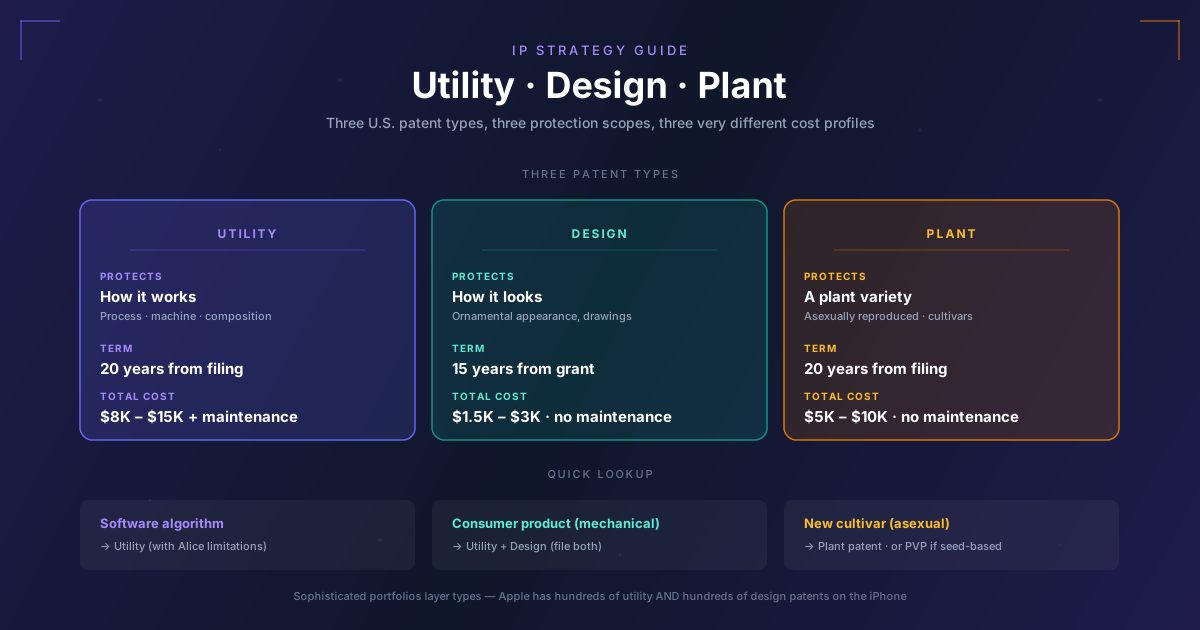
The U.S. Patent and Trademark Office grants three distinct types of patents, and most inventors don't realize they're different until an attorney asks which one to file. The choice matters: a utility patent protects how something works for 20 years and costs $8K-$15K to file; a design patent protects how it looks for 15 years and costs $1,500-$3,000; a plant patent protects an asexually reproduced plant variety for 20 years.
The three patent types are not interchangeable. An inventor who files a utility patent on a product whose only novelty is appearance will get a weak patent or a rejection. An inventor who files only a design patent on a product with functional innovation will protect only the look — and a competitor can copy the function legally as long as they change the appearance.
This guide compares the three patent types head-to-head, explains what each one actually protects with examples, provides a lookup table for matching inventions to patent types, and walks through when to file multiple types for the same invention.
Key Takeaways
- The USPTO grants three patent types: utility (how it works), design (how it looks), and plant (asexually reproduced varieties).
- Costs differ dramatically: utility patents cost $8K–$15K to file plus lifetime examination; design patents cost $1.5K–$3K all-in with no maintenance fees; plant patents cost $5K–$10K.
- Terms: utility 20 years from filing, design 15 years from grant, plant 20 years from filing.
- Software faces tighter eligibility under the 2014 Alice decision — utility claims must recite a specific technical implementation, not an abstract idea.
- Sophisticated portfolios layer types — Apple files BOTH utility and design patents on every flagship product; pharma layers composition, method-of-treatment, and formulation utility patents.
If you have an invention disclosure to file on, or you're trying to understand what type of patent fits your technology, this is the framework to start with.
How Do the Three U.S. Patent Types Compare?
| Dimension | Utility Patent | Design Patent | Plant Patent |
|---|---|---|---|
| Authorizing statute | 35 U.S.C. § 101 et seq. | 35 U.S.C. § 171 et seq. | 35 U.S.C. § 161 et seq. |
| What it protects | The way an invention functions or is used | The ornamental appearance of an article of manufacture | An asexually reproduced, distinct and new plant variety |
| Term | 20 years from filing | 15 years from grant | 20 years from filing |
| Number of claims | 1-25 typical (often 15-25) | Exactly 1 (referring to drawings) | Typically 1 |
| Drawings required | When needed for understanding | Yes, drawings ARE the patent | Yes, typically photographs |
| Total filing cost (small entity) | $8,000–$15,000+ with attorney | $1,500–$3,000 with attorney | $5,000–$10,000 with attorney |
| Examination time | 18-36+ months | 12-24 months | 18-30 months |
| Maintenance fees | Yes — three payments at 3.5, 7.5, 11.5 years | No | No |
| Roughly how many issued per year | ~300,000+ | ~35,000+ | ~1,000+ |
The cost difference between utility and design is striking and matters strategically. A design patent costs less than a strong provisional patent application and provides 15 years of enforceable protection on appearance. For consumer products with distinctive looks, filing design patents alongside (or instead of) utility patents is often the more cost-effective IP strategy.
What Does a Utility Patent Protect?
A utility patent is what most people mean when they say "patent." It protects any new and useful process, machine, manufacture, or composition of matter (35 U.S.C. § 101).
What qualifies for a utility patent:
- Processes — methods of manufacturing, methods of treatment, business methods (with limitations), software algorithms (with limitations)
- Machines — devices, apparatus, systems
- Articles of manufacture — physical objects produced by humans
- Compositions of matter — chemical compounds, alloys, pharmaceutical formulations, biological materials
What does not qualify:
- Laws of nature (gravity, mathematical formulas in abstract)
- Natural phenomena (a discovered mineral)
- Abstract ideas (a business idea without specific implementation)
- Mere mental processes
- Human organisms (specifically excluded by statute)
The 2014 Supreme Court decision in Alice Corp. v. CLS Bank substantially narrowed software and business-method utility patents. Software inventions can still be patented, but the claims must recite a specific technical implementation that solves a technical problem, not an abstract idea implemented on a generic computer. This is still an evolving area of law and is the most common source of utility patent rejections in software fields.
For the detailed structure of utility patent claims (which are essentially the patent itself), see Patent Claims Explained: Independent, Dependent, and Why They Matter.
Examples of utility patents:
- Pharmaceutical compounds (e.g., the patent for a specific drug molecule)
- Surgical methods and medical devices
- Manufacturing processes (e.g., a new way to deposit thin films)
- Software algorithms tied to specific technical implementations
- Mechanical devices and systems
- Chemical compositions and materials
The bulk of patents granted in the U.S. each year are utility patents.
What Does a Design Patent Protect?
A design patent protects the ornamental design of an article of manufacture (35 U.S.C. § 171). It does not protect function. It protects appearance.
A design patent has exactly one claim, and the claim refers to the drawings: "The ornamental design for a [thing], as shown and described." The drawings ARE the patent. The scope of protection is determined entirely by what's shown in the drawings, modified by which lines are solid (claimed) and which are broken (unclaimed environment).
Examples of design patents:
- The rounded-rectangle iPhone screen and home-button layout (Apple has many famous design patents)
- The shape of a Coca-Cola bottle (also protected as trade dress, separately)
- The visual design of a graphical user interface (GUI design patents are a growing area)
- The shape of a piece of furniture
- The visual design of a shoe sole pattern
What design patents cannot protect:
- The function of the article (file utility patent for that)
- Features that are purely functional with no ornamental aspect
- Features dictated by industry standards (a USB-C connector's specific dimensions)
- Pure surface decoration in cases where copyright is the better fit (a fabric print)
Design patents are dramatically cheaper to obtain than utility patents (typically $1,500-$3,000 all-in with an attorney) because there's no specification to write and the application is essentially the drawings plus a one-sentence claim. They're also faster to grant (12-24 months vs. 18-36+ for utility).
The combination of low cost, fast grant, and 15-year term makes design patents one of the most cost-effective IP tools available for consumer products with distinctive appearance. Many sophisticated patent strategies include design patents not because they were the inventor's first instinct but because the cost-benefit math is favorable.
What Does a Plant Patent Protect?
A plant patent protects an inventor who has discovered or invented, and asexually reproduced, a distinct and new variety of plant other than a tuber-propagated plant or a plant found in an uncultivated state (35 U.S.C. § 161).
The three requirements:
- Asexual reproduction. The plant must be capable of being reproduced asexually (cuttings, grafting, layering, tissue culture). Plants reproduced from seed do not qualify for plant patents. (Seed-reproduced varieties are protected under the Plant Variety Protection Act, a separate program administered by USDA.)
- Distinct and new variety. The plant must be genetically distinct from existing varieties.
- Not found in an uncultivated state. Newly discovered wild plants don't qualify; plant patents are for varieties produced through cultivation, breeding, or sport mutation.
Examples of plant patents:
- New rose varieties (heavily patented)
- New apple cultivars (Honeycrisp, Pink Lady, etc., are all patented varieties)
- New ornamental plants (specific cultivars of azalea, hydrangea, etc.)
- New fruit and vegetable cultivars reproduced asexually
The plant patent system is technical and field-specific. Most inventors will never engage with it. For those in plant breeding, horticulture, or agricultural biotech, it's an important tool — and one with international equivalents (Plant Breeders' Rights under UPOV in most other countries).
Which Patent Type Fits Your Invention?
For the common question ("I have invented X, what kind of patent do I file?") the table below maps invention types to patent types. The patent indicated is the primary fit; many inventions also benefit from filing multiple types (see next section).
| Invention type | Primary patent type | Also consider |
|---|---|---|
| Pharmaceutical compound | Utility | Multiple utility filings on composition, method of treatment, formulation |
| Medical device | Utility | Design (for the housing/form factor) |
| Software algorithm | Utility (with Alice limitations) | Trade secret; copyright |
| User interface design | Design | Utility for the underlying interaction methods |
| Consumer product (mechanical) | Utility + Design | File both for full protection |
| Industrial process | Utility | — |
| Chemical composition | Utility | — |
| Material (alloy, polymer) | Utility | — |
| Manufacturing equipment | Utility | Design for distinctive form |
| Furniture | Design | Utility if functionally novel |
| Apparel design | Design | Copyright for print/pattern elements |
| Plant variety (asexual reproduction) | Plant patent | — |
| Plant variety (seed reproduction) | Utility OR Plant Variety Protection (USDA) | — |
| Genetically modified organism | Utility | — |
| Architectural design | Copyright primarily | Utility for functional elements |
| Graphical icon | Design | Trademark if used as a brand element |
| Algorithm / business method | Utility (high Alice risk) | Trade secret |
| Type design / typography | Copyright | Design patent has been used in some cases |
| Game mechanics | Utility (limited) | Copyright for expression |
| Architecture and arrangement of components | Utility | Design for visual aspect |
The lookup table reflects common patterns, but the boundary cases are real and matter. Software vs. design vs. utility for a user interface is a perennial gray area; the right answer depends on what's commercially valuable about the interface.
When Should You File Multiple Patent Types for One Invention?
Sophisticated IP strategies often involve filing multiple patent types on the same underlying invention to create layered protection.
Apple's iPhone is the textbook example. Apple has filed:
- Hundreds of utility patents on the underlying technology (touchscreen interactions, processors, antennas, software algorithms)
- Hundreds of design patents on the visual elements (rounded-corner rectangle shape, icon layout, home button, specific UI screens)
- Trade dress protection on the overall look and feel as a brand element
A competitor who wants to make a phone that copies the iPhone's functionality faces utility patents. A competitor who wants to make a phone that copies the iPhone's look faces design patents. A competitor who wants to make a phone that looks similar enough to confuse consumers faces trade dress claims. The layered IP creates a defense against three different attack vectors.
Pharmaceutical companies layer differently. A new drug is typically protected by:
- A composition-of-matter utility patent on the molecule
- A method-of-treatment utility patent on the specific clinical use
- A formulation utility patent on the dosage form
- Sometimes a manufacturing-process utility patent
- (Design patents are rare in pharma; appearance doesn't drive commercial value)
Consumer products typically combine utility and design. A novel kitchen appliance might have:
- Utility patents on the mechanism that makes it work
- A design patent on the distinctive housing shape
- A design patent on the user interface graphics
The combined cost ($8K-$15K utility + $2K design = $10K-$17K) is often less than 50% more than utility alone, but the protection it provides is substantially broader.
For broader strategic context on layering IP for commercial protection, see our Patent to Product IP Strategy Playbook.
What Are the International Equivalents of U.S. Patent Types?
Internationally, U.S. utility patents correspond to utility patents (and, in some countries, utility models), design patents correspond to industrial designs or design registrations, and plant patents correspond to Plant Breeders' Rights under UPOV. The three U.S. patent types have rough international equivalents, but the structures differ.
Utility patent equivalents. Most countries grant utility patents through their national patent offices or through regional systems (European Patent Office). The Patent Cooperation Treaty (PCT) provides a centralized international filing route for utility patents. Some countries (Germany, China, Japan) also offer utility models — a separate category with shorter terms (6-10 years), lower cost, and easier examination. Utility models do not exist in the U.S. patent system.
Design patent equivalents. Most countries call these industrial designs or design registrations. The Hague System provides international design registration. EU Community Design protects designs across all EU member states. Most jurisdictions have term lengths comparable to or slightly different from U.S. design patents (10-25 years depending on jurisdiction).
Plant patent equivalents. The Plant Breeders' Rights system, administered under the International Union for the Protection of New Varieties of Plants (UPOV), provides international plant variety protection. UPOV is the dominant international framework. The U.S. is a UPOV member and U.S. plant patents are recognized alongside UPOV protections in most countries.
For inventions with international commercial potential, the IP strategy must account for both the U.S. classification (utility, design, plant) and the appropriate international filing routes. For the broader international filing mechanics, see Provisional vs Non-Provisional Patent: When to Convert.
Frequently Asked Questions
What is the difference between a utility patent and a design patent?
A utility patent protects how something functions or is used (its mechanical operation, its chemistry, its algorithm. A design patent protects how something looks) its ornamental appearance. The same product can have both kinds of patents on different aspects: utility patents on how it works, design patents on how it looks.
How much does a utility patent cost?
A utility patent typically costs $8,000-$15,000 to file with an attorney (USPTO fees plus attorney drafting). Lifetime costs through issuance, including examination and office action responses, typically run $12,000-$25,000. Maintenance fees over the 20-year term add roughly $13,000 more for small entities, paid in installments.
How much does a design patent cost?
A design patent typically costs $1,500-$3,000 all-in with an attorney, substantially less than a utility patent. There are no maintenance fees during the 15-year term. The lower cost and absence of maintenance fees make design patents one of the most cost-effective IP tools available.
Can software be patented?
Software can be patented in the U.S. as a utility patent, but the 2014 Alice Corp. v. CLS Bank Supreme Court decision narrowed eligibility substantially. Software claims must recite a specific technical implementation that solves a technical problem, not an abstract idea implemented on a generic computer. The case law is still evolving and software utility patents face higher rejection rates than other utility categories.
What is the difference between a plant patent and Plant Variety Protection (PVP)?
A plant patent (USPTO) protects asexually reproduced plant varieties under 35 U.S.C. § 161. Plant Variety Protection (USDA Plant Variety Protection Office) protects sexually reproduced (seed-propagated) varieties under the Plant Variety Protection Act. They cover different reproduction methods; many breeders use PVP for crops grown from seed and plant patents for ornamental varieties propagated by cutting.
Can I file both a utility and a design patent on the same product?
Yes, and for consumer products it's often the right strategy. The utility patent protects the functional novelty; the design patent protects the appearance. Apple, Tesla, Nike, and most consumer brands file extensively in both categories on flagship products.
How long does each type of patent last?
Utility patents last 20 years from the earliest filing date. Design patents granted after May 13, 2015 last 15 years from grant. Plant patents last 20 years from filing. Utility patents require maintenance fees at 3.5, 7.5, and 11.5 years; design and plant patents do not.
Ready to Build the IP Layer of Your Commercialization Strategy?
Choosing the right patent type (or types) is one piece of a broader IP strategy that connects to commercialization. The market analysis, competitive landscape, and customer discovery work that justifies any IP investment is the foundation.
Commercify builds that commercialization-side work for innovators, helping you decide which IP filings are worth their cost and which aren't.
Build your IP-aligned commercialization strategy with Commercify →
Read next: Provisional Patent Application: The Founder's Guide · Patent Claims Explained: Independent, Dependent, and Why They Matter · Patent to Product: The IP Strategy Playbook