Provisional vs Non-Provisional Patent: When to Convert

Provisional vs Non-Provisional Patent: When to Convert (and Whether You Should)
Convert a provisional to a non-provisional within the 12-month window when your invention has real commercial validation and the United States is a priority market. If it does not, the better move is often to file a PCT application, refile a stronger provisional, or deliberately let it lapse. Only a minority of provisionals are ever converted, and many conversions would have been filed differently, or not at all.
A provisional patent application is the cheapest, easiest decision in the U.S. patent system. The non-provisional that follows it (twelve months later, with five to ten times the cost) is the strategic decision that actually determines whether the inventor ends up with a patent.
Most articles that compare provisional and non-provisional patents treat the conversion as automatic. The provisional is filed, twelve months pass, the non-provisional is filed. In reality, only a minority of provisional applications are converted into non-provisional applications, and a substantial fraction of the conversions that do happen would have been better off being filed differently — or not at all.
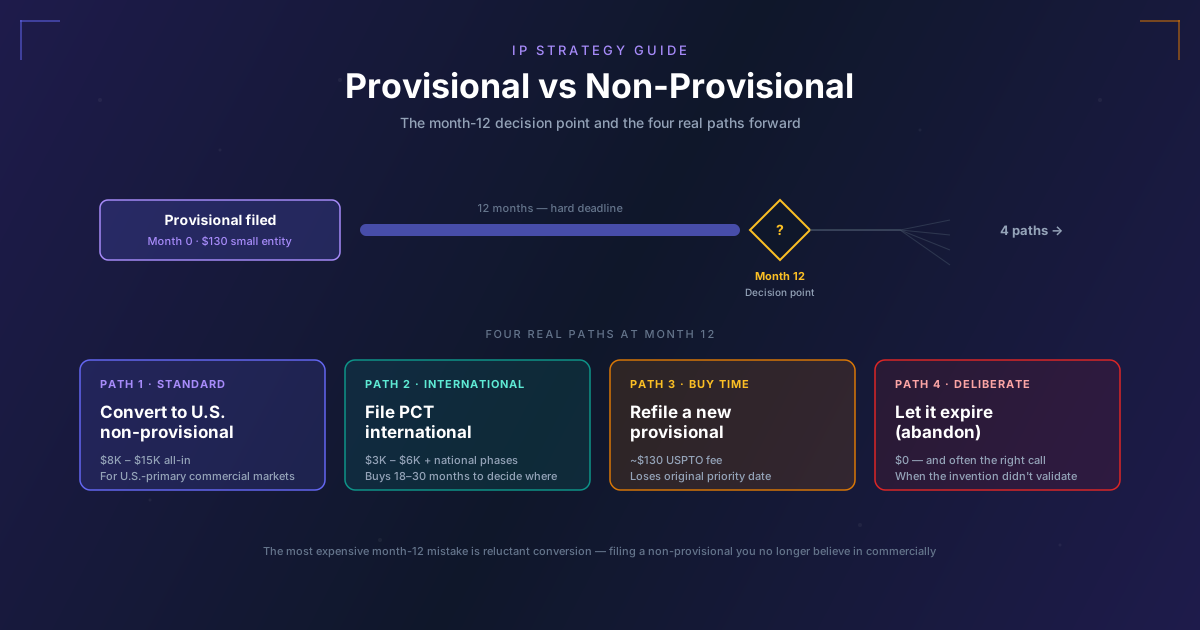
This guide compares provisional and non-provisional patents head-to-head, walks through the 12-month decision clock, breaks down conversion costs, and presents the four real options at month 12: convert, file PCT, refile, or deliberately abandon.
Key Takeaways
- A provisional buys a 12-month priority date and "patent pending" status for $130–$5,500. A non-provisional is the examined application that can issue as an enforceable patent — and costs $8K–$15K to file plus $4K–$12K in office action responses.
- At month 12 there are four real paths: convert to a U.S. non-provisional, file a PCT international application, refile a new provisional to buy time, or deliberately abandon.
- PCT filing within 12 months preserves the right to file in 150+ countries for an additional 18–30 months — increasingly the preferred path for technology with global markets.
- New matter added at conversion gets the non-provisional's later filing date, not the provisional's priority date. Include broad alternatives in the provisional itself.
- Deliberate abandonment is sometimes the right call. Reluctant conversion (filing an expensive non-provisional on an invention you no longer believe in) is the most expensive month-12 mistake.
If you have a provisional on file and the 12-month deadline is approaching, this is the decision framework to read first.
How Do Provisional and Non-Provisional Patents Compare?
| Dimension | Provisional Patent Application | Non-Provisional Patent Application |
|---|---|---|
| Governing statute | 35 U.S.C. § 111(b) | 35 U.S.C. § 111(a) |
| What it produces | A priority date and "patent pending" status. Never examined; cannot issue. | An examined application that, if allowed, becomes an issued patent. |
| Filing fee (small entity) | ~$130 | ~$800 (filing + search + examination fees combined) |
| Total cost | $130 DIY · $1,500–$5,500 with attorney | $8,000–$15,000+ all-in with attorney |
| Required claims | No formal claim requirement | At least one claim required; typically 15–25 |
| Required drawings | When needed; informal | Full formal drawings meeting USPTO rules |
| Duration | 12 months, then automatic expiration | 20 years from filing, subject to maintenance fees |
| Examination | Never examined | Examined; office actions and amendments required |
| Publication | Confidential unless converted; never published as a provisional | Published at 18 months from earliest priority (or earlier on request) |
| Enforceability | Cannot be enforced; "patent pending" only | Enforceable once issued |
| Priority effect | Sets a priority date for follow-on filings | Inherits the provisional's priority date if filed within 12 months |
| Required to enter PCT | Yes (or a non-provisional can serve the same purpose) | Yes for foreign filings, or PCT can be filed independently |
The single most important row in this table is enforceability. A provisional cannot be enforced against an infringer. It is a placeholder that buys time and "patent pending" credibility. The non-provisional (once it issues) is the patent.
How Does the 12-Month Conversion Clock Actually Work?
A provisional patent application has a 12-month life. From the filing date, the clock starts counting down to either:
- Conversion — a non-provisional application filed within 12 months that claims priority to the provisional, OR
- PCT filing — an international PCT application filed within 12 months that claims priority to the provisional, OR
- Refile — a new provisional (with different content) filed before the original expires, OR
- Abandonment — the 12-month deadline passes without any priority filing, and the provisional expires forever.
Two specific deadlines matter:
Day 365 from filing. The hard deadline. A non-provisional or PCT application must be filed on or before the day-365 anniversary of the provisional's filing date. There is no extension, no grace period, no excuse the USPTO will accept. Miss this day and the provisional dies.
Day 365 minus drafting time. A typical non-provisional drafting engagement takes 6-10 weeks. If the inventor doesn't engage an attorney by Month 9, the drafting timeline gets compressed and the document quality suffers. The practical deadline for starting the non-provisional is months earlier than the legal deadline for filing it.
For the broader timeline mechanics, see our Provisional Patent Application: The Founder's Guide, which covers the full filing-through-conversion arc.
How Much Does a Non-Provisional Patent Actually Cost?
A non-provisional patent application is substantially more expensive than a provisional because of three cost layers.
Layer 1: USPTO Fees
| Fee | Small entity | Standard |
|---|---|---|
| Filing fee | $80 | $400 |
| Search fee | $300 | $700 |
| Examination fee | $400 | $800 |
| Subtotal | $780 | $1,900 |
Additional USPTO fees may apply for excess claims (over 20 total or over 3 independent), for application size over 100 pages, and for extensions of time during examination.
Layer 2: Attorney Drafting and Filing
Attorney fees to draft and file a non-provisional vary substantially:
| Application complexity | Typical attorney cost |
|---|---|
| Simple mechanical or process | $5,000 – $8,000 |
| Standard software, electronic, or chemistry | $7,000 – $11,000 |
| Complex biotech, pharmaceutical, or systems | $10,000 – $20,000+ |
For inventions where the provisional was filed as a "convertible" premium provisional (i.e., already drafted at non-provisional quality), the conversion cost is much lower (often $2,000-$4,000) because the attorney is largely converting an existing document rather than drafting from scratch.
Layer 3: Examination Costs
The non-provisional examination process typically generates 2-4 office actions over 2-4 years. Each office action requires an attorney response. Cumulative office action costs over the lifetime of an application:
| Item | Typical cost |
|---|---|
| Office action responses (2-4 over examination) | $4,000 – $12,000 cumulative |
| Examiner interview (optional, often valuable) | $500 – $1,500 per interview |
| Request for Continued Examination (RCE), if needed | $1,000 USPTO fee + $1,500 – $3,000 attorney |
| Notice of Allowance + issue fees | $500 USPTO + $500 attorney |
Total expected lifetime cost from provisional through issued non-provisional: $12,000–$25,000 for a typical small-entity inventor. The number is higher for complex inventions and lower for clean inventions with experienced attorneys.
For the broader IP budgeting context across the commercial lifecycle, see our Patent to Product IP strategy playbook.
What Are the Four Month-12 Decision Paths?
At month 12, the provisional is about to expire. The decision is not just "convert or don't" — there are four realistic options.
Path 1: Convert to a U.S. Non-Provisional
The standard path. File a non-provisional application that claims priority to the provisional, within 12 months. The non-provisional inherits the provisional's filing date for everything it discloses, and gets a new (later) filing date for any new matter added.
Best when: the invention is commercially valid, the U.S. market is the primary commercial market, and international protection is not a near-term priority.
Costs: $8,000–$15,000 all-in for filing.
Path 2: File a PCT International Application
The Patent Cooperation Treaty (PCT) provides a centralized international filing system. A PCT application filed within 12 months of the provisional preserves the right to file in 150+ countries for an additional 18-30 months.
PCT is not an international patent — there is no such thing. PCT is a delayed-decision mechanism that lets the applicant defer the expensive national-phase filings while preserving the priority date.
Best when: the invention has international commercial potential and the applicant needs more time to assess which countries to file in.
Costs: $3,000–$6,000 for the PCT filing itself, plus $1,500–$3,000 for each national-phase entry at month 30 (Europe, Japan, China, Canada, etc.).
PCT is increasingly the preferred path for technology with global markets. Even if the applicant ultimately files only in the U.S. and one other major market, PCT buys planning time that the 12-month provisional clock does not.
Path 3: Refile the Provisional (with Modifications)
Less commonly discussed, but legitimate: file a second provisional application at month 11 with the same content (and any improvements) before the original provisional expires. The second provisional has its own 12-month clock.
This is not a way to extend the original priority date — the original provisional still expires, and the priority date for anything new in the refile is the refile date. But it can be useful in two scenarios:
- The invention has materially evolved. A refile that includes new embodiments and improvements gets a priority date for those new disclosures while preserving (via the original provisional) the priority date for the original disclosures.
- Commercialization timing has slipped. The applicant is not ready to commit to a non-provisional but wants to maintain "patent pending" status. The refile preserves the marking right.
Best when: the invention is genuinely evolving, OR the applicant is buying time for one more commercial milestone before committing.
Costs: Same as the original provisional — $130 USPTO + optional attorney fees.
This path has a critical limitation: the original provisional's priority date is lost. If the applicant has made a public disclosure between the original filing and the refile, the disclosure becomes prior art against the refile (in the U.S., subject to the 1-year grace period; in most other countries, unconditionally).
Path 4: Deliberately Abandon
The option that experienced patent practitioners discuss openly and first-time inventors rarely consider: let the provisional expire without filing anything.
Deliberate abandonment is the correct choice when:
- The invention turned out not to be commercially valuable
- The prior art search done during the 12 months revealed blocking art
- The commercial direction shifted such that the original invention no longer matters
- The fundraising or business model didn't materialize and the conversion budget isn't available
- A different invention has emerged that's more worth filing on
Abandonment costs nothing additional. The provisional disappears, no further fees are owed, and the inventor can continue commercializing the underlying technology (subject to whatever public disclosures may have happened in the interim).
The most expensive mistake at month 12 is not deliberate abandonment. It is reluctant conversion — filing an expensive non-provisional on an invention that the inventor no longer believes in commercially, because filing feels safer than not filing. Many issued patents are filed reluctantly, never enforced, and contribute nothing to the company's value.
Best when: any of the conditions above apply.
Costs: $0.
For the strategic framing that supports deliberate abandonment when warranted, see Stop Falling in Love with Your IP.
How Should You Decide Whether to Convert?
A structured way to choose among the four paths:
-
Has the invention been validated commercially? (Customer discovery completed, prospective customers identified, market signal is real) → No → consider Path 3 (refile to buy time) or Path 4 (abandon) → Yes → continue
-
Is the U.S. the primary commercial market? → Yes → Path 1 (U.S. non-provisional) → No, or unclear → Path 2 (PCT)
-
Has the commercial direction changed since the provisional was filed? → Yes, significantly → consider Path 3 (refile with updated content) before committing to Path 1 or 2 → No → proceed with Path 1 or 2
-
Is the conversion budget ($8K–$15K) available without strain? → Yes → proceed → No → consider Path 3 (refile) to defer the expense OR Path 4 (abandon) if the invention isn't worth the cost
A clean answer of "yes" to all four conditions points to Path 1 (U.S. non-provisional) or Path 2 (PCT). Any "no" answer should slow the decision down.
What Can and Cannot Be Added at Conversion?
A common misconception: that the non-provisional can add freely to what the provisional disclosed. It can — but anything new gets a later priority date.
Material in the provisional that's preserved in the non-provisional: gets the provisional's filing date as its priority date.
Material that's new in the non-provisional (i.e., not adequately disclosed in the provisional): gets the non-provisional's filing date as its priority date.
If the inventor publicly disclosed the invention between the provisional and the non-provisional filings, the public disclosure is prior art against any new matter — but not against material already in the provisional.
The practical implication: include broad alternatives, edge cases, and aspirational embodiments in the provisional itself. The non-provisional should expand on what's there, not introduce wholly new concepts that won't get the provisional's priority benefit.
This is the single most common surprise in conversion practice. A thinly drafted provisional plus a richly drafted non-provisional produces a patent that nominally claims priority to the provisional but effectively can be invalidated by intervening prior art for most of its scope.
Frequently Asked Questions
Can I convert a provisional to a non-provisional at any time?
No. The non-provisional must be filed within 12 months of the provisional's filing date. After 12 months, the provisional is irrevocably expired and cannot be converted. The exact day-365 deadline is hard.
What happens to the provisional after conversion?
The provisional remains on file as a record but is "consumed" by the conversion. Its purpose was to provide the priority date, which now attaches to the non-provisional. The provisional document itself is never published (unless the applicant specifically requests publication), and after the conversion it cannot be revived or used for any other application.
Can a non-provisional claim priority to multiple provisionals?
Yes. A non-provisional can claim priority to multiple earlier-filed provisionals if all were filed within 12 months of the non-provisional. This is a common strategy for inventions that evolved across multiple provisional filings during the year.
Is a PCT application a substitute for a non-provisional?
For preserving the 12-month priority from a provisional, yes — a PCT filing within 12 months satisfies the priority requirement. A PCT application is not, however, an issued patent in any country. The PCT route eventually requires national-phase filings (in the U.S., Europe, Japan, etc.) to produce enforceable patents.
What is "new matter" and why does it matter?
"New matter" is content in a later application that wasn't adequately disclosed in the earlier application from which priority is claimed. New matter doesn't get the earlier priority date — it gets the later filing's date. This matters because intervening prior art (public disclosures, third-party filings) between the two dates can be used against the new matter but not against the original material.
Can I file a non-provisional without ever filing a provisional?
Yes. A non-provisional can be filed directly without an earlier provisional. The advantage of the provisional-first path is a cheap early priority date and 12 months to refine the invention; the disadvantage is the cost of two filings instead of one. For inventors with strong existing disclosure and clear commercial direction, direct non-provisional filing is sometimes the right path.
How long does a non-provisional take to issue?
Typical examination takes 18-36 months from filing to first office action, with full prosecution taking 24-48 months from filing to either issuance or final rejection. Fast-track options exist (Track One prioritized examination at the USPTO, available for an additional fee of ~$1,600 small entity) that compress this to 12 months.
Ready to Decide Whether Conversion Makes Strategic Sense?
The conversion decision should follow the same logic as the original filing decision: does the commercial path justify the IP investment? Commercify builds the market analysis, competitive landscape, and customer discovery synthesis that tells you whether the invention is worth converting — and into which markets.
Make your conversion decision data-driven with Commercify →
Read next: Provisional Patent Application: The Founder's Guide · Patent Claims Explained: Independent, Dependent, and Why They Matter · Patent to Product: The IP Strategy Playbook