Patent Claims: Independent vs Dependent

Patent Claims Explained: Independent, Dependent, and Why They Decide Everything
A patent isn't a story. It's a list of legal boundaries called claims, and those claims (not the cool drawings, not the technical specification, not the abstract) are the only thing a court enforces.
When a patent is litigated, attorneys argue about claim language word by word. When the USPTO examines a patent, it grants or rejects each claim individually. When a startup gets acquired, the acquirer's lawyers read the claims first to determine what was actually purchased. Everything else in a patent document exists to support, interpret, and contextualize the claims.
This guide explains what patent claims are, the anatomy of a single claim, the difference between independent and dependent claims with annotated examples, the strategic trade-off between broad and narrow claims, and the five drafting mistakes that turn promising patents into worthless paper.
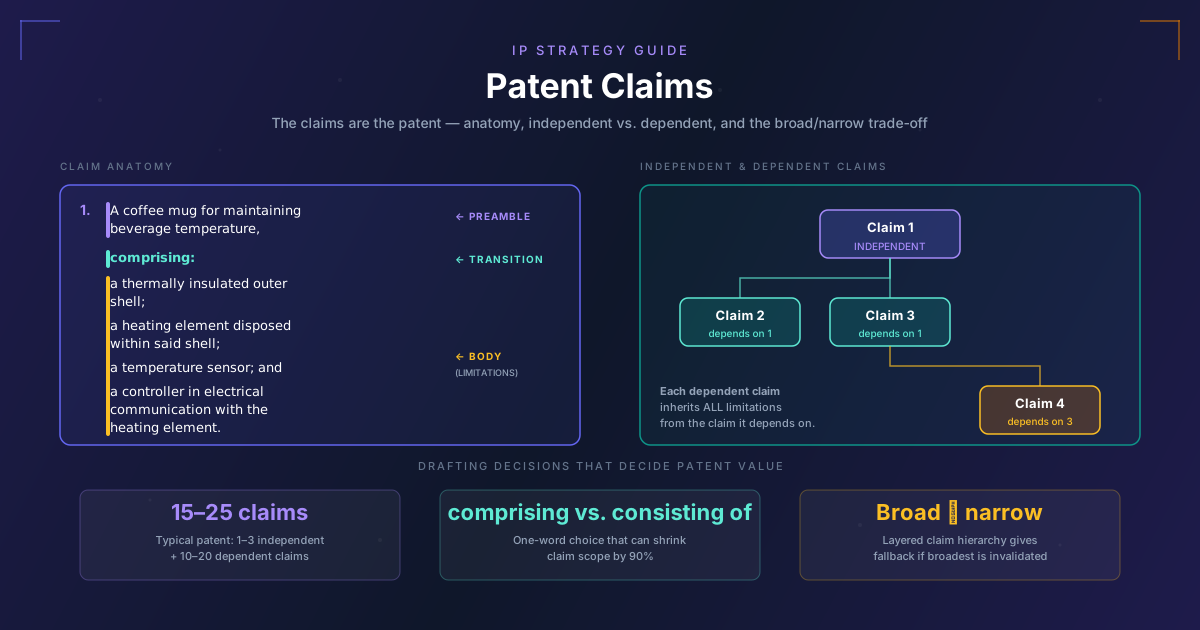
Key Takeaways
- Claims define what the patent legally protects. The specification supports the claims; only the claims are enforced in court.
- Every claim has three parts: preamble (what's being claimed), transitional phrase ("comprising" / "consisting of"), and body (the limitations that must all be present for infringement).
- A typical patent has 15–25 claims: 1–3 broad independent claims plus 10–20 narrower dependent claims that inherit limitations and serve as fallback positions.
- The strategic trade-off: broad claims catch more infringers but are easier to invalidate; narrow claims are easier to defend but easier to design around. Strong portfolios layer both.
- Five drafting mistakes invalidate patents: indefinite language, missing antecedent basis, picture claims only, single-step methods, and unclear means-plus-function claiming.
If you're about to convert a provisional, review claims your attorney drafted, or just understand what you actually own, start here.
Why Are Claims the Patent Itself?
The patent specification (the multi-page technical description of an invention with its drawings, embodiments, and background) is the supporting argument for the claims. It establishes that the inventor possessed the invention, enables others to practice it, and provides interpretive context. But the specification does not define what the patent owner can stop others from doing. Only the claims do.
This is set by 35 U.S.C. § 112(b): "The specification shall conclude with one or more claims particularly pointing out and distinctly claiming the subject matter which the inventor or a joint inventor regards as the invention."
Three consequences flow from this:
- Infringement is determined claim-by-claim. Each claim in a patent is a separate legal right. A defendant infringes a patent if they make, use, sell, or import something that meets every element of any single claim.
- Validity is determined claim-by-claim. A court can find some claims invalid while others remain valid. A weak claim doesn't drag the others down with it (though it does waste the patentee's litigation resources).
- Claim scope is everything. Broad claims cover more potential infringers but are more vulnerable to prior art. Narrow claims are easier to defend but easier to design around.
The shift in mindset that experienced patent practitioners have (and that first-time inventors usually lack) is that the specification is a means to claim breadth. Every detail in the specification exists either to enable a broader claim or to provide a fallback position if the broader claim falls.
What Is the Anatomy of a Patent Claim?
Every patent claim is a single grammatical sentence with three structural parts.
Part 1: The Preamble
The preamble introduces the type of thing being claimed and provides context. It typically begins with "A" or "An" followed by what's being claimed.
Examples:
- "A coffee mug for maintaining beverage temperature..."
- "A method of treating diabetes..."
- "A system for detecting anomalies in network traffic..."
The preamble identifies what category of invention the claim covers: apparatus (device, system, composition) or method (process, treatment). Whether the preamble's language is itself "limiting" (i.e., counts as a required feature for infringement) depends on context and case law, which is why thoughtful drafters write the preamble carefully.
Part 2: The Transitional Phrase
A single word or short phrase that connects the preamble to the body. The transition you choose determines whether the claim is "open" or "closed":
- "Comprising" — open. The claim covers things that include the listed elements plus anything else. This is the most common transition in modern claim drafting because it's the broadest.
- "Consisting of" — closed. The claim covers things that include only the listed elements and nothing more. Very narrow. Used selectively, often in chemistry.
- "Consisting essentially of" — semi-closed. The claim covers things that include the listed elements plus other elements that don't materially affect the basic characteristics of the invention. The intermediate option.
The choice of transitional phrase is one of the highest-stakes single-word decisions in claim drafting. Switching "comprising" to "consisting of" can shrink a claim's scope by 90%.
Part 3: The Body (Claim Limitations)
The body lists the features (called "limitations" or "elements") that define the invention. Each limitation must be present in an accused product or process for it to infringe.
Each limitation is typically introduced with "a" (when first mentioned) and "the" (when referenced again, providing "antecedent basis").
An Annotated Example: An Independent Claim
Here is a complete patent claim, annotated with its three structural parts:
1. A coffee mug for maintaining beverage temperature,            ← PREAMBLE
   comprising:                                                    ← TRANSITION
   a thermally insulated outer shell defining an interior         ← LIMITATION
       cavity;
   a heating element disposed within the interior cavity;         ← LIMITATION
   a temperature sensor configured to detect the temperature      ← LIMITATION
       of a beverage in the interior cavity; and
   a controller in electrical communication with the heating      ← LIMITATION
       element and the temperature sensor, the controller
       configured to activate the heating element when the
       detected temperature falls below a threshold value.
A few drafting notes about this claim:
- The preamble identifies the category (a coffee mug) and the purpose (maintaining beverage temperature). The "for maintaining beverage temperature" language may or may not be limiting depending on later interpretation.
- "Comprising" makes the claim open — a coffee mug with these features plus a Bluetooth radio and an LCD display still infringes.
- The body lists four limitations. To infringe this claim, an accused product must have all four. A coffee mug with insulation, heating, and a sensor but no controller doesn't infringe.
- Each limitation uses "a" the first time and "the" subsequently, establishing antecedent basis. "The detected temperature" in the controller limitation refers back to the temperature established in the sensor limitation.
- The claim is a single grammatical sentence with semicolons separating limitations.
A claim like this (one complete description that stands on its own) is called an independent claim.
What's the Difference Between Independent and Dependent Claims?
A patent typically has multiple claims, organized in a hierarchy.
Independent claims stand alone and define the invention's broadest scope. A patent usually has 1-3 independent claims.
Dependent claims reference an earlier claim and add additional limitations. They inherit every limitation of the claim they depend on, and then add more.
Continuing the coffee mug example:
1. A coffee mug for maintaining beverage temperature,            ← INDEPENDENT
   comprising: [as above]

2. The coffee mug of claim 1, wherein the heating element        ← DEPENDENT on 1
   comprises a resistive heating coil.

3. The coffee mug of claim 1, wherein the controller is          ← DEPENDENT on 1
   further configured to send a notification to a mobile
   device when the heating element activates.

4. The coffee mug of claim 3, further comprising a wireless      ← DEPENDENT on 3
   transceiver in electrical communication with the controller.
Claim 2 depends on claim 1, so it includes everything in claim 1 plus the requirement that the heating element be a resistive coil. To infringe claim 2, the accused product must satisfy all of claim 1 and have a resistive heating coil specifically.
Claim 3 also depends on claim 1, adding the notification-to-mobile feature. Claim 4 depends on claim 3 (not claim 1), so it inherits all of claim 1 and all of claim 3, then adds the wireless transceiver.
Why Dependent Claims Exist
If the independent claim is the broadest position, why include narrower dependent claims at all? Three reasons:
- Fallback positions. If the independent claim is invalidated by prior art (someone shows that thermally insulated coffee mugs with heating elements and controllers already existed), the dependent claims may survive. A patent with an invalidated claim 1 but a valid claim 2 still protects the resistive-coil version.
- Doctrine of equivalents arguments. Dependent claims help establish the patentee's understanding of which features are equivalent and which aren't, which matters when arguing about non-literal infringement.
- Examination strategy. During USPTO examination, the examiner may allow dependent claims while rejecting the broader independent claim. The patentee can then narrow the independent claim to match the allowable scope.
A well-drafted patent typically has 15-25 claims total: 1-3 independent claims (covering apparatus, method, and computer-readable medium variants of the same invention) plus 10-20 dependent claims that progressively narrow scope and add fallback positions.
How Broad Should Patent Claims Be?
The single most important strategic decision in claim drafting is how broad to make the independent claims. The trade-off:
| Approach | Strength | Weakness |
|---|---|---|
| Broad claims (few limitations, generic language) | Covers more potential infringers, including future products you can't anticipate | More vulnerable to invalidation by prior art; harder to convince the examiner to grant |
| Narrow claims (many limitations, specific language) | Easier to defend against invalidation challenges; faster to grant | Easier for competitors to design around; covers fewer potential infringers |
A common pattern that experienced practitioners use: file claims at multiple breadth levels. The broadest claim is aspirational — if it survives examination, it provides expansive protection. If it doesn't, the patentee narrows to the next-broadest claim that the prior art doesn't reach. The narrowest "picture claim" describes the specific commercial embodiment and is almost always granted.
Moderna's mRNA patent portfolio is often cited as an example of this strategy executed well. Across hundreds of patent families, Moderna filed claims ranging from broad compositional claims (modified nucleotides with specific functional properties) to narrow application claims (specific mRNA constructs encoding specific antigens for specific diseases). The breadth pyramid means that even where the broadest claims have been invalidated or narrowed, the narrower claims still cover specific commercial products.
For broader strategic context on layering an IP position, see our Patent to Product IP strategy playbook.
Apparatus, Method, and System Claims
Most inventions can be claimed in multiple categories. A well-drafted application often files claims in several categories for the same invention:
- Apparatus claims describe a physical device or composition: "A coffee mug comprising..."
- Method claims describe a process: "A method of maintaining beverage temperature, comprising the steps of..."
- System claims describe a combination of components, often distributed: "A system for monitoring beverage temperature, comprising a mug, a mobile device, and a server..."
- Computer-readable medium claims (Beauregard claims) describe software embodied in a storage medium: "A non-transitory computer-readable storage medium storing instructions that, when executed by a processor, cause the processor to..."
Filing across multiple claim categories matters because different categories catch different infringers. An apparatus claim catches whoever makes or sells the device. A method claim catches whoever uses the device or performs the steps. A computer-readable medium claim catches whoever distributes the software that performs the method. A coffee mug company that only filed apparatus claims might find that a software vendor providing the temperature-control app is not an infringer because the software vendor doesn't make the mug.
For software inventions in particular, claiming the same innovation as both a method and a computer-readable medium catches different infringement scenarios (the customer running the software vs. the vendor distributing it).
What Drafting Mistakes Invalidate Patent Claims?
After reviewing thousands of patent claims, five drafting failures account for the majority of invalidated or unenforceable patents.
Mistake 1: Indefinite Language
Claims must "particularly point out and distinctly claim" the invention (35 U.S.C. § 112(b)). Language that is reasonably understood by a person skilled in the art is fine; language that is meaningfully ambiguous is fatal.
Common offenders:
- "Substantially" — sometimes acceptable, often challenged
- "About" — acceptable for numerical ranges if a person skilled in the art would understand the scope
- "Approximately" — similar to "about"
- Subjective terms ("user-friendly," "high-quality," "efficient")
- Relative terms without a baseline ("strong," "thick," "fast")
The fix: use specific numeric ranges where possible, define terms in the specification, and reference industry-standard measurements.
Mistake 2: Missing Antecedent Basis
When a claim references "the heating element," there must be an earlier "a heating element" that introduced the term. Skipping the introduction creates a "lacks antecedent basis" rejection during examination, or an indefiniteness challenge during litigation.
The fix: every "the X" must trace back to a "a X" earlier in the same claim or in the claim it depends on.
Mistake 3: Picture Claims Only
A "picture claim" describes only the specific embodiment shown in the patent's drawings — every feature, in the specific configuration depicted. Picture claims are easy to draft and easy to grant, but trivially easy to design around. A competitor changes one feature and no longer infringes.
The fix: file claims at multiple levels of generality. The picture claim is the narrowest fallback, not the only claim.
Mistake 4: Single-Method-Step Claims
A method claim that recites only a single step ("A method comprising: detecting a temperature") is usually too broad and gets rejected, or if granted, is easily invalidated. Strong method claims typically recite 3-7 steps that together define the novel process.
The fix: claim the full sequence of steps that constitutes the invention, not just the most novel one.
Mistake 5: Functional Claiming Without Structural Support
A claim limitation that recites only what something does ("means for heating") without describing how it does it can trigger a "means-plus-function" interpretation under 35 U.S.C. § 112(f), which narrows the claim to the specific structure disclosed in the specification (plus equivalents).
The fix: use functional language deliberately when you want broad coverage, and use structural language when you want predictable scope. Either is acceptable; mixing them carelessly is not.
How Claims Connect to Commercialization Strategy
Strong claims protect a commercial product. Weak claims protect words on a page. The connection between the two requires the inventor (or company) to know exactly what the commercial product will look like before the non-provisional is filed — and to draft claims that track the commercial product's features specifically while preserving broader fallback positions.
This is why the most expensive moment to be unsure about commercial direction is at non-provisional drafting time. A founder who doesn't know whether the product will be sold as hardware, software, or a service is going to file claims that cover one and miss the others. A TTO that hasn't talked to potential licensees doesn't know which embodiments matter for licensing.
The disciplined approach: complete enough customer discovery before non-provisional filing to know which commercial directions are real, then file claims that track those directions. This is the same logic that drives provisional patent timing and the prior art search before filing — IP strategy should follow commercialization strategy, not lead it.
Frequently Asked Questions
How many claims should a patent have?
A typical issued patent has 15-25 claims: 1-3 independent claims plus 10-20 dependent claims. Patents with fewer claims often have inadequate fallback positions; patents with substantially more claims may indicate the inventor was unsure which scope would be allowable. USPTO fees increase above 20 total claims and above 3 independent claims, which incentivizes a reasonable claim count.
What is the difference between a claim and a specification?
The specification is the multi-page technical description of an invention, including drawings, embodiments, and background. The claims are the numbered sentences at the end that define the legal scope of protection. The specification supports the claims; the claims are what the patent actually protects.
Can I write my own patent claims?
Yes, but it's the highest-risk DIY activity in patent practice. Claim drafting is genuinely difficult , even patent attorneys spend years developing the skill. Pro se inventors who draft their own claims often produce claims that are technically descriptive but legally weak. For provisional applications the risk is lower because provisional claims aren't strictly required; for non-provisional applications, engaging an attorney or agent is usually worth the cost.
What is a means-plus-function claim?
A means-plus-function claim limitation (governed by 35 U.S.C. § 112(f)) recites a function rather than a structure: "means for heating" rather than "a resistive heating coil." Such claims are interpreted as covering only the specific structures disclosed in the specification, plus equivalents. They can broaden or narrow scope depending on the specification's disclosure.
What is claim differentiation?
Claim differentiation is a presumption that different claims have different scope. If claim 2 adds a limitation to claim 1, then claim 1 is presumed not to require that limitation. This presumption can be overcome by other evidence, but it's an important tool for arguing the breadth of independent claims.
What is a Markush claim?
A Markush claim is a special claim format used primarily in chemistry that recites a list of alternatives: "wherein the active ingredient is selected from the group consisting of A, B, C, and D." It allows one claim to cover multiple specific embodiments without filing a separate claim for each.
How does claim breadth affect patent value?
Broader claims generally produce more valuable patents because they cover more potential infringers and future products. However, broader claims are also more vulnerable to invalidation, harder to enforce, and more expensive to defend. The most valuable patents typically have a layered claim structure with broad claims for offensive use and narrower claims for defensive fallback.
Ready to Tie Your IP Strategy to Your Commercial Strategy?
Strong patent claims protect commercial products that customers actually want. The work of figuring out what those products are (and which features matter for the commercial market) is the same work that determines whether a patent is worth filing at all.
Commercify builds the market sizing, competitive analysis, and customer discovery synthesis that helps you decide which features to claim, which embodiments to file, and which directions are worth a patent in the first place.
Start your commercialization strategy with Commercify →
Read next: How to Conduct a Prior Art Search · Provisional Patent Application: The Founder's Guide · Patent to Product: The IP Strategy Playbook