Provisional Patent Application: The Founder's Guide

Provisional Patent Application: The Founder's Guide to Filing, Converting, and Using It Strategically
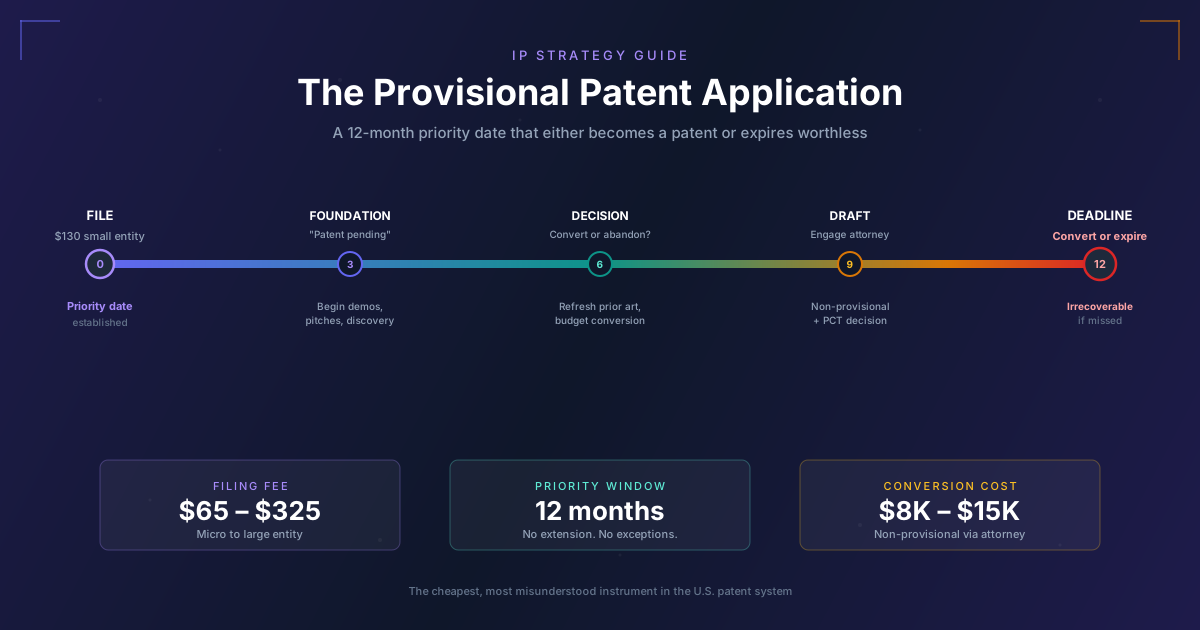
A provisional patent application is a low-cost placeholder filing that secures a 12-month priority date and lets you mark an invention "patent pending." It is not a patent and grants no enforceable rights on its own. If you do not convert it to a non-provisional within 12 months, it expires and the disclosure can fall into the public domain. File one when you need to lock in a priority date quickly or to buy time to validate commercial potential before committing to the full cost of a non-provisional.
A provisional patent application is the cheapest, most misunderstood instrument in the U.S. patent system.
It costs as little as $65 to file. It buys you a 12-month priority date. It lets you say "patent pending" on your pitch deck. And it gives you exactly one window (that expires in 12 months) to either commit real money to a non-provisional filing or let your idea fall into the public domain.
Most founders file a provisional thinking it's a patent. It isn't. Most TTOs file provisionals to preserve optionality without understanding the conversion economics. Most attorneys charge $3,500 for a provisional that the founder could have drafted as a stronger document themselves with two days of focused work.
This guide is for the researcher, tech transfer officer, or founder who needs to understand what a provisional patent application actually does, when to file one, what it costs, how to file it, and (most importantly) how to use the 12-month window strategically.
Key Takeaways
- A provisional patent application establishes a 12-month priority date for $65–$325 in USPTO fees plus optional attorney time. It does not produce an enforceable patent.
- File before any public disclosure (paper publication, conference talk, public demo) if you want international patent rights. Most countries don't have the U.S. 1-year grace period.
- The 12-month conversion deadline is irrecoverable. A missed deadline kills the priority date and any intervening public disclosure becomes prior art.
- A "convertible" provisional drafted at non-provisional quality usually costs less total than the cheap-provisional / expensive-conversion pattern.
- The right question isn't "should I file a provisional?" — it's "does the next 24 months of commercialization need patent-pending optionality?"
If you're staring at a disclosure form, a customer demo coming up next month, or a paper that's about to be published, this is the article you need before you do anything else.
What Is a Provisional Patent Application?
A provisional patent application is a placeholder filing with the U.S. Patent and Trademark Office (USPTO) that establishes an early filing date for an invention. It is governed by 35 U.S.C. § 111(b) and was introduced in 1995 to give U.S. inventors a low-cost first step on par with the first-to-file systems used in other countries.
Here's what it does:
- Establishes a priority date. Whatever you disclose in the provisional becomes prior art against anyone filing a similar invention after that date.
- Lets you claim "patent pending." Legally accurate marking that you can put on products, pitch decks, and websites.
- Gives you 12 months. From the filing date, you have exactly one year to file a non-provisional (or PCT international) application that claims priority to the provisional.
- Is never examined. USPTO never reads the document on its merits. It sits in a drawer until you either convert it or abandon it.
- Is never published. Unless you convert and the resulting non-provisional publishes, the provisional itself stays confidential , even after it expires.
Here's what it does not do:
- It is not a patent. You cannot enforce a provisional against an infringer. You have no exclusive rights until (and unless) a non-provisional is examined and issued.
- It does not require claims. Unlike a non-provisional, a provisional has no formal claim requirement (though strong provisionals include claim-like language — more on this below).
- It is not automatic. A provisional that's filed and then ignored expires worthless at month 13. Most provisionals never get converted.
- It does not protect anything you didn't disclose. If your provisional describes a chemistry approach and your non-provisional adds an entirely new mechanical embodiment, the mechanical part won't get the provisional's priority date.
That last point is the single biggest source of expensive surprises in U.S. patent practice. A thin provisional doesn't protect the invention; it protects the words on the page.
When Should You File a Provisional Patent Application?
There are five concrete decision triggers that should send you to the USPTO portal in the next 30 days.
Trigger 1: Public Disclosure Within 12 Months
U.S. law gives inventors a 1-year grace period under 35 U.S.C. § 102(b) after a public disclosure (publication, conference talk, public demo, sale offer) to file a patent application. Most other countries don't. If you've already disclosed publicly or are about to, file a provisional before the disclosure if at all possible. International rights die instantly with most public disclosures unless you filed first.
If you're a researcher whose paper goes live in three weeks, this is the most common path: provisional first, paper second, conversion within 12 months with international filings (PCT) preserved.
Trigger 2: First Customer Demo or Investor Pitch
Showing a working prototype to an investor under NDA is a gray area; showing it at a public demo day or without NDA is a clear public disclosure under U.S. law and can be a bar to international patentability. If you have a customer demo or pitch coming up in the next 60 days, file a provisional first.
Trigger 3: Conference, Trade Show, or Publication
Same principle. Academic conferences and trade show demos both qualify as public disclosures in most jurisdictions. The provisional preserves your filing date before the disclosure.
Trigger 4: Fundraising Round About to Close
Investors don't fund unprotected technology. A provisional is the minimum credibility signal that your IP position is being managed. "Patent pending" on your pitch deck is materially different from "no patent activity."
Trigger 5: Competitor About to File
If you have any signal that a competitor is working on the same problem (patent literature searches showing recent filings, conference abstracts, hiring patterns), a provisional locks in your priority date cheaply. The U.S. is now a first-inventor-to-file system; the first to file wins ties.
If none of these triggers applies, you may not need a provisional yet. Founders sometimes file a provisional just to feel like they're protecting something. That feeling costs money you may need 11 months from now to convert.
How Much Does a Provisional Patent Application Cost in 2026?
The cost is in two layers: USPTO fees, which are fixed and trivial, and attorney fees, which are large and optional.
USPTO Fees (Filing Fees)
| Entity status | Provisional filing fee | Who qualifies |
|---|---|---|
| Micro entity | $65 | Inventor with <$X gross income (current micro thresholds), limited prior filings |
| Small entity | $130 | Most startups, individuals, universities, small businesses (<500 employees) |
| Undiscounted | $325 | Large companies |
These are the only mandatory fees. The USPTO does not charge anything else to receive a provisional. If you DIY-file as a small entity, your total cash outlay is $130.
(Fee amounts are periodically adjusted by the USPTO. Confirm current figures at uspto.gov before filing.)
Attorney / Agent Fees (Optional but Common)
| Approach | Typical cost | When to choose it |
|---|---|---|
| DIY filing | $0 | Simple inventions you can describe in plain English; you have the technical writing skill |
| Patent agent (drafting only) | $1,500 – $3,000 | You want a professional draft but want to save vs. an attorney |
| Patent attorney (full drafting) | $2,500 – $5,500 | Complex inventions, software, chemistry, mechanical with many embodiments |
| Patent attorney (premium / "convertible" provisional) | $5,000 – $10,000 | Provisional drafted to non-provisional quality so conversion is trivial |
The "convertible provisional" tier is worth understanding. A premium provisional is essentially a non-provisional document filed as a provisional. The conversion at month 12 costs almost nothing extra in legal fees because the document is already written. The "cheap provisional + expensive conversion" pattern usually costs more total than the "expensive provisional + cheap conversion" pattern, and produces weaker rights.
Total 12-Month Path Costs
Most founders should budget for the full path (provisional + conversion to non-provisional), not just the provisional in isolation:
| Path | Provisional | Non-provisional conversion | 12-month total |
|---|---|---|---|
| DIY both ends | $130 | $400 – $800 USPTO fees | $530 – $930 |
| DIY provisional, attorney non-provisional | $130 | $8,000 – $15,000 | $8,130 – $15,130 |
| Attorney provisional + attorney conversion | $3,500 | $5,000 – $10,000 | $8,500 – $13,500 |
| Premium provisional (convertible) | $7,000 | $2,000 – $4,000 | $9,000 – $11,000 |
The DIY-both path is genuinely viable for simple inventions but failure-prone for biotech, complex software, and anything with significant prior art density.
For broader budgeting context across the full IP lifecycle, see our Patent to Product IP strategy playbook.
How Do You File a Provisional Patent Application?
A complete provisional requires four documents (or three documents and one form):
- Specification. A written description of the invention that satisfies 35 U.S.C. § 112's enablement and written description requirements.
- Drawings. Whenever they aid understanding of the invention. Most provisionals should include them.
- Cover Sheet (Form SB/16) or Application Data Sheet (ADS). Identifies inventors, title, correspondence address, and entity status.
- Filing fee. Paid through Patent Center.
Here's how to do it.
Step 1: Write the Specification
The specification should describe the invention with enough technical detail that a person of ordinary skill in your field could practice it without undue experimentation. The non-negotiable structural elements are:
- Title of the invention. Short, descriptive, not marketing language.
- Background. The technical problem and limitations of existing solutions. Keep this short — it can be used against you later as admitted prior art.
- Brief summary. A few sentences capturing what the invention does and why it's different.
- Brief description of the drawings. One sentence per figure.
- Detailed description. The bulk of the document. Walk through every embodiment of the invention in technical detail. Use clear, specific language. Include alternatives ("the polymer may be selected from A, B, or C") to broaden coverage.
- Claim-like sentences (optional but strongly recommended). Even though provisionals don't require formal claims, drafting numbered claim-like sentences forces you to articulate what you actually invented and creates a defensible bridge to the non-provisional. Skipping this is one of the most common provisional mistakes.
Length matters less than completeness. A 6-page provisional that describes every embodiment is worth more than a 40-page provisional that describes one.
Step 2: Prepare Drawings
Provisional drawings don't have to meet the strict USPTO drawing rules that apply to non-provisionals (no shading restrictions, no margin formalities). They do need to be legible and adequately describe the invention. For software inventions, include flowcharts. For mechanical, include exploded views and cross-sections. For chemistry, include structural diagrams and reaction schemes.
Black-and-white line drawings are standard. Color and grayscale are accepted but generate a request for clarification more often.
Step 3: Conduct a Prior Art Search
Before filing, search for prior art that might block your invention. This isn't legally required for a provisional, but discovering blocking prior art after spending $10K on a non-provisional is the most expensive way to learn. A patent search through Google Patents, USPTO PatFT, and Espacenet takes 4-8 hours of focused work and is worth it.
Our prior art search guide walks through the seven-step method most professional searchers use.
Step 4: File via Patent Center
The USPTO's Patent Center (the successor to EFS-Web and PAIR) is the filing portal. The flow:
- Register or log in with a USPTO.gov account
- Select "New Submission" → "Provisional"
- Upload your specification as PDF
- Upload your drawings as PDF
- Fill in the Application Data Sheet (ADS) — inventor names, addresses, citizenship, entity status
- Pay the fee with credit card, EFT, or deposit account
- Submit and receive the filing receipt
The filing receipt (with your application number in 62/XXX,XXX format and filing date) arrives within minutes. Save it. The filing date is the entire value of what you just bought.
Step 5: Set the 12-Month Calendar Reminder
This is the single most important step after filing. Set three calendar reminders:
- Month 6 reminder: Decision checkpoint. Do you have the budget and intent to convert? If not, start raising or accept abandonment.
- Month 10 reminder: Begin non-provisional drafting if you haven't already. Most attorneys want 6-8 weeks lead time.
- Month 11.5 reminder: Conversion deadline approaches.
A missed 12-month deadline is irrecoverable. The provisional dies, the priority date dies with it, and any intervening public disclosure becomes prior art against any future filing.
The 12-Month Conversion Clock
The 12 months between provisional filing and conversion is the most important year in a startup's IP timeline. Here's what should happen during it.
Month 1-3: Foundation
- Confirm filing receipt is accurate (inventor names spelled correctly, entity status correct)
- Document any additional embodiments, improvements, or commercial details as you develop them
- Begin or continue commercialization activities (customer discovery, demos, pitch meetings) now safely under "patent pending"
Month 3-6: Decision Information
- Conduct or update prior art search with results from the past 6 months
- If commercialization is progressing: budget conversion costs and start lining up attorney engagement
- If commercialization is stalling: ask honestly whether continuing the IP spend is worth it
Month 6-9: Conversion Planning
- Decide on filing strategy: U.S. non-provisional only, or PCT (international) to preserve foreign rights for 18 more months
- Engage attorney if not already engaged
- Begin drafting non-provisional claims based on commercial direction
Month 9-12: Execution
- Attorney drafts non-provisional or PCT application
- Review and refine claims to cover commercial product and likely workarounds
- File before the 12-month deadline — most attorneys aim for month 11 to leave margin
- After conversion, the provisional is "consumed" — its priority date attaches to the non-provisional, but the provisional document itself can never be revived
The PCT (Patent Cooperation Treaty) route deserves a brief note. Filing a PCT application within 12 months of the provisional preserves the option to file in 150+ countries for an additional 18-30 months. PCT filing costs $3K-$5K and is often worth it for any technology with international commercial potential. It does not produce an enforceable patent anywhere; it preserves the right to file enforceable patents in member countries later.
What Are the Most Expensive Mistakes Founders Make?
After reviewing hundreds of provisional filings across university and startup contexts, four mistakes account for the majority of expensive failures.
Mistake 1: The "Just-File-Something" Provisional
A provisional filed in 30 minutes with two paragraphs of description and no drawings is technically a filing. It is rarely a useful one. If the disclosure doesn't enable a person skilled in the art to practice the invention, the non-provisional won't get the provisional's priority date for whatever's missing. Courts have invalidated patents because the provisional was too thin to support the non-provisional's claims.
The fix: treat the provisional as a real engineering disclosure document, even if you're DIY-filing. If your description couldn't be handed to a competent engineer or scientist with instructions to build the invention, it's not enough.
Mistake 2: Adding New Matter at Conversion
If your non-provisional describes embodiments, features, or claim scope that wasn't in the provisional, that "new matter" gets the non-provisional's filing date, not the provisional's. Any public disclosure in the interim becomes prior art against that new matter.
The fix: include broad alternatives, edge cases, and aspirational embodiments in the provisional itself. Don't hold things back for the non-provisional.
Mistake 3: Forgetting the 12-Month Deadline
A provisional that expires unconverted is irrecoverable. There is no grace period, no extension, no excuse the USPTO will accept. The deadline is the exact calendar day, twelve months after the filing date.
The fix: calendar reminders at multiple intervals, and a named human responsible for the deadline.
Mistake 4: Filing Too Late
A provisional filed after a public disclosure may preserve U.S. rights (under the 1-year grace period) but kills international rights in most jurisdictions. If international protection matters, the provisional must be filed before any public disclosure.
The fix: file the provisional even when the disclosure is one week away. A 7-day-old priority date is materially different from no priority date.
Why Filing Decisions Should Connect to Commercialization Strategy
A provisional patent application is a strategic choice, not a technical formality. The right question isn't "should I file a provisional?" — it's "what does my commercialization path look like in the next 24 months, and does a provisional create the optionality I need?"
If your commercialization path requires investor capital, the answer is almost always yes, because "patent pending" materially affects fundraising. If your path requires partnership with an incumbent, the answer is yes, since incumbents won't engage seriously without an IP position. If your path is open-source release or pure consulting services, the answer may be no.
This is the framing university tech transfer offices use when deciding which inventions to file on. It's the framing experienced founders use when deciding which inventions to disclose externally. And it's the framing Commercify is built around: the commercialization plan informs the IP strategy, not the other way around.
For more on building this commercialization-first framing, see Stop Falling in Love with Your IP and the Patent to Product IP strategy playbook.
For university researchers and TTOs navigating this decision specifically within the Bayh-Dole framework, our Bayh-Dole Act guide covers the federal funding obligations that constrain (and sometimes require) provisional filings.
Frequently Asked Questions
How long does a provisional patent application last?
Exactly 12 months from the filing date. It cannot be extended, renewed, or revived. At month 13 it expires permanently. To preserve the priority date you must file a non-provisional or PCT application claiming priority to the provisional before the 12-month deadline.
Can I file multiple provisionals on the same invention?
Yes. Many founders file an initial provisional, then file additional provisionals during the 12 months as the invention develops, then convert all of them into a single non-provisional that claims priority to multiple provisionals. Each provisional preserves the priority date for whatever it discloses.
Does a provisional patent application get published?
No. Provisionals are confidential and never published unless they are converted into a non-provisional that publishes (or unless the filer specifically requests publication). An abandoned provisional remains confidential.
Can I say "patent pending" with just a provisional?
Yes. As long as the provisional is on file and has not expired, "patent pending" is legally accurate marking. Once the provisional expires without conversion, you must stop using "patent pending" or face false-marking liability.
What is the difference between a provisional and a non-provisional patent?
A non-provisional is a full patent application that the USPTO examines and can issue as a patent. A provisional is a 12-month placeholder that establishes a priority date but is never examined and cannot issue as a patent. See our provisional vs non-provisional patent guide for a full comparison.
Do I need an attorney to file a provisional patent application?
No. The USPTO accepts pro se (self-filed) provisional applications. Whether you should file pro se depends on the complexity of the invention, your technical writing ability, and the consequences of a thin filing. Simple inventions in fields you know well are reasonable DIY candidates. Software, biotech, and chemistry are typically not.
What happens if I miss the 12-month deadline?
The provisional expires permanently. The priority date is lost. Any intervening public disclosures become prior art against any future filing. There is no extension mechanism. This is the most expensive mistake in U.S. patent practice.
Ready to Make Your IP Strategy Match Your Commercialization Plan?
A provisional patent application is most valuable when it's part of a coherent commercialization strategy , not a reflex. Use Commercify to build the market analysis, competitive landscape, and customer discovery work that determines whether and how to file, convert, or expand your IP position.
Start your commercialization strategy with Commercify →
Read next: How to Conduct a Prior Art Search Before You File · Patent to Product: The IP Strategy Playbook · The Bayh-Dole Act Explained