Stop Falling in Love with Your IP

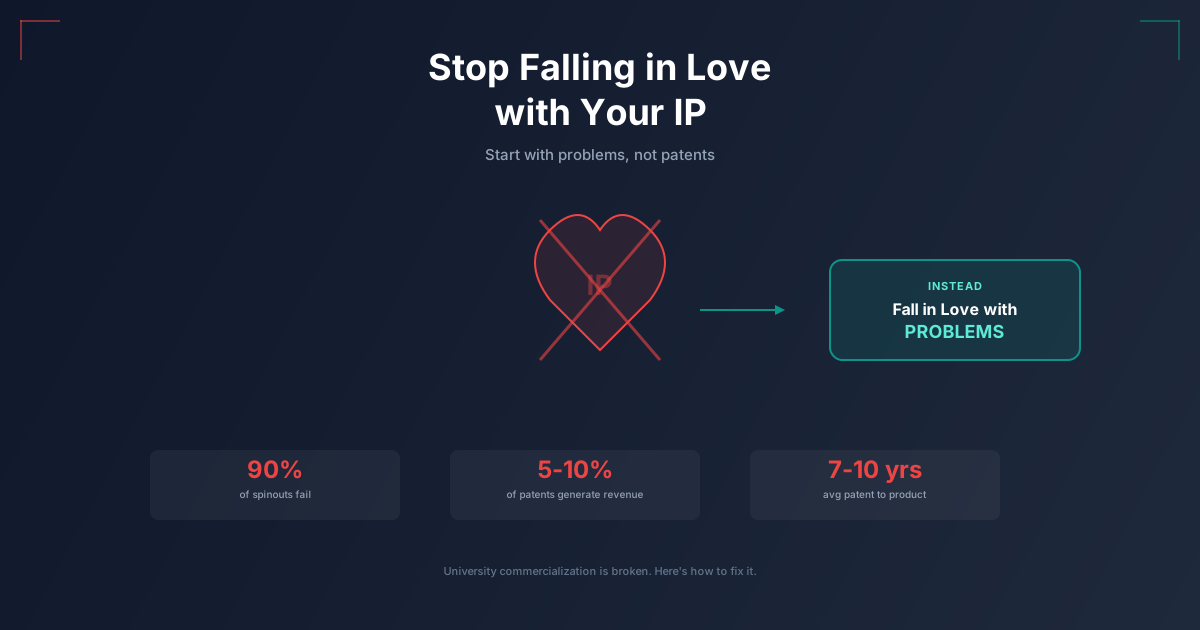
Founders should not fall in love with their IP because IP-first commercialization builds solutions nobody wants: 90% of university spinouts fail, only 5-10% of patents generate meaningful revenue, and the path from patent to product runs 7-10 years if it happens at all. Instead, fall in love with the problem. Validate that a real, painful, paid problem exists through customer discovery, then build the solution and protect it strategically. Startups that validate problems first see 3x higher success rates.
You've spent years perfecting your research. Your innovation could change the world. You've filed the patents, protected the IP, and now you're ready to commercialize.
But here's the brutal truth: 90% of university spinouts fail. Only 5-10% of university patents generate meaningful revenue. The average time from patent to product? 7-10 years—if it ever happens at all.
Why? Because we're building solutions nobody wants.
After analyzing 500+ university commercialization projects and working with dozens of tech transfer offices, I've seen the same pattern over and over: brilliant research, protected IP, and zero market traction. The problem isn't the technology. The problem is that we're falling in love with our IP instead of falling in love with problems.
The $50 Million Mistake
Let me tell you about a university I worked with that developed a revolutionary new polymer material. It was stronger, lighter, and more durable than anything on the market. The research was published in top journals. They filed multiple patents. They spent $2 million developing the technology and another $500K on IP protection.
Three years later, they had zero commercial interest. The patents expired. The technology sits unused.
What went wrong? They never validated that anyone actually needed this material. They assumed that because the technology was better, the market would want it. They built a solution looking for a problem.
This isn't an isolated case. It's the norm.
The IP-First Trap: How Universities Commercialize Today
The Traditional Flow
Here's how university commercialization typically works:
- Research breakthrough → Exciting new technology discovered
- Patent filing → Protect the IP immediately
- Tech transfer office → "Now let's find a market"
- Licensing attempts → Pitch to companies who might want it
- Market search → Try to find someone who needs this solution
The fundamental assumption: "If we built it, they will come."
But here's what actually happens:
- Companies say "That's interesting, but we don't have that problem"
- Investors ask "Who needs this?" and you don't have a clear answer
- The market doesn't materialize because you never validated it existed
- Years pass, patents expire, and the technology goes unused
Why This Happens: The Incentive Mismatch
The IP-first approach persists because of how universities are structured:
Academic Incentives:
- Researchers are rewarded for publications and patents
- Career advancement depends on IP generation
- Grant funding rewards research, not market validation
Tech Transfer Office Pressure:
- Need to show IP portfolio value to university leadership
- Metrics focus on patents filed, not problems solved
- Licensing deals signed, not products launched
Cultural Mismatch:
- Academic culture values thoroughness and perfection
- Entrepreneurial culture values speed and iteration
- Research timelines: years. Market validation: weeks.
The Result: We optimize for IP generation instead of market impact.
The Cost of IP-First Thinking
The statistics are sobering:
- 90% of university spinouts fail (vs. 70% of all startups)
- Only 5-10% of university patents generate revenue
- Average time from patent to product: 7-10 years (if ever)
- $2-5 million average cost to get a university technology to market
But the real cost isn't just the failures. It's the opportunity cost:
- Resources spent on IP that never finds a market
- Researcher time wasted on solutions nobody wants
- Reputation damage from failed spinouts
- Investor skepticism: "Another university solution looking for a problem"
The Problem-First Alternative
What Problem-First Really Means
The traditional approach: Solution → Problem → Market
The problem-first approach: Problem → Market → Solution
The core principle: "Fall in love with the problem, not your solution. Your solution will change, but the problem won't."
The Validation Loop
Here's how problem-first commercialization works:
- Discover the problem → Customer interviews, not patent searches
- Validate the problem → Quantify pain, frequency, cost
- Validate willingness to pay → Will customers pay to solve this?
- THEN build the solution → Now you know what to build
- THEN protect the IP → Strategic protection of validated solutions
Why Problem-First Works
Market Pull vs. Technology Push:
- Technology push: "We have this cool tech, who wants it?"
- Market pull: "They have this problem, how do we solve it?"
The evidence is clear:
- Startups that validate problems first have 3x higher success rates
- Products built for validated problems have 70% lower market risk
- Customer-funded development (pre-orders) validates both problem and solution
Real Examples: The Power of Problem-First
Example 1: Moderna's COVID-19 Vaccine
Moderna had mRNA technology for years. But it was the problem (global pandemic) that drove the solution. The technology existed, but the validated problem created the market pull.
Lesson: Even breakthrough IP needs a validated problem.
Example 2: The University Spinout That Pivoted
A university developed novel sensor technology. Their initial approach: "Who needs better sensors?" They spent 18 months trying to find a market.
Then they pivoted. They started interviewing potential customers and discovered a specific problem in medical device sterilization that their technology could solve. They refocused, raised $5M, and successfully exited.
Lesson: The technology was good, but the problem validation saved the company.
Example 3: The Researcher Who Interviewed First
Dr. Sarah Chen had breakthrough diagnostic technology. Before filing patents, she interviewed 50 potential customers. She discovered the real problem wasn't what she thought—it was workflow integration, not just accuracy.
She pivoted her technology application, raised $5M, and launched successfully. Her IP was stronger because it protected a validated solution.
Lesson: Problem validation before IP protection creates stronger, more valuable patents.
The Problem-First Framework for Universities
Stage 1: Problem Discovery (Before Patent Filing)
The Process:
Conduct 20-30 problem discovery interviews with people who might have the problem (not people who might want your solution).
Key Questions:
- "Tell me about your current process for [relevant area]"
- "What's the most frustrating part?"
- "How often does this problem occur?"
- "What does this problem cost you? (time, money, quality)"
- "What have you tried to solve this?"
- "If you could solve this problem, what would that be worth to you?"
The Rules:
- Ask open-ended questions
- Focus on behaviors, not opinions
- Dig into specifics
- Avoid leading questions
- Don't mention your solution until the end
The Output:
- Top 3-5 validated problems
- Quantified pain (frequency, severity, cost)
- Willingness to pay signals
Red Flags:
- "That's interesting, but..." (not a real problem)
- "Maybe in the future..." (not urgent)
- "We'd consider it..." (not willing to pay)
Stage 2: Problem Validation (Before Building)
The Metrics:
- Problem confirmation rate: ≥60% of interviewees confirm the problem
- Pain severity: Problem described as "painful" or "critical"
- Frequency: Problem occurs regularly (not one-off)
- Cost: Problem has measurable financial impact
- Willingness to pay: ≥40% express willingness to pay
The Validation Questions:
- Does the problem exist? (Yes/No)
- Is it painful enough? (Severity scale)
- Does it happen often? (Frequency)
- What does it cost? (Quantified impact)
- Will they pay to solve it? (Purchase intent)
The Decision Point:
- If problem validation fails → Don't build, don't file patents (yet)
- If problem validation succeeds → Proceed to solution validation
Stage 3: Solution Validation (Before Full Development)
The Process:
Present your solution concept (mockups, descriptions, prototypes) to problem-validated customers. Test purchase intent and feature preferences.
The Metrics:
- Purchase intent: ≥40% say "I would definitely buy this"
- Feature validation: Must-have vs. nice-to-have features
- Use case clarity: Can customers articulate specific use cases?
The Tools:
- Landing pages: Measure sign-ups and interest
- Mockups/prototypes: Gauge interest before building
- Wizard of Oz: Manual service behind automated interface
- Concierge MVP: Provide service manually to validate demand
The Output:
- Validated solution concept
- Feature priorities
- Pricing signals
- Use case clarity
Stage 4: Market Validation (Before Scaling)
The Process:
Calculate TAM, SAM, SOM. Validate market size assumptions. Assess competitive landscape. Test pricing models.
The Metrics:
- Serviceable Obtainable Market (SOM): ≥$10M within 5 years
- Competitive differentiation: Clear advantage
- Pricing validation: Customers willing to pay target price
The Output:
- Validated market size
- Competitive positioning
- Pricing strategy
- Go/no-go decision
Stage 5: IP Protection (After Validation)
The New Timing:
- Traditional: Patent first, validate later
- Problem-First: Validate first, patent strategically
When to File:
- After problem validation (you know the problem exists)
- After solution validation (you know the solution works)
- Before full market entry (protect competitive advantage)
What to Protect:
- The validated solution (not just the research)
- The problem-solution fit (unique approach)
- The market application (not just the technology)
The Strategic Advantage:
IP that protects a validated solution is more valuable than IP that protects unvalidated research. You're not just protecting technology—you're protecting a proven market position.
How to Shift University Culture
For Researchers: Start with Customer Discovery
The Mindset Shift:
- From: "My research is valuable because it's novel"
- To: "My research is valuable if it solves a real problem"
The Action Plan:
- Before writing grant proposals: Interview 10 potential customers
- Before filing patents: Validate the problem exists
- Before building: Test solution concept with customers
- Throughout research: Keep problem validation loop running
The Tools:
- Customer interview templates
- Problem validation frameworks
- Solution testing methods (landing pages, mockups)
The Benefits:
- Higher commercialization success rates
- Stronger IP (protects validated solutions)
- Faster time to market
- Better investor reception
For Tech Transfer Offices: Add Problem Validation to the Process
The New Commercialization Checklist:
- Problem discovery (20-30 interviews)
- Problem validation (≥60% confirmation rate)
- Solution validation (≥40% purchase intent)
- Market validation (SOM ≥$10M)
- THEN: IP protection strategy
- THEN: Business model development
- THEN: Go-to-market planning
The Metrics to Track:
- Problems validated (not just patents filed)
- Solutions tested (not just IP licensed)
- Markets validated (not just deals signed)
- Products launched (not just spinouts created)
The Incentive Shift:
- Reward problem validation alongside IP generation
- Track "problems solved" alongside "patents filed"
- Celebrate market validation as much as research breakthroughs
The Process Change:
Add problem validation as a required step before major IP investment. Make it part of the commercialization review process, not an optional add-on.
For Universities: Reward Problem Discovery
The Policy Changes:
- Add problem validation to tenure/promotion criteria
- Fund market discovery alongside research
- Create "problem validation grants" (small, fast, focused)
- Measure commercialization success by market impact, not IP metrics
The Culture Shift:
- Celebrate researchers who validate problems
- Share stories of problem-first successes
- Train researchers in customer discovery
- Connect researchers with industry early (not just at licensing stage)
The Measurement Change:
- Track "problems solved" alongside "patents filed"
- Measure market impact, not just IP portfolio value
- Celebrate products launched, not just deals signed
For Investors: Ask "What Problem?" First
The New Due Diligence:
- First question: "What problem does this solve?"
- Second question: "How do you know the problem exists?"
- Third question: "Who has this problem and will they pay?"
- Fourth question: "What's your IP strategy?" (not first question)
The Red Flags:
- "We have a patent, now we need to find a market" → Run
- "The technology is so cool, someone will want it" → Run
- "We haven't talked to customers yet, but..." → Run
The Green Flags:
- "We interviewed 30 customers and 70% confirmed the problem" → Interest
- "We have 5 customers who pre-ordered" → Strong interest
- "The problem costs them $X per year, and they'll pay $Y to solve it" → Very interested
The Practical Toolkit
Problem Discovery Interview Guide
The Questions:
- "Tell me about your current process for [relevant area]"
- "What's the most frustrating part?"
- "How often does this problem occur?"
- "What does this problem cost you? (time, money, quality)"
- "What have you tried to solve this?"
- "If you could solve this problem, what would that be worth to you?"
The Rules:
- Ask open-ended questions
- Focus on behaviors, not opinions
- Dig into specifics ("Can you walk me through the last time this happened?")
- Avoid leading questions
- Don't mention your solution until the end
The Output:
- Problem confirmation rate
- Pain severity and frequency
- Cost quantification
- Willingness to pay signals
Problem Validation Checklist
- Conducted 20-30 problem discovery interviews
- ≥60% confirmed the problem exists
- Problem described as "painful" or "critical"
- Problem occurs regularly (not one-off)
- Problem has measurable financial impact
- ≥40% express willingness to pay
- Quantified the cost of the problem
- Identified top 3-5 validated problems
Solution Testing Methods
Low-Fidelity:
- Landing pages: Measure sign-ups and interest
- Mockups: Gauge interest before building
- Detailed descriptions: Test understanding and appeal
Medium-Fidelity:
- Wizard of Oz: Manual service behind automated interface
- Concierge MVP: Provide service manually to validate demand
High-Fidelity:
- Working prototype: Limited features, real functionality
- Pilot program: 5-10 customers, full solution
Resources and Tools
Templates:
- Customer interview guides
- Problem validation frameworks
- Solution testing checklists
Tools:
- Landing page builders (Carrd, Webflow, Framer)
- Survey tools (Typeform, Google Forms)
- Analytics (Google Analytics, Mixpanel)
Frameworks:
- Jobs-to-be-Done
- Value Proposition Canvas
- Problem-Solution Fit
- Customer Development (Steve Blank)
Training:
- Customer discovery workshops
- Problem validation courses
- Lean startup methodology
The Future of University Commercialization
The Vision: Problem-First Universities
What Success Looks Like:
- Researchers start with customer discovery
- TTOs track "problems solved" alongside "patents filed"
- Universities measure market impact, not just IP metrics
- Investors see universities as problem-solvers, not just IP generators
The Benefits:
- Higher commercialization success rates
- Faster time to market
- Stronger IP (protects validated solutions)
- Better researcher satisfaction
- Increased investor confidence
The Barriers to Change
Academic Culture:
- Slow to change, values tradition
- Rewards research, not validation
- Risk-averse, prefers proven methods
Incentive Structures:
- Tenure/promotion based on publications/patents
- Grant funding rewards research, not market discovery
- TTO metrics focus on IP, not impact
Funding Models:
- Grants fund research, not market validation
- Limited resources for customer discovery
- No dedicated problem validation funding
Risk Aversion:
- Validating problems feels risky
- Easier to file patents than validate markets
- Fear of negative validation results
The Path Forward
Start Small:
- Pilot problem-first approach with willing researchers
- Create "problem validation grants" (small, fast, focused)
- Train early adopters in customer discovery
Show Success:
- Share stories of problem-first wins
- Celebrate researchers who validate problems
- Highlight market impact, not just IP metrics
Change Incentives:
- Reward problem validation in tenure/promotion
- Fund market discovery alongside research
- Track "problems solved" alongside "patents filed"
Train Researchers:
- Customer discovery workshops
- Problem validation courses
- Lean startup methodology training
Measure Differently:
- Market impact, not just IP metrics
- Products launched, not just deals signed
- Problems solved, not just patents filed
Frequently Asked Questions
Why shouldn't founders fall in love with their IP?
Loving your IP leads to building solutions nobody wants. The numbers are stark: 90% of university spinouts fail, only 5-10% of patents generate meaningful revenue, and reaching market takes 7-10 years if ever. Fall in love with the problem instead, because your solution will change but the problem won't.
What is the difference between problem-first and IP-first commercialization?
IP-first follows Solution to Problem to Market: you build the technology, file patents, then search for someone who needs it. Problem-first follows Problem to Market to Solution: you validate a real, painful, paid problem through customer interviews before building or patenting. The first chases markets; the second responds to market pull.
How do you validate a technology before investing in patents?
Run 20-30 problem discovery interviews with people who might have the problem, not people who might want your solution. Quantify pain, frequency, and cost, then test willingness to pay. The thresholds are at least 60% confirming the problem and at least 40% expressing willingness to pay before you build or file.
When should you file patents under a problem-first approach?
File after validation, not before. Patent once problem validation confirms the problem exists and solution validation confirms the solution works, but before full market entry to protect your competitive advantage. IP that protects a validated solution is more valuable than IP protecting unvalidated research, because you are protecting a proven market position.
What should investors ask before funding university IP?
Ask "What problem does this solve?" first, then "How do you know the problem exists?" and "Who has this problem and will they pay?" Save the IP strategy question for last. Run from pitches that say "We have a patent, now we need to find a market" or "We haven't talked to customers yet."
How can universities shift toward problem-first commercialization?
Change incentives, metrics, and culture. Reward problem validation alongside IP generation, track "problems solved" alongside "patents filed," and measure market impact rather than IP portfolio value. Start small with problem validation grants and willing researchers, train them in customer discovery, and celebrate problem-first wins to build momentum.
Conclusion: The Core Message
The best way to commercialize university research isn't to start with your IP—it's to start with a problem.
Fall in love with the problem, validate it exists, then build the solution. Your IP will be stronger, your market will be clearer, and your chances of success will be 3x higher.
The Key Takeaways
- IP-first thinking creates solutions looking for problems → Most university IP never finds a market
- Problem-first thinking creates solutions that solve real problems → Validated problems lead to successful products
- The validation framework: Problem → Solution → Market → IP
- Universities need to shift culture, incentives, and metrics → Reward problem validation alongside IP generation
- The future belongs to problem-first universities → Those who validate problems will commercialize successfully
The Final Thought
Your research is brilliant. Your IP is valuable. But neither matters if you're solving a problem that doesn't exist.
Start with the problem. Everything else follows.
Ready to Validate Your Problem?
If you're a researcher, TTO, or university looking to shift to a problem-first approach, here are resources to get started:
- Market Validation Mastery Whitepaper - Comprehensive guide to validating innovations before full commercialization
- Customer Discovery Tools - Frameworks and templates for problem discovery and validation
- Solutions for Researchers - How Commercify helps researchers navigate commercialization pathways
- University Tech Transfer Hub - Explore top universities and their commercialization approaches
The shift from IP-first to problem-first isn't easy, but it's necessary. The universities that make this shift will be the ones that successfully commercialize their research and create real market impact.
Start today. Interview one customer. Validate one problem. The rest will follow.