Market Sizing for Emerging Tech Categories

Market Sizing for Deep Tech: How to Size Markets That Don't Exist Yet
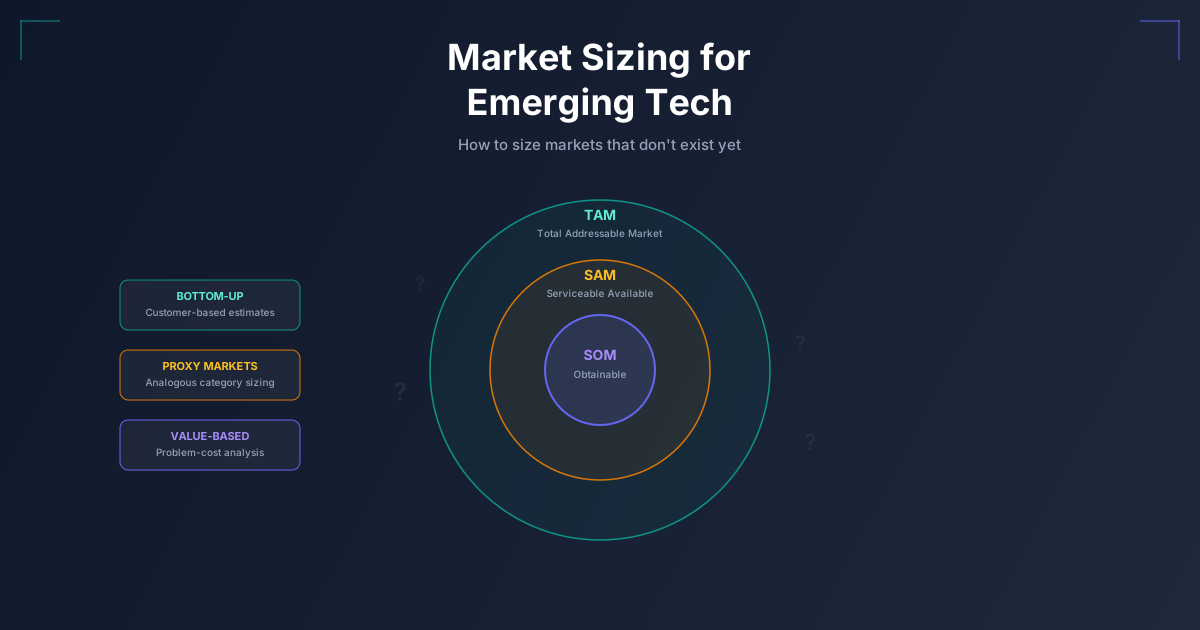
To size a market for a brand-new category, construct it from first principles rather than pulling a percentage from an industry report. Build the Total Addressable Market bottom-up from the problem you solve, use proxy markets (existing markets with similar dynamics) to project growth by analogy, and ground your near-term Serviceable Obtainable Market in a specific beachhead with a real customer count. The result is a credible estimate investors believe, because it demonstrates you understand your customers rather than just citing a big number.
"What's your TAM?"
It's one of the first questions investors ask. And for deep tech founders developing breakthrough technologies, it's often the most challenging to answer.
The problem is fundamental: traditional market sizing assumes you're entering an existing market with defined competitors and established categories. But truly innovative technologies—the kind that emerge from university research and deep tech labs—often create new categories rather than competing in existing ones.
How do you size a market that doesn't exist yet? How do you credibly project demand for something customers have never seen?
This guide provides practical frameworks for market sizing when you're creating something genuinely new. You'll learn how to build bottom-up estimates investors will believe, how to use proxy markets to size new categories, and how to present your market opportunity in a way that's both ambitious and credible.
A note on the numbers: every dollar figure, customer count, and percentage in the worked examples below is hypothetical, chosen to show the arithmetic. None of it is market data. Replace each one with figures you can source for your own market.
Why Traditional Market Sizing Fails for Deep Tech
Before diving into frameworks, let's understand why standard approaches don't work:
The Top-Down Trap
Traditional top-down sizing works like this:
- Find an industry report: "The [industry] market is $50 billion"
- Apply a percentage: "We'll capture 1% = $500 million"
This fails for deep tech for three reasons:
1. Your market may not exist in industry reports. When the first solid-state lidar companies were founded, there was no "solid-state lidar market" to size. The market had to be constructed from first principles.
2. The percentage is meaningless. "We'll capture 1%" provides no information about how you'll actually acquire customers. It's a made-up number that doesn't reflect your capabilities or competitive dynamics.
3. It doesn't demonstrate understanding. Investors see right through top-down analysis. It signals that you haven't done the hard work of understanding your customers and market.
The Analogy Trap
Another common approach: "We're like Uber, but for X."
This fails because:
- Your technology likely serves different customers with different needs
- The adoption dynamics of deep tech differ from consumer apps
- The analogy often obscures more than it reveals
The "If Only" Trap
"If only 10% of factories adopted our technology, that's a $2 billion market."
This ignores:
- Why those factories haven't adopted existing solutions
- What barriers prevent adoption
- Whether your solution actually addresses their needs
- The timeline for adoption
The TAM/SAM/SOM Framework—Done Right
The Total Addressable Market / Serviceable Addressable Market / Serviceable Obtainable Market framework remains useful, but deep tech requires a different approach to each layer.
TAM: Total Addressable Market
Traditional Definition: The total market for all products/services that could be replaced by your solution.
Deep Tech Reality: For category-creating technologies, TAM requires construction, not just research.
How to Build It:
Approach 1: Problem-Based TAM
Start with the problem you're solving, not the solution you're building:
- Quantify the problem: How much does this problem cost annually? (Lost productivity, wasted resources, inefficiencies, safety costs)
- Identify all sufferers: Who experiences this problem? How many?
- Calculate maximum value creation: If your technology perfectly solved the problem, how much value would be created?
Hypothetical example: "Suppose equipment failures cost our target industries $650 billion a year in downtime and maintenance, and roughly $180 billion of that traces to undetected wear. That $180 billion is the problem our predictive maintenance technology addresses."
Approach 2: Adjacent Market TAM
Aggregate related markets your technology could ultimately address:
- Identify related markets: What existing markets does your technology touch?
- Calculate displacement: What portion of each market could your technology replace?
- Sum the opportunity: The total of displacement across markets equals your TAM.
Hypothetical example: "Suppose our bioplastics technology could displace slices of three markets sized at $500B, $50B, and $30B. If the slices we can realistically replace add up to $80B, that $80B, not the $580B headline, is our TAM."
Approach 3: Value Chain TAM
Map the value chain and identify where you capture value:
- Map the full value chain: From raw materials to end customer
- Identify your position: Where does your technology fit?
- Calculate value capture: What percentage of the chain's value do you represent?
Hypothetical example: "Suppose the value chain we sell into is worth $600B a year, the equipment stage we touch is 15% of it ($90B), and the component our technology replaces accounts for $15B of that stage. Our TAM is the $15B, not the $600B."
SAM: Serviceable Addressable Market
Traditional Definition: The portion of TAM you can technically address with your current solution.
Deep Tech Reality: SAM should reflect technical limitations, geographic scope, and near-term applicability.
How to Build It:
- Technical constraints: What portion of TAM does your current technology actually work for?
- Geographic scope: Where can you realistically sell and support?
- Segment focus: Which customer segments are most applicable?
- Regulatory considerations: Which markets can you access with current approvals?
Hypothetical example: "Of the $180B predictive maintenance opportunity (TAM), our current technology—optimized for rotating equipment—addresses $45B in applicable machinery segments (SAM). Initial regulatory clearance limits us to North American and European markets, reducing accessible SAM to $28B."
SOM: Serviceable Obtainable Market
Traditional Definition: The portion of SAM you can realistically capture in 3-5 years.
Deep Tech Reality: SOM should reflect your beachhead strategy and demonstrate credible customer acquisition.
How to Build It:
This is where bottom-up analysis is essential:
- Define your beachhead: The specific segment you'll dominate first
- Count potential customers: How many organizations fit your ideal customer profile?
- Estimate conversion: What percentage will you convert over 3-5 years?
- Calculate revenue: Customers × average contract value × penetration
Hypothetical example: "We're targeting Gulf Coast refining and petrochemical plants (150 qualifying facilities in this example) as our beachhead—operations most exposed to unplanned downtime costs. We project 15 customers in Year 1, 45 in Year 2, and 80 by Year 3, representing a $120M SOM at our average contract value of $1.5M."
The Bottom-Up Market Sizing Method
Bottom-up sizing builds credibility because it demonstrates you understand your customers and have a real plan to acquire them.
Step 1: Define Your Ideal Customer Profile (ICP)
Get specific about who will buy:
Characteristics to Define:
- Industry and sub-segment
- Company size (revenue, employees)
- Technical requirements (infrastructure, capabilities)
- Business characteristics (growth stage, technology adoption)
- Geographic location
- Decision-maker profile
Example ICP: "Refineries and petrochemical plants in North America with large fleets of rotating equipment manufactured after 2010, at least one reliability engineer on staff, and a documented history of unplanned downtime events."
Step 2: Count Your Addressable Customers
How many organizations match your ICP?
Data Sources:
- Industry associations and directories
- Government databases (EPA, SEC filings, etc.)
- Commercial databases (D&B, ZoomInfo, etc.)
- Industry reports and analyst estimates
- Your own customer research and interviews
Hypothetical example: "Suppose directory and database work turns up 340 North American plants matching the ICP. Of these, 220 have equipment profiles we can address with current technology. Of those, 150 are in the Gulf Coast region where we have sales coverage and local support infrastructure."
Step 3: Estimate Customer Acquisition
Build a realistic model for how you'll acquire customers:
Factors to Consider:
- Sales cycle length (often a year or more for deep tech)
- Proof-of-concept requirements (pilots, trials, validation)
- Annual sales capacity (how many deals can your team close?)
- Market awareness (do customers know they need this?)
- Competitive dynamics (who else is selling to these customers?)
Adoption Curve Considerations: Everett Rogers's Diffusion of Innovations (first published 1962) divides adopters into categories by standard deviations from the average adoption time. The shares below are those definitional cut-offs, not measurements of any particular market:
- Innovators (2.5%) and Early Adopters (13.5%): Technology enthusiasts and visionaries willing to take risks
- Early Majority (34%): Pragmatists who need proven solutions and references
- Late Majority (34%): Conservatives who adopt only when standard practice
- Laggards (16%): Skeptics who resist change
Hypothetical example: "Year 1: 15 customers (10% of beachhead, early adopters with existing relationships) Year 2: 45 customers (30% cumulative, expanding through references and proof points) Year 3: 80 customers (53% cumulative, approaching early majority) Year 4: 110 customers (73% of beachhead captured) Year 5: 130 customers (87% of beachhead, near-saturation)"
Step 4: Calculate Revenue
Customers × Average Contract Value = Revenue
For Deep Tech, Consider:
- Hardware sales (one-time)
- Software/SaaS subscriptions (recurring)
- Service and maintenance contracts (recurring)
- Consumables (recurring)
- Implementation and professional services (one-time)
Hypothetical example: "Average contract value: $1.5M
- Hardware: $500K (one-time)
- Annual SaaS: $300K/year
- Annual service: $100K/year
- Implementation: $100K (one-time)
Year 1: 15 customers × $1.5M = $22.5M Year 2: 45 customers × expansion = $67.5M ARR Year 3: 80 customers × expansion = $120M ARR"
Step 5: Validate With Customer Research
Your bottom-up model is only as good as your assumptions. Validate:
- Price points: Will customers pay what you're projecting?
- Customer counts: Are there really that many qualified prospects?
- Adoption timeline: Is your sales cycle assumption realistic?
- Competition: Are you accounting for competitive dynamics?
Validation Methods:
- Customer interviews and surveys
- Pilot program results
- LOIs and early contracts
- Industry expert input
Proxy Market Analysis for Category-Creating Technologies
When you're creating an entirely new category, proxy markets can help size the opportunity by analogy.
What Is a Proxy Market?
A proxy market is an existing market with dynamics similar to the market you're creating. By analyzing how the proxy developed, you can project your own market's potential.
Selecting Good Proxies
Characteristics of Good Proxies:
- Similar customer dynamics and decision-making
- Comparable technology adoption patterns
- Analogous value propositions and business models
- Similar competitive and regulatory landscapes
Illustration: Sizing Solid-State Lidar in 2015
In 2015, solid-state lidar was an emerging technology with no established market. How would you have sized it? The walkthrough below shows the shape of the reasoning; the inputs are placeholders, not historical market data.
Proxy Markets:
- Mechanical lidar market: Direct predecessor technology, showing adoption in autonomous vehicles
- Automotive camera market: Established ADAS sensor market with known growth rates
- Automotive radar market: Another ADAS sensor category with industry adoption data
Analysis:
- Mechanical lidar: start from that market's revenue and its forecast growth
- Camera/radar sensors: track how fast they followed vehicle ADAS adoption
- ADAS penetration: project what share of new vehicles will carry the relevant driver-assistance features, and by when
Projection: "If solid-state lidar reaches performance/cost parity with mechanical lidar by year X and then follows the camera/radar adoption curve for ADAS, the market could reach $Y by year Z."
Reality Check: Timing is where proxy analyses like this break. Fully autonomous driving arrived far more slowly than many 2015-era plans assumed, so lidar revenue lagged the most optimistic projections. The lesson: the proxy tells you the shape of the curve, but you need scenarios for when the inflection actually happens.
Proxy Analysis Framework
Step 1: Identify 2-3 Relevant Proxies
- What existing markets are most analogous?
- What technologies followed similar adoption paths?
Step 2: Analyze Proxy Evolution
- How did the proxy market develop?
- What drove adoption and growth?
- What were the critical inflection points?
Step 3: Map to Your Technology
- What would similar dynamics look like for your market?
- What's different that might accelerate or slow adoption?
- What triggers would drive similar inflection points?
Step 4: Build Your Projection
- Apply proxy growth rates to your starting point
- Adjust for unique factors in your market
- Create scenarios (conservative, base, aggressive)
Beachhead Market Strategy
For deep tech, your initial market (beachhead) matters as much as your ultimate TAM. Geoffrey Moore's "Crossing the Chasm" framework is particularly relevant.
What Makes a Good Beachhead?
Characteristics:
- Clear, acute pain point (not "nice to have")
- Ability to pay (budget exists for solutions)
- Accessible through your current resources
- Referenceable (success creates credibility for expansion)
- Buildable (you can dominate this segment)
Beachhead-First Positioning
Instead of presenting your massive TAM with a vague "we'll get 1%," show a credible plan to dominate a specific beachhead:
Hypothetical example: "While our technology ultimately addresses a $50B industrial monitoring market, we're focused on dominating the $150M Gulf Coast refining and petrochemical segment. We have domain expertise, industry relationships, and a solution perfectly matched to their acute unplanned downtime problem. Once we own this beachhead, we'll expand to the rest of North America, then process plants globally, then broader industrial applications."
Why Investors Like This:
- Shows strategic thinking, not just ambition
- Demonstrates understanding of go-to-market challenges
- Provides concrete near-term milestones
- Creates a credible path to the larger opportunity
Beachhead to TAM Bridge
Show how beachhead success enables expansion:
Expansion Levers:
- Geographic expansion: Same application, new geographies
- Adjacent segments: Same capability, related industries
- Product expansion: New applications for existing customers
- Platform development: Enabling others to build on your technology
Example Expansion Path (hypothetical figures):
- Year 1-2: Gulf Coast refining + petrochemical ($150M segment)
- Year 3-4: All North American refining + petrochemical ($500M)
- Year 4-5: Global refining + petrochemical ($2B)
- Year 5+: Broader industrial monitoring ($10B+)
Presenting Market Size to Investors
How you present your market analysis matters as much as the analysis itself.
What Investors Want to See
1. A Large Ultimate Opportunity Your TAM needs to support a venture-scale outcome. A common VC rule of thumb (a heuristic, not a published threshold) is a $1B+ TAM with a credible path to $100M+ in revenue.
2. A Credible Near-Term Focus Your SOM needs to be achievable with current resources and demonstrate a concrete plan for customer acquisition.
3. A Logical Bridge The path from SOM to SAM to TAM should be clear and defensible.
4. Customer Validation Evidence that customers will pay—interviews, LOIs, pilots, early sales.
Common Mistakes
Mistake 1: Leading with TAM Starting with "We're addressing a $100 billion market" without foundation. Lead with the beachhead and work up.
Mistake 2: Top-Down Only No bottom-up validation of customer count, pricing, or acquisition. Always include bottom-up analysis.
Mistake 3: Disconnected Tiers TAM/SAM/SOM that don't logically relate. Ensure clear connections between levels.
Mistake 4: Ignoring Adoption Timeline Presenting market size without addressing how long it takes for markets to develop. Deep tech markets take time.
Mistake 5: No Customer Evidence Market sizing without customer validation. Include interview quotes, LOIs, or pilot data.
Presentation Structure
Slide 1: The Opportunity (Lead with Impact) "$X billion is wasted annually on [problem]. We're building the solution."
Slide 2: TAM Construction (Show Your Work) Brief methodology—problem-based, adjacent markets, or value chain approach.
Slide 3: SAM Focus (Where You Play) Your addressable segment with clear definition of scope.
Slide 4: SOM with Beachhead (Near-Term Reality) Bottom-up analysis of your initial target market with specific customer data.
Slide 5: Expansion Path (The Bridge) How success in beachhead unlocks larger opportunity.
Industry-Specific Considerations
Different industries have unique market sizing challenges:
Medical Devices and Therapeutics
Considerations:
- Market access depends on regulatory approval
- Reimbursement affects pricing and adoption
- Clinical evidence requirements affect timeline
- Geographic markets have different approval requirements
Sizing Approach:
- Start with disease prevalence and incidence
- Apply treatment eligibility criteria
- Factor in reimbursement and pricing
- Account for competitive alternatives
- Apply adoption curves for medical technologies
Industrial Technology
Considerations:
- Long sales cycles (often a year or more)
- Capital expenditure budgets and cycles
- Installed base replacement dynamics
- OEM vs. end-user sales paths
Sizing Approach:
- Count facilities/plants matching ICP
- Estimate units per facility
- Factor in replacement cycles
- Account for new facility construction
Software and AI/ML
Considerations:
- Land-and-expand dynamics
- Seat-based vs. usage-based pricing
- Platform vs. point solution positioning
- Open source competition
Sizing Approach:
- Count potential customer companies
- Estimate users/seats or usage volume
- Apply pricing model assumptions
- Factor in expansion and churn
Clean Tech and Energy
Considerations:
- Policy-driven markets (incentives, mandates)
- Infrastructure requirements
- Long project timelines
- Capital intensity
Sizing Approach:
- Policy scenario analysis
- Infrastructure build-out projections
- Project pipeline analysis
- Technology cost curves
Building Your Market Model
A good market model is a living document that evolves with your understanding:
Components of a Robust Model
1. Customer Database Detailed list of target customers with relevant attributes. Start with your beachhead and expand.
2. Pricing Model Bottom-up pricing based on value delivered and competitive alternatives. Test with customers.
3. Adoption Assumptions Realistic projections based on sales capacity, market awareness, and competitive dynamics.
4. Scenario Analysis Conservative, base, and aggressive scenarios with clearly stated assumptions.
5. Sensitivity Analysis What variables most affect your projections? What needs to be true for your model to work?
Updating Your Model
Your market model should evolve as you learn:
- Customer discovery insights: Adjust ICP and pricing based on conversations
- Pilot results: Refine adoption assumptions based on real data
- Competitive developments: Incorporate new entrants and competitive dynamics
- Market changes: Update for regulatory, economic, and technology shifts
Frequently Asked Questions
How do you size a market that doesn't exist yet?
You construct it rather than research it. Start with the problem you solve and quantify what it costs annually, then identify everyone who suffers from it. You can also aggregate adjacent markets your technology could displace, or map the value chain to find where you capture value. The goal is a TAM built from first principles, not an industry report.
What is the difference between TAM, SAM, and SOM?
TAM (Total Addressable Market) is the total market your solution could ultimately replace. SAM (Serviceable Addressable Market) is the portion your current technology can address given technical, geographic, and regulatory limits. SOM (Serviceable Obtainable Market) is what you can realistically capture in three to five years, grounded in your beachhead and a credible customer acquisition plan.
What is a proxy market?
A proxy market is an existing market with dynamics similar to the one you are creating. By analyzing how that proxy developed, you can project your own market's potential by analogy. Good proxies share similar customer decision-making, comparable technology adoption patterns, analogous value propositions and business models, and similar competitive and regulatory landscapes.
How do you size a market bottom-up?
Define your Ideal Customer Profile, then count how many organizations match it using industry directories, government and commercial databases, and your own research. Build a realistic acquisition model accounting for sales cycle length, proof-of-concept needs, and adoption curves. Multiply customers by average contract value to calculate revenue, then validate your assumptions with customer interviews, pilots, and LOIs.
Why does top-down market sizing fail for deep tech?
Top-down sizing finds an industry report and applies an arbitrary percentage, but your category may not exist in any report yet. The percentage is meaningless because it says nothing about how you will actually acquire customers, and it does not demonstrate that you understand your market. Investors see through it as a made-up number.
What makes a good beachhead market?
A good beachhead has a clear, acute pain point rather than a "nice to have." Customers must have the ability to pay, with budget already allocated for solutions. It should be accessible through your current resources, referenceable so early success builds credibility for expansion, and buildable so you can realistically dominate the segment.
Size Your Market with Confidence
Market sizing for deep tech and category-creating innovations requires a different approach than traditional analysis. By combining bottom-up customer analysis, proxy market projections, and a clear beachhead strategy, you can build credible market estimates that resonate with investors and guide your commercialization strategy.
Use our Market Sizing Calculator to build investor-ready TAM/SAM/SOM projections for your technology, complete with bottom-up validation and customizable assumptions.