University Patent Filing: Invention Disclosure to PCT

University Patent Filing: From Invention Disclosure to PCT
In a startup, an inventor decides to file a patent on Tuesday and an attorney files it on Friday. In a university, the same inventor submits an invention disclosure, the Technology Transfer Office (TTO) evaluates it for 60 days, outside counsel is engaged for drafting, and a provisional patent application is filed three to six months later — if the TTO decides to file at all.
This article walks through how university patent filing actually works. It's written for two audiences: researchers who want to understand what happens after they submit an invention disclosure, and TTO professionals who want a structured reference for the workflow they manage.
The mechanics matter. Researchers who don't understand the TTO's filing decision process often make commercialization moves (public talks, manuscript submissions, customer demos) that constrain the IP options they didn't know they had. TTOs that don't communicate the workflow clearly lose researcher trust and end up with disclosures arriving too late to file before public disclosure clocks expire.
Key Takeaways
- Typical timing from invention disclosure to filed provisional is 3–9 months, depending on TTO capacity and the urgency of any pending public disclosure.
- The invention disclosure is the most underestimated document in the process. Complete disclosures get filed quickly; thin disclosures slow everything down.
- Under the Bayh-Dole Act, universities have up to 2 years to elect title to federally funded inventions, but public disclosure clocks typically force a decision within 90 days.
- TTO filing costs run $4K–$8K for a provisional, $5K–$15K for non-provisional/PCT, $1.5K–$3K per national-phase entry. Full international lifecycle: $30K–$80K.
- Inventor-founder COI requires explicit management. Most research universities have established policies — disclose early and follow the management plan.
If you're a researcher considering disclosure, or a TTO building out your filing process, this is the workflow to start with.
What Is the University Patent Filing Workflow?
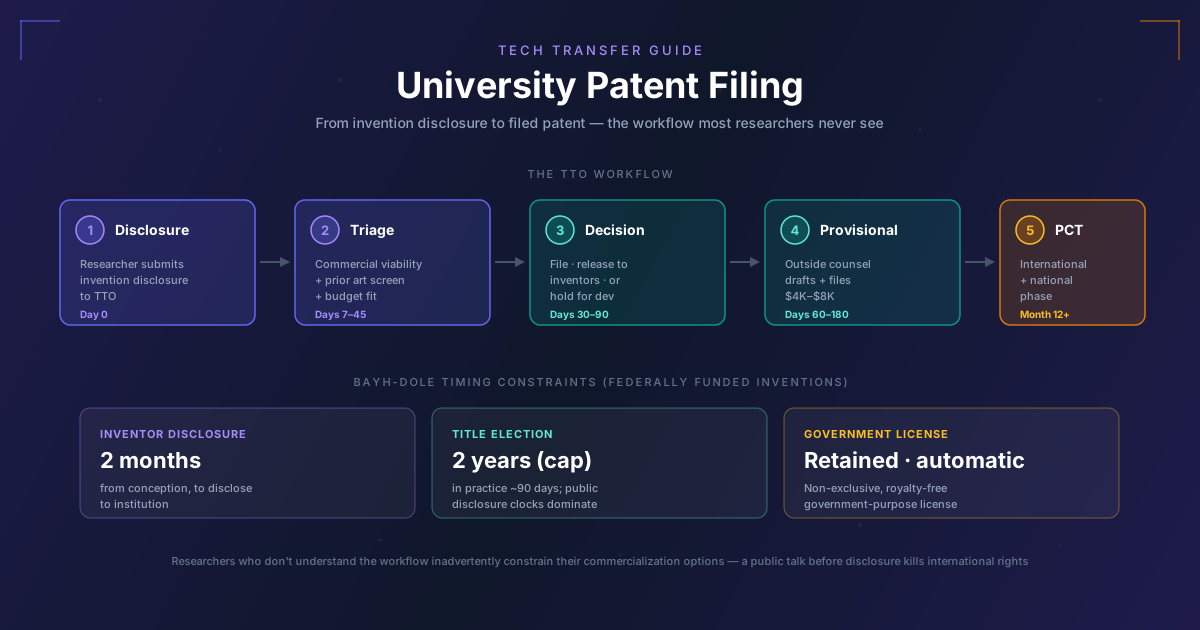
University patent filing follows a structured workflow regardless of which institution runs it. The steps and approximate timing:
| Step | Owner | Typical timing |
|---|---|---|
| 1. Researcher conducts work, develops invention | Researcher | Ongoing |
| 2. Researcher submits invention disclosure to TTO | Researcher | Day 0 |
| 3. TTO acknowledges receipt, assigns case manager | TTO | Days 1-7 |
| 4. TTO conducts initial triage (commercial viability, prior art screen) | TTO + outside searchers | Days 7-45 |
| 5. TTO decides: file, release back to inventors, or hold for development | TTO leadership | Days 30-90 |
| 6. If filing: TTO engages outside counsel | TTO | Days 30-90 |
| 7. Outside counsel drafts provisional | Counsel + inventors | Days 60-180 |
| 8. Provisional filed | Counsel | Days 90-180 |
| 9. 12-month conversion to non-provisional / PCT | Counsel + TTO | Days 365-455 |
| 10. National-phase entry decisions for PCT | TTO + counsel | Month 30 from PCT filing |
| 11. Examination and prosecution | Counsel | Years 2-5 |
| 12. Issuance (if successful) | USPTO + foreign offices | Years 3-5+ |
The timeline varies meaningfully by institution. Well-resourced TTOs at research-intensive universities (Stanford, MIT, UCSF, Penn) often move from disclosure to provisional filing in 30-60 days for high-priority cases. Smaller institutions may take 6-9 months for the same step. The variability matters because public disclosure deadlines don't wait for TTO capacity.
What Goes Into an Invention Disclosure?
The invention disclosure is the document that initiates the entire process. Despite its importance, it's the part most researchers do poorly.
A useful invention disclosure includes:
Technology description. What's the invention? Plain-language explanation followed by technical detail. Aim for completeness — the TTO and outside counsel will draft the patent from this document plus follow-up conversations, so anything you leave out gets filled in less precisely later.
Novelty argument. What's specifically new about this invention compared to existing technology? Who has published or patented similar work, and how is yours different? This is the section TTOs use to triage.
Prior art known to the inventor. Any related patents, papers, products, or public disclosures the inventor is aware of. The inventor has a duty to disclose prior art they know about; surprises that surface later complicate examination.
Public disclosure history. Has the invention been described publicly anywhere? Conference talks, posters, abstracts, manuscript drafts under review, lab websites, NIH RePORTER abstracts, dissertation defenses, public seminars. Each one starts a one-year U.S. grace period clock and immediately kills international patentability in most jurisdictions.
Public disclosure plans. Manuscripts in submission, upcoming conferences, planned product demos, scheduled talks. The TTO needs to know about these to time the filing before disclosure. This is the field most disclosure forms have, and the field most researchers leave blank.
Sponsors funding the work. Which grants, contracts, or industry sponsors funded the research that produced this invention? This drives Bayh-Dole obligations and any IP commitments to industry sponsors.
Inventorship contributors. Who contributed to the invention? Inventorship under U.S. patent law is determined by conception of the claimed invention , not authorship of a paper, not lab contribution, not seniority. Getting inventorship wrong is grounds for invalidating an issued patent.
Commercial inquiries received. Has anyone (an industry contact, a former colleague, a startup founder) approached the inventor about the invention? This signals commercial interest and is useful for TTO triage.
For broader context on what TTOs do and how they fit into the university ecosystem, see What is AUTM? The Association Behind US Tech Transfer and What Is Tech Transfer? A Plain-Language Guide for 2026.
How Does the TTO Decide Whether to File?
After receiving an invention disclosure, the TTO conducts an evaluation that determines whether to file. Common evaluation criteria:
Commercial viability. Is there a plausible commercial market for this technology? Has any company expressed interest? Does the invention fit a known commercialization pathway (license to existing company, spin out startup, sell to early-stage acquirer)?
Patentability. Does a preliminary prior art search suggest the invention is novel and non-obvious? Many TTOs run informal searches at this stage; some engage outside searchers for substantive opinions.
Resource fit. Does the TTO have the budget to file? TTOs at smaller institutions may file on 30-50% of disclosures; well-resourced TTOs at major research universities file on 50-70%.
Bayh-Dole obligations. Was the work federally funded? If yes, Bayh-Dole requires the university to make an election decision (whether to take title to the invention) within 2 years of disclosure to the federal funding agency. (See The Bayh-Dole Act Explained for the underlying framework.)
The TTO's decision options:
- File a patent application. The TTO takes title and engages outside counsel to draft.
- File a provisional only, then evaluate further. Less common — usually combined with active commercial development during the 12-month provisional window.
- Release the invention to the inventors. Under Bayh-Dole, if the university chooses not to retain title, the inventors (with permission from the federal funding agency, if applicable) can take title themselves and file at their own cost.
- Hold the disclosure without filing. Waiting for additional data, commercial interest, or budget capacity.
The release-to-inventors option is more common than researchers realize. If the TTO concludes there's no commercial path for an invention, releasing it back gives the inventors the option to file at their own expense if they believe in it. Many startup founders have founded companies on inventions the TTO declined to file on.
How Does Outside Counsel Engagement Work?
Once the TTO decides to file, the work moves to outside patent counsel. Most universities use a small set of preferred patent firms with established relationships and rate structures.
Outside counsel selection. TTOs maintain panels of preferred firms, often differentiated by technology area. A biotech invention goes to a different firm than a software invention. Selection within the panel is typically based on counsel availability and prior experience with the inventor's field.
Counsel engagement. The TTO assigns the case, provides the disclosure and any prior art identified, and arranges for the inventors to meet with counsel for technical interviews. Counsel typically needs 4-8 weeks of inventor time spread across 2-3 months for a thorough provisional draft.
Provisional drafting cost. TTOs typically budget $4,000-$8,000 for a provisional application drafted by outside counsel. Premium "convertible" provisionals (drafted at non-provisional quality so conversion is later trivial) cost $7,000-$12,000. Most universities default to the standard tier unless commercial development is well underway.
Provisional filing. Once drafted and reviewed by the inventors, the provisional is filed. The TTO receives the filing receipt and adds the case to its portfolio.
For broader context on what a provisional patent application is and how it functions, see Provisional Patent Application: The Founder's Guide.
What Are the Bayh-Dole Timing Constraints?
For inventions arising from federally funded research, the Bayh-Dole Act sets specific timing requirements that constrain when filings must happen.
Inventor disclosure to the institution: 2 months. From the time of conception, inventors are required to disclose inventions to their institution within 2 months. In practice, this requirement is poorly enforced and frequently missed — but failure to disclose creates legal exposure for both the inventor and the institution.
Institution election of title: 2 years from inventor disclosure. The university has up to 2 years to decide whether to retain title to a federally funded invention. In practice, decisions are typically made much faster (within 90 days) because waiting 2 years would allow public disclosure clocks to expire.
Filing the patent: 1 year from public disclosure (or earliest of certain bars). Under U.S. law's 1-year grace period, the institution must file within 12 months of any public disclosure to preserve U.S. patent rights. For international rights, the filing must precede any public disclosure.
Government license retention. Even when the university takes title to a federally funded invention, the U.S. government retains a non-exclusive, irrevocable, royalty-free license to practice the invention for government purposes. This is automatic under Bayh-Dole and applies to all federally funded inventions.
For institutional researchers writing federally funded SBIR/STTR applications, these constraints intersect with the SBIR program rules. See SBIR vs STTR: Which One Should You Apply For? for the parallel SBIR considerations.
How Do Universities Handle PCT and National Phase?
The 12-month conversion decision is structurally identical to the conversion decision for a startup-filed provisional, but the institutional context differs. The TTO typically holds the budget authority for conversion, not the inventor.
The standard pattern for university filings. Most TTOs default to filing a PCT international application at month 12 rather than a U.S. non-provisional. The PCT route preserves international filing options for an additional 18-30 months, which matters for university inventions because licensing prospects often emerge slowly and international filing decisions can be made more deliberately.
The cost trade-off. PCT filings cost $3,000-$6,000. National-phase entries at month 30 cost $1,500-$3,000 per country plus translation costs in non-English jurisdictions. A patent that goes to PCT then to U.S., Europe, Japan, and one or two other markets typically costs $30,000-$80,000 over its lifetime before considering examination costs.
Selecting countries at month 30. The most consequential budget decision in a university patent's lifetime. TTOs typically narrow international filings to 3-5 jurisdictions based on the likely market for the technology and the strength of commercial development at that point. A patent without a licensee or active startup at month 30 often gets cut to U.S. only.
For the underlying mechanics of provisional-to-non-provisional and PCT conversion, see Provisional vs Non-Provisional Patent: When to Convert.
What COI Issues Affect Inventor-Founders?
A common scenario: a researcher invents a technology in their university lab, the TTO files a patent, and the inventor founds (or co-founds) a startup that licenses the patent from the university. This pattern is well-established and frequent at research universities. It also creates a structural conflict of interest that requires explicit management.
The COI structure. The inventor has a financial interest in the licensing terms (as a founder of the licensee). The inventor also continues to direct or oversee university research that may produce additional inventions the same licensee may want to license. The two roles create incentives that can conflict — for example, an incentive to delay disclosing follow-on inventions until the startup is positioned to license them.
University COI policies. Most research universities have well-developed COI policies covering this scenario. Common requirements:
- Disclosure to the university COI office of the inventor's financial interest in the startup
- A management plan that may include separation of research direction from licensing decisions, regular reporting on company activities, and prohibitions on using the licensee company's resources for university research
- Equity transparency — universities often track the inventor's equity in the startup and may receive equity themselves as part of the license
- Disclosure to graduate students and postdocs in the inventor's lab — students should know that the lab's work may flow to a company in which the PI has equity
The startup's IP-allocation problem. The license agreement between the university and the startup determines what IP the startup actually controls. Field-of-use limitations, exclusivity terms, reservation of rights for academic use, and improvement-IP allocation all matter. A startup that licenses a single foundational patent without negotiating for follow-on inventions may find subsequent lab work going to a competitor.
For broader context on the university IP licensing process, see The Complete Guide to Licensing University IP and The Technology Transfer Agreement: Anatomy of the Deal.
What Should Researchers and TTOs Do Differently?
For researchers thinking about a future invention disclosure:
-
Submit the disclosure before public disclosure, not after. Most TTOs can move quickly when needed. Submit even a thin disclosure 60-90 days before a planned talk or manuscript submission, and the TTO has time to file a provisional first.
-
Write the disclosure completely. Treat it as a real document. A complete disclosure can be filed as-is as a provisional in an emergency; an incomplete one cannot.
-
Disclose related work and contributors honestly. Inventorship and prior art issues that surface during prosecution are dramatically harder to fix than during the initial disclosure.
-
Engage with the TTO early and repeatedly. TTOs prioritize disclosures where they have clear commercial interest and engaged inventors. A disclosure from a responsive researcher with named commercial contacts moves faster than one from a disengaged researcher with no commercial signal.
-
Understand the timeline before relying on it. If you assume your disclosure is filed within 30 days and it actually takes 6 months, you may have miscalculated your conference talk timing. Ask the TTO for typical timing on inventions like yours.
For TTOs:
-
Communicate the workflow clearly to researchers. Most researcher frustration comes from not understanding why a filing decision is taking time. A clear timeline expectation up front saves repeated explanations.
-
Triage quickly for time-sensitive cases. A disclosure with a manuscript already in submission needs a faster track than one without external deadlines.
-
Document the release decisions. When a TTO declines to file, communicating the reasoning to the inventor (and offering the release option) preserves the relationship for future disclosures.
Frequently Asked Questions
How long does it take from invention disclosure to filed patent?
Typical timing is 3-9 months from disclosure to filed provisional patent application. Major research universities with well-resourced TTOs can move from disclosure to provisional filing in 30-60 days for high-priority cases; smaller institutions may take longer. The 12-month conversion to non-provisional or PCT follows the provisional filing.
Who owns the patent on a university invention?
Under the Bayh-Dole Act, the university typically takes title to inventions arising from federally funded research, subject to the federal government's retained license. The inventor has rights to compensation under the university's IP policy (typically a share of license revenue and equity in spinouts), but does not own the patent directly. Inventions made on personal time without university resources may belong to the inventor.
What is an invention disclosure form?
An invention disclosure is the document a researcher submits to the TTO to formally describe an invention. It typically includes the technology description, novelty argument, prior art known to the inventor, public disclosure history, planned disclosures, sponsors, inventorship contributors, and any commercial inquiries received. The TTO uses this document to evaluate whether to file a patent.
Can a university refuse to file a patent on an invention?
Yes. Universities are not required to file patents on every invention disclosed. If the TTO concludes that an invention is not commercially viable or doesn't fit the institution's resources, it can release the invention back to the inventors. The inventors can then file at their own expense (subject to federal funding agency permission if applicable).
What is the Bayh-Dole election deadline?
Under Bayh-Dole regulations, the university has up to 2 years from the inventor's disclosure to elect whether to retain title to a federally funded invention. In practice, elections are typically made within 90 days because public disclosure deadlines often constrain the timeline.
How much does a university patent cost to file?
A typical provisional patent application drafted by outside counsel costs $4,000-$8,000. A non-provisional or PCT conversion at month 12 costs $5,000-$15,000 (PCT) or more for full non-provisional drafting. National-phase entries at month 30 add $1,500-$3,000 per country plus translations. A fully-prosecuted patent across U.S., Europe, Japan, and 1-2 other markets typically costs $30,000-$80,000 over its lifetime.
What happens if I publicly disclose before the patent is filed?
For U.S. rights, the 1-year grace period under 35 U.S.C. § 102(b) preserves patentability for 12 months after the inventor's own disclosure. For most international jurisdictions, public disclosure before filing destroys novelty entirely. The international consequence is the more serious one — a public disclosure before filing kills the option for European, Chinese, Japanese, and most other foreign patents.
Ready to Build Commercialization Strategy Around Your University Invention?
A filed patent is one part of a commercialization path. The market analysis, competitive landscape, and licensee identification work that turns a filed patent into a commercial outcome is the other part.
Commercify builds that commercialization-side work for university TTOs and inventor-founders (market sizing, competitive landscape, customer discovery synthesis, and licensee/spinout structuring) aligned to the realities of university IP commercialization.
Build your university commercialization strategy with Commercify →
Read next: The Bayh-Dole Act Explained · The Complete Guide to Licensing University IP · The Technology Transfer Agreement: Anatomy of the Deal · What Is Tech Transfer? A Plain-Language Guide for 2026