Innovation Pricing Guide: AI Strategies

The Complete Guide to Pricing Your Innovation
To price an innovative product, use value-based pricing: set the price as a function of the economic value the customer receives rather than your production costs or competitor prices. This is the gold standard for innovations with clear, quantifiable ROI, because it captures a defined share of the benefit delivered and consistently produces higher margins than cost-plus methods. Match the approach to your product type, with dynamic, penetration, segmented, freemium, and bundle pricing as alternatives.
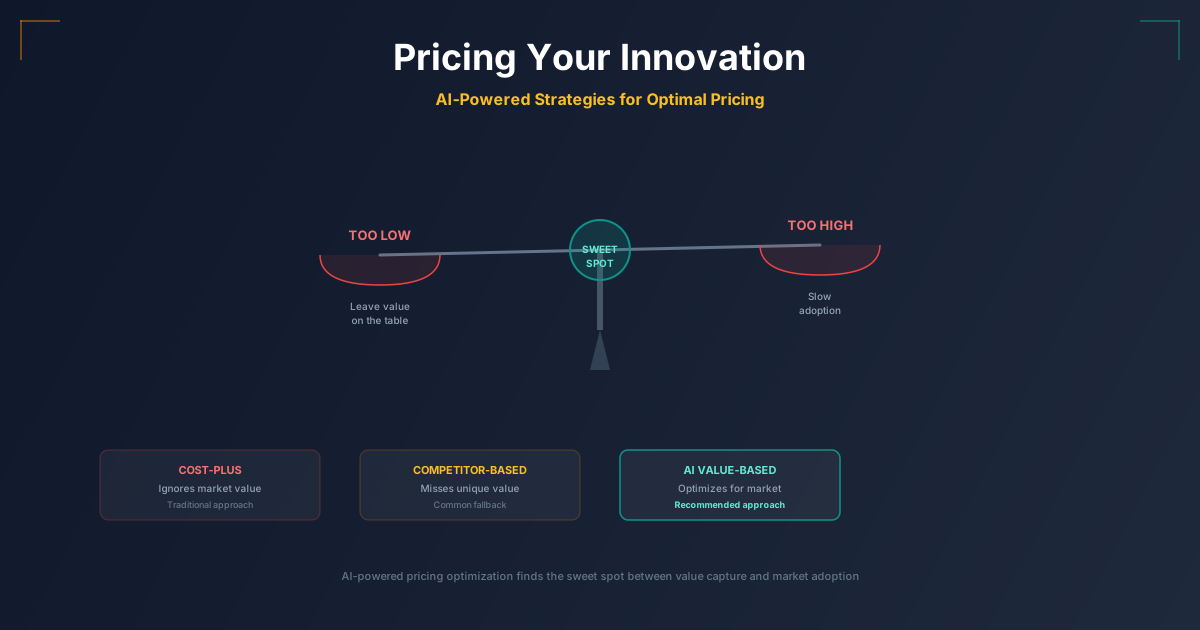
Pricing is often the most challenging aspect of commercializing innovation. Set the price too high, and you risk slow adoption. Too low, and you leave value on the table. This guide shows how AI-powered pricing optimization can help you find the sweet spot.
Of all the strategic decisions a founding team makes when bringing an innovation to market, pricing is arguably the highest-leverage. Unlike product features or marketing spend, which tend to produce incremental gains, a well-calibrated pricing strategy can dramatically improve unit economics, accelerate adoption curves, and signal market positioning all at once. Yet pricing is consistently under-invested in by early-stage companies. Many founders treat it as an afterthought, defaulting to cost-plus arithmetic or rough competitive benchmarking rather than conducting rigorous value analysis. The result is that a significant share of innovative products launch at prices that either suppress demand or surrender margin unnecessarily. This guide provides a structured framework for avoiding both traps.
Why Traditional Pricing Methods Fail
When it comes to pricing genuinely novel products, conventional approaches carry structural blind spots that can undermine even the most promising commercialization effort. Cost-plus pricing, the most common default, anchors the price to internal production costs rather than the value the customer receives — an approach that systematically underprices breakthrough innovations with high R&D costs but low marginal production costs. Competitor-based pricing assumes there are meaningful comparables in the market, which is often untrue for novel technologies. And intuition-based pricing, while sometimes surprisingly accurate for experienced operators, introduces variance and bias that can be difficult to detect until revenue data accumulates. Understanding these failure modes is the first step toward a more rigorous alternative.
Common approaches often fall short:
- Cost-plus pricing ignores market value
- Competitor-based pricing misses unique value
- Gut-feel pricing lacks data support
- One-size-fits-all pricing limits potential
The AI Advantage in Pricing
Artificial intelligence has fundamentally changed what is possible in pricing strategy by enabling real-time analysis of market signals that would overwhelm any human analyst. Modern AI-powered pricing platforms can ingest competitive intelligence, customer behavior data, macroeconomic indicators, and historical transaction records to produce pricing recommendations that adapt as market conditions shift. For innovation-driven companies, this capability is particularly valuable because novel products lack the long transaction histories that traditional pricing models depend on. AI can compensate by drawing inferences from adjacent markets, analogous product launches, and customer willingness-to-pay signals captured through surveys or A/B testing. The result is a pricing approach that is both more precise and more responsive than anything achievable through manual analysis alone. Our pricing calculator puts these capabilities within reach.
Modern AI-powered pricing tools provide:
- Market sensitivity analysis
- Value-based pricing models
- Dynamic pricing optimization
- Segment-specific strategies
- Revenue impact forecasting
6 Proven Pricing Strategies for Innovation
1. Value-Based Pricing
Best for: Breakthrough innovations with clear ROI
Value-based pricing is the gold standard for innovations that deliver measurable, quantifiable benefits to their customers. Rather than anchoring to production costs or competitor prices, this approach sets the price as a function of the economic value the customer receives. For a technology that saves a manufacturing plant millions in annual energy costs, for example, a price that captures a defined share of those savings will almost always exceed what a cost-plus model would produce. The key requirement is the ability to document and communicate that value credibly, which is why this strategy works best when the innovation has clear, defensible ROI metrics. Companies that execute value-based pricing well tend to see meaningfully higher margins and stronger customer relationships, because the buyer perceives the price as fair relative to the benefit received.
How It Works
- Quantify customer benefits
- Calculate ROI for each segment
- Set price based on value delivered
- Adjust for market conditions
Success Indicators
- Meaningfully higher margins compared to cost-plus alternatives
- Faster market adoption driven by clear value articulation
- Stronger customer satisfaction due to perceived price fairness
2. Dynamic Pricing
Best for: Market-sensitive innovations
Dynamic pricing is most effective for innovations operating in markets where demand fluctuates meaningfully based on external conditions — seasonal patterns, commodity prices, regulatory changes, or competitive moves. The core principle is that a single fixed price point leaves money on the table during high-demand periods and suppresses volume during low-demand periods. By adjusting prices in response to real-time market signals, companies can optimize across both dimensions simultaneously. AI-powered dynamic pricing systems have made this approach accessible even to small and mid-sized companies that lack the data science teams of major enterprises. The strategy requires careful implementation to avoid customer backlash, particularly in B2B contexts where buyers expect pricing stability, but when executed thoughtfully it can deliver substantial revenue and utilization improvements.
How It Works
- Monitor market conditions
- Adjust prices in real-time
- Optimize for demand
- Balance volume and margin
Success Indicators
- Notable revenue uplift from demand-responsive price adjustments
- Improved market share through competitive responsiveness
- Better capacity utilization across demand cycles
3. Penetration Pricing
Best for: Platform technologies
Penetration pricing makes strategic sense when the long-term value of a customer relationship far exceeds the revenue captured at the point of first sale. This is particularly true for platform technologies where network effects, switching costs, or ecosystem lock-in create compounding value over time. By pricing aggressively at launch, the innovator accelerates adoption, builds a critical mass of users, and establishes a market position that is difficult for later entrants to dislodge. The trade-off is clear: near-term margin is sacrificed for long-term market dominance. This strategy demands strong unit economics confidence and sufficient capital to sustain the initial low-margin period, but for the right product in the right market, the payoff can be transformative.
How It Works
- Start with competitive pricing
- Build market share quickly
- Increase prices as value proven
- Lock in long-term contracts
Success Indicators
- Significantly faster market penetration relative to premium-priced alternatives
- High customer retention rates driven by switching costs and platform investment
- Growing lifetime value as customers expand usage over time
4. Segmented Pricing
Best for: Versatile innovations
Many innovations serve multiple customer segments that derive different levels of value from the same core technology. A diagnostic tool might be worth one amount to a large hospital system and a very different amount to a small rural clinic. Segmented pricing acknowledges this reality by tailoring the price — and often the packaging, feature set, or service level — to each distinct buyer group. The approach requires a clear understanding of how different segments perceive and measure value, which is where market research and customer discovery become essential. When done well, segmented pricing expands the total addressable market by making the innovation accessible to price-sensitive segments without surrendering margin in segments that can pay more.
How It Works
- Identify distinct segments
- Customize value proposition
- Set segment-specific prices
- Optimize product mix
Success Indicators
- Broader market reach across diverse customer segments
- Higher total revenue through optimized segment-level pricing
- Improved market coverage without margin dilution in premium segments
5. Freemium Model
Best for: Scalable digital innovations
The freemium model has become the dominant go-to-market strategy for digital products where the marginal cost of serving an additional user is near zero. By offering a functional free tier, the innovator removes the primary barrier to adoption — price — and allows users to experience the product's value before committing financially. The strategic challenge lies in designing the boundary between free and paid tiers: too generous, and conversion rates suffer; too restrictive, and free users never experience enough value to become advocates. For research-derived software tools and digital platforms, freemium can be especially powerful because academic users on the free tier often become commercial advocates when they move to industry roles. The pricing optimization capabilities in our platform can help identify the optimal free-to-paid threshold.
How It Works
- Offer basic version free
- Premium features paid
- Clear upgrade path
- Value-driven conversion
Success Indicators
- Dramatically accelerated user acquisition at low marginal cost
- Healthy free-to-paid conversion rates sustained over time
- Substantially lower customer acquisition costs compared to direct-sales models
6. Bundle Pricing
Best for: Complementary innovations
Bundle pricing works by packaging multiple related products or services together at a combined price that is lower than the sum of individual purchases, creating a perceived value advantage that drives larger deal sizes and deeper product adoption. For innovators with a portfolio of complementary offerings — such as a diagnostic device paired with consumables and a data analytics subscription — bundling simplifies the buyer's decision and increases the economic switching cost of moving to a competitor. The key to effective bundling is ensuring that the components genuinely reinforce one another; poorly conceived bundles that combine unrelated offerings tend to confuse rather than persuade. When the components are truly complementary, bundling can simultaneously increase average deal size and reduce the sales cycle length.
How It Works
- Package related offerings
- Create value combinations
- Optimize bundle mix
- Simplify decision making
Success Indicators
- Meaningfully higher average deal sizes
- Stronger solution adoption across the product portfolio
- Reduced sales costs through simplified purchasing decisions
Real-World Success Stories
The following examples illustrate how different pricing strategies have been applied to real innovation commercialization challenges. While the details have been generalized to protect confidentiality, each reflects a pattern we have observed repeatedly across the companies that use our platform. The common thread is that a deliberate, data-informed pricing strategy — rather than a default or afterthought — was the primary driver of commercial success.
Case Study 1: Biotech Platform
- Challenge: Complex technology with multiple applications
- Solution: Segmented pricing by industry
- Result: Tripled revenue within eighteen months of implementing segment-specific pricing
Case Study 2: Clean Energy Innovation
- Challenge: High initial costs barrier
- Solution: Value-based pricing with ROI guarantee
- Result: Dramatically faster market adoption once customers could quantify energy savings
Case Study 3: Research Tool
- Challenge: Academic vs commercial pricing
- Solution: Dual pricing model with a low-cost academic tier and a premium commercial license
- Result: Dominant market penetration across both segments
Implementation Guide
Step 1: Value Analysis
- Map customer benefits
- Quantify ROI impact
- Identify value drivers
- Document proof points
Step 2: Market Assessment
- Analyze competition
- Study price sensitivity
- Map buyer personas
- Evaluate alternatives
Step 3: Strategy Selection
- Choose pricing approach
- Set target metrics
- Define monitoring plan
- Create adjustment triggers
Step 4: Implementation
- Build pricing tools
- Train sales team
- Create materials
- Launch monitoring
Step 5: Optimization
- Track performance
- Gather feedback
- Make adjustments
- Scale success
Common Pitfalls to Avoid
-
Undervaluing Innovation
- Not quantifying full value
- Focusing only on costs
- Ignoring strategic value
-
Poor Segmentation
- Too broad segments
- Unclear value proposition
- Weak differentiation
-
Inflexible Pricing
- Rigid structures
- Slow adjustments
- Limited options
-
Weak Value Communication
- Complex pricing
- Poor ROI clarity
- Weak proof points
How AI Optimizes Pricing
Commercify's AI platform provides:
1. Market Intelligence
- Real-time market data
- Competitive analysis
- Demand forecasting
- Price sensitivity testing
2. Value Quantification
- Benefit calculation
- ROI modeling
- Value comparison
- Impact assessment
3. Strategy Development
- Approach selection
- Scenario modeling
- Revenue forecasting
- Risk assessment
4. Implementation Support
- Sales enablement
- Communication tools
- Monitoring systems
- Adjustment triggers
Measuring Success
Key Metrics to Track
-
Revenue Metrics
- Total revenue
- Average deal size
- Win rate
- Market share
-
Profitability Metrics
- Gross margin
- Customer acquisition cost
- Lifetime value
- Churn rate
-
Market Metrics
- Adoption rate
- Customer satisfaction
- Competitive position
- Market penetration
Frequently Asked Questions
How do you price an innovative product?
Set the price based on the economic value the customer receives, not your production costs. Quantify customer benefits, calculate ROI for each segment, and capture a defined share of that value. Then select the strategy that fits your product, whether value-based, dynamic, penetration, segmented, freemium, or bundle pricing.
What is value-based pricing?
Value-based pricing sets the price as a function of the economic value delivered to the customer rather than anchoring to production costs or competitor prices. It is the gold standard for innovations with clear, defensible ROI metrics, producing meaningfully higher margins and stronger customer relationships because buyers perceive the price as fair relative to the benefit received.
Why does cost-plus pricing fail for innovations?
Cost-plus pricing anchors the price to internal production costs rather than the value the customer receives. This systematically underprices breakthrough innovations that carry high R&D costs but low marginal production costs. By ignoring market value, it surrenders margin unnecessarily and fails to reflect the real economic benefit the innovation delivers to buyers.
What are the most common pricing mistakes?
The most common pitfalls are undervaluing innovation by focusing only on costs, poor segmentation with overly broad segments and weak differentiation, inflexible pricing with rigid structures and slow adjustments, and weak value communication with unclear ROI and weak proof points. Each one suppresses demand or surrenders margin that a deliberate strategy would capture.
How does AI help with pricing?
AI enables real-time analysis of market signals that would overwhelm a human analyst, ingesting competitive intelligence, customer behavior, macroeconomic indicators, and transaction records. For novel products lacking long histories, it draws inferences from adjacent markets and willingness-to-pay signals, delivering market intelligence, value quantification, strategy development, and implementation support more precisely than manual analysis.
When should you use penetration pricing?
Use penetration pricing when the long-term value of a customer relationship far exceeds the revenue captured at first sale, especially for platform technologies with network effects, switching costs, or ecosystem lock-in. Pricing aggressively at launch accelerates adoption and builds a defensible position, though it demands strong unit economics confidence and capital to sustain the low-margin period.
Next Steps
-
Assess Your Current Pricing
- Use our Pricing Optimization tool
- Get AI-powered recommendations
- Identify improvement opportunities
-
Develop Your Strategy
- Choose optimal approach
- Build implementation plan
- Create monitoring system
-
Start Optimizing
- See plans & pricing
- Access expert support
- Track your success
Transform your pricing strategy with AI-powered insights. Start your optimization journey with Commercify today.