5 AI Strategies for Tech Transfer Success

5 AI-Powered Strategies for Successful Technology Transfer
The five most impactful AI-powered strategies for successful technology transfer are: AI-powered portfolio prioritization, automated market intelligence, smart patent strategy, intelligent partner matching, and data-driven valuation. Together, these strategies automate the labor-intensive research that consumes most of a TTO's bandwidth and enable data-driven decisions that manual methods could not support. The goal is not to replace tech transfer professionals but to give them tools that match the scale and complexity of the modern innovation landscape.
University technology transfer remains one of the most challenging functions in the innovation ecosystem. Technology transfer offices (TTOs) are charged with evaluating a growing volume of invention disclosures, determining which have commercial potential, securing intellectual property protection, finding industry partners, and negotiating licensing agreements -- all with teams that are often stretched thin. The vast majority of university inventions never reach the market, not because they lack technical merit, but because the commercialization process demands resources, market knowledge, and industry connections that most TTOs struggle to maintain at scale. Artificial intelligence is beginning to change this equation by automating labor-intensive research tasks, surfacing patterns in large datasets, and enabling data-driven decision-making that was previously impossible with manual methods. The five strategies outlined below represent the most impactful ways that forward-thinking tech transfer offices are deploying AI to improve outcomes.
Part of our Complete Tech Transfer Process guide — a ten-stage operator's playbook covering the broader workflow this article fits into.
The Evolution of Tech Transfer
The traditional tech transfer model was built for an era when universities produced a modest number of invention disclosures each year and licensing deals were negotiated through personal industry relationships cultivated over decades. That model is no longer sufficient. Disclosure volumes have grown substantially as research funding has expanded, while the technologies emerging from university labs -- in fields like AI, synthetic biology, quantum computing, and advanced materials -- require market expertise that spans multiple industries and geographies. At the same time, university leadership and government funders are placing greater emphasis on measurable commercialization outcomes, creating pressure to demonstrate return on research investment. The shift to AI-powered approaches is not about replacing the expertise of tech transfer professionals, but about giving them tools that match the scale and complexity of the modern innovation landscape.
Traditional tech transfer processes often involve:
- Manual market research consuming weeks per disclosure
- Time-consuming patent searches with incomplete coverage
- Subjective evaluation methods that vary by individual
- Limited industry connections constrained by personal networks
- Resource-intensive portfolio management with minimal data infrastructure
Today's AI-powered approach offers a more efficient, data-driven path to success.
Strategy 1: AI-Powered Portfolio Prioritization
Every technology transfer office faces the same fundamental resource allocation challenge: too many invention disclosures competing for too few staff hours, legal budgets, and marketing resources. Without a systematic prioritization framework, TTOs often default to evaluating inventions on a first-come, first-served basis or rely heavily on the enthusiasm of individual inventors -- neither of which correlates reliably with commercial potential. AI-powered prioritization changes this dynamic by scoring each disclosure against a comprehensive set of market, technical, and IP indicators, enabling offices to focus their limited resources on the innovations most likely to generate licensing revenue, attract industry partners, or support viable startup formation.
The Challenge
Most TTOs manage hundreds of innovations with limited resources. Identifying which projects deserve immediate attention is crucial for maximizing the office's commercial impact and ensuring that high-potential inventions do not languish while resources are consumed by lower-priority disclosures.
The AI Solution
Modern AI platforms can:
- Analyze market potential across multiple sectors simultaneously
- Evaluate patent strength and freedom to operate using comprehensive prior art databases
- Assess technical readiness and remaining development needs via TRL assessment
- Calculate potential return on investment based on comparable transactions
- Recommend optimal commercialization timing based on market and regulatory signals
Success Metrics
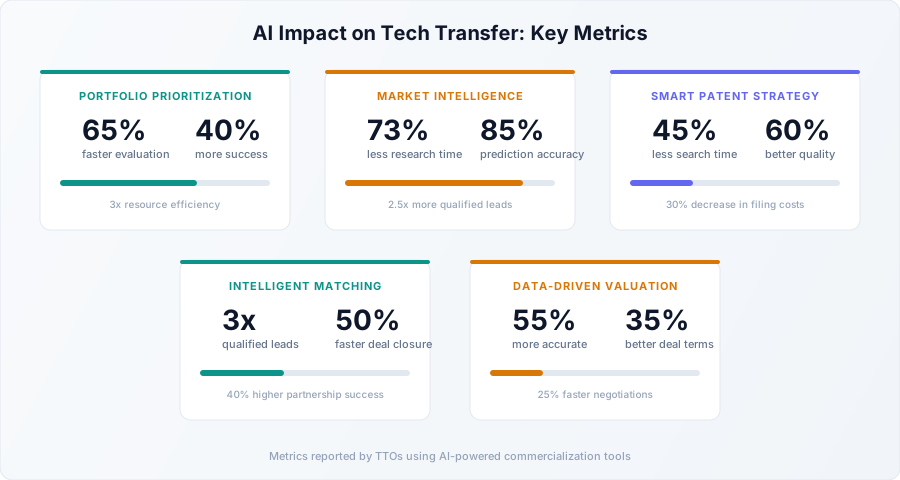
TTOs using AI for portfolio prioritization report significant improvements across key performance indicators, including substantially faster evaluation cycles, higher rates of successful commercialization, and markedly better allocation of staff time and legal budgets toward high-potential opportunities.
Strategy 2: Automated Market Intelligence
Market intelligence is the foundation of every successful commercialization effort, yet it is also the area where traditional TTOs are most constrained. Understanding the competitive landscape, sizing addressable markets, identifying potential licensees, and validating commercial assumptions typically requires weeks of manual research per invention -- research that is often outdated by the time it is completed. AI-powered market intelligence platforms compress this timeline from weeks to hours by continuously ingesting and analyzing patent filings, industry reports, funding announcements, regulatory changes, and corporate strategy signals across global markets. This capability transforms the TTO from a reactive processing function into a proactive strategic advisor to inventors and university leadership.
The Challenge
Understanding market dynamics, identifying potential licensees, and validating commercial potential traditionally requires extensive manual research that most TTOs cannot perform at the scale their portfolios demand.
The AI Solution
AI platforms now deliver:
- Real-time market size analysis using market intelligence engines
- Competitive landscape mapping across global markets
- Potential licensee identification based on strategic fit and acquisition history
- Industry trend forecasting grounded in patent and funding data
- Valuation benchmarking against comparable licensing transactions
Success Metrics
Offices deploying AI-driven market intelligence have reported dramatic reductions in research time per disclosure, meaningful improvements in the accuracy of market sizing, and a substantial increase in the number of qualified industry leads identified per innovation.
Strategy 3: Smart Patent Strategy
Intellectual property protection is both the most expensive line item in most TTO budgets and the foundation upon which all downstream commercialization activities depend. Filing decisions made early in the process -- which claims to pursue, which jurisdictions to cover, whether to file provisionally or go directly to full utility applications -- have outsized impact on eventual licensing outcomes. AI tools are proving particularly valuable in this domain because patent strategy benefits enormously from comprehensive data analysis: identifying relevant prior art, mapping white space in crowded technology areas, and benchmarking claim scope against comparable patents that have generated significant licensing revenue.
The Challenge
Developing effective patent strategies while managing costs and maximizing protection is increasingly complex, particularly for technologies that span multiple application domains and geographic markets.
The AI Solution
AI tools provide:
- Comprehensive prior art search covering global patent databases and academic literature
- Strategic patent mapping that identifies both protection opportunities and potential freedom-to-operate risks
- Licensing opportunity identification based on industry patent acquisition patterns
- Portfolio gap analysis highlighting areas where additional filings could strengthen negotiating position
- Value-based filing recommendations that optimize budget allocation across the portfolio
Success Metrics
TTOs using AI for patent strategy report significant reductions in prior art search time, measurable improvements in patent quality as reflected in examiner acceptance rates, and meaningful decreases in per-patent filing costs through more strategic allocation of prosecution budgets.
Strategy 4: Intelligent Matching
The single greatest bottleneck in most technology transfer processes is not evaluation or IP protection -- it is finding the right commercial partner for each innovation. Traditional approaches rely heavily on the personal networks of TTO staff, conference attendance, and inbound inquiries, all of which introduce significant bias and leave vast portions of the potential partner landscape unexplored. AI-powered matching platforms address this gap by continuously scanning corporate R&D strategies, acquisition patterns, venture portfolios, and strategic hiring signals to identify organizations whose needs align with available university technologies. This capability is especially valuable for interdisciplinary innovations that may find their best commercial fit in industries outside the originating researcher's field.
The Challenge
Finding the right partners, licensees, or investors for each innovation is time-consuming and often relies on limited networks that may not include the best-fit organizations for a given technology.
The AI Solution
Modern platforms offer:
- Automated partner matching based on technology fit, strategic alignment, and deal history
- Industry connection recommendations spanning sectors the TTO may not traditionally engage
- Investor interest prediction based on portfolio analysis and fund thesis alignment
- Collaboration opportunity identification for pre-competitive research partnerships
- Strategic introduction facilitation with context-rich briefing materials
Success Metrics
Offices leveraging AI-powered matching have seen substantial increases in qualified lead generation, meaningfully faster deal closure timelines, and higher success rates in establishing productive partnerships that lead to licensing revenue or startup formation.
Strategy 5: Data-Driven Valuation
Valuation is where many promising tech transfer deals stall or fail entirely. Set the price too high and potential licensees walk away; set it too low and the university leaves significant value on the table while undermining the credibility of the TTO for future negotiations. Traditional valuation approaches often rely on a small number of comparable transactions that may not be truly analogous, or on discounted cash flow models built on highly speculative assumptions. AI-powered valuation tools improve this process by analyzing large datasets of completed licensing transactions, factoring in technology-specific risk profiles, market growth trajectories, and competitive dynamics to generate defensible valuation ranges that serve as strong foundations for negotiation.
The Challenge
Determining fair licensing terms and predicting potential returns remains one of tech transfer's most persistent challenges, with consequences that ripple through every subsequent stage of the commercialization process.
The AI Solution
AI-powered valuation tools provide:
- Market-based pricing models calibrated against large transaction databases
- Comparable deal analysis with sophisticated matching across technology domains
- Revenue potential forecasting incorporating market growth and adoption curves
- Risk assessment quantifying technical, market, and regulatory uncertainties
- Negotiation support with data-backed positioning for key deal terms
Success Metrics
TTOs deploying AI-driven valuation report more accurate initial pricing that better reflects market conditions, improved deal terms that capture more value for the university, and faster negotiation cycles as data-backed valuations reduce the back-and-forth that characterizes subjective pricing discussions.
Real-World Success: AI in Action at Leading Institutions
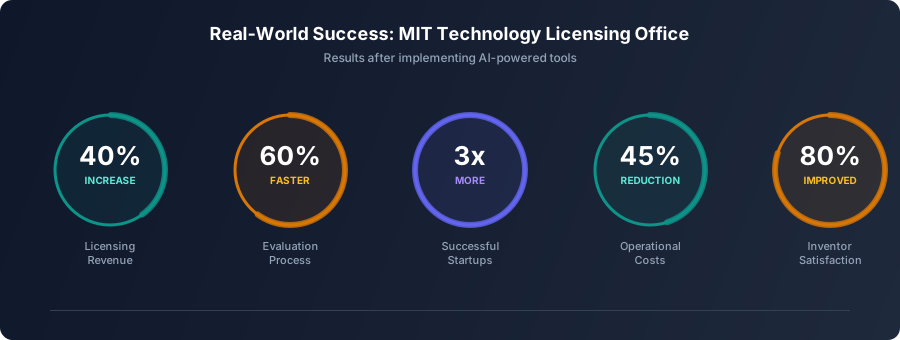
Leading research universities have begun publishing results from their adoption of AI-powered tech transfer tools, and the early evidence is compelling. Institutions that have integrated AI into their evaluation, matching, and valuation workflows report meaningful increases in annual licensing revenue alongside significant reductions in the time required to move from invention disclosure to executed license agreement. Perhaps most importantly, inventor satisfaction scores have improved markedly -- a leading indicator of future disclosure volume and faculty engagement with the commercialization process. While specific results vary by institution size and portfolio composition, the directional evidence strongly supports AI adoption as a force multiplier for TTO effectiveness.
Leading institutions implementing AI-powered tools have achieved:
- Meaningful increases in annual licensing revenue
- Substantially faster evaluation and deal closure processes
- Higher rates of successful startup formation from university IP
- Significant reductions in operational costs per transaction
- Marked improvements in inventor satisfaction and engagement
Implementation Guide
Adopting AI tools within a technology transfer office is most effective when approached as a phased rollout rather than a wholesale transformation. Offices that attempt to overhaul every process simultaneously often encounter resistance from staff, integration challenges with existing systems, and difficulty isolating which changes are driving improvements. A staged approach allows the team to build familiarity with the tools, demonstrate measurable wins that build institutional support, and refine workflows before expanding to additional processes.
-
Start Small
- Begin with portfolio analysis and prioritization, where the data requirements are most straightforward
- Focus on high-potential projects where AI insights can produce visible early results
- Measure and validate results against historical benchmarks
-
Build Buy-In
- Train team members with hands-on workshops, not just documentation
- Demonstrate early wins to university leadership and faculty stakeholders
- Share success metrics transparently to build institutional confidence
-
Scale Strategically
- Expand to market intelligence and partner matching as the team builds confidence
- Integrate with existing disclosure management and CRM systems
- Optimize workflows based on staff feedback and process data
-
Monitor and Adjust
- Track key metrics including time-to-evaluation, deal velocity, and revenue per disclosure
- Gather structured feedback from both TTO staff and inventor-clients
- Continuously improve by updating AI models and refining scoring criteria
The Future of Tech Transfer
The role of the technology transfer professional is evolving, not disappearing. AI handles the data-intensive research, pattern recognition, and scoring that previously consumed the majority of a TTO's operational bandwidth, freeing experienced professionals to focus on the high-judgment activities where human expertise remains irreplaceable: building trusted relationships with inventors, navigating complex negotiations, and making strategic decisions about portfolio direction. The offices that will thrive in the coming years are those that embrace AI as an integral part of their operational toolkit while continuing to invest in the relationship-building and strategic thinking that define world-class tech transfer.
AI is not replacing tech transfer professionals -- it is empowering them to:
- Make better decisions faster with comprehensive data analysis
- Focus on high-value relationship and negotiation activities
- Scale their impact across larger and more diverse portfolios
- Improve success rates through pattern recognition and predictive analytics
- Drive more value from innovation for universities, inventors, and society
Frequently Asked Questions
How is AI used in technology transfer?
AI is used in technology transfer to automate labor-intensive research, surface patterns in large datasets, and enable data-driven decisions that manual methods could not support. It powers portfolio prioritization, market intelligence, patent strategy, partner matching, and valuation, transforming the TTO from a reactive processing function into a proactive strategic advisor to inventors and university leadership.
What are the best AI strategies for tech transfer?
The five most impactful AI strategies are portfolio prioritization, automated market intelligence, smart patent strategy, intelligent matching, and data-driven valuation. Each targets a specific bottleneck in the commercialization process, from scoring disclosures against market and IP indicators to generating defensible valuation ranges built on large datasets of completed licensing transactions.
How does AI speed up commercialization?
AI compresses market research from weeks to hours by continuously ingesting patent filings, industry reports, funding announcements, and regulatory changes. Offices report faster evaluation cycles, quicker deal closure, and reduced time from invention disclosure to executed license agreement, because data-backed insights replace slow manual research and reduce the back-and-forth of subjective decision-making.
Can AI help TTOs evaluate inventions?
Yes. AI-powered portfolio prioritization scores each disclosure against market, technical, and IP indicators, evaluating market potential, patent strength, technical readiness, and potential return on investment. This lets offices focus limited staff hours, legal budgets, and marketing resources on innovations most likely to generate licensing revenue, attract industry partners, or support viable startup formation.
Does AI replace tech transfer professionals?
No. AI handles the data-intensive research, pattern recognition, and scoring that previously consumed most of a TTO's bandwidth, freeing professionals to focus on high-judgment work: building trusted inventor relationships, navigating complex negotiations, and making strategic portfolio decisions. The strongest offices treat AI as an integral operational tool while continuing to invest in relationship-building.
How should a TTO start adopting AI tools?
Adoption works best as a phased rollout rather than a wholesale transformation. Start small with portfolio analysis and prioritization where data requirements are most straightforward, build buy-in through hands-on training and early wins, scale strategically into market intelligence and partner matching, then monitor metrics like time-to-evaluation, deal velocity, and revenue per disclosure.
Ready to Transform Your Tech Transfer Office?
Commercify offers AI-powered tools specifically designed for TTOs. Our platform helps you:
- Evaluate innovations faster with AI-driven portfolio analysis
- Identify the best opportunities using market intelligence
- Connect with ideal partners through intelligent matching
- Optimize your portfolio with data-driven prioritization
- Increase licensing revenue with AI-powered valuation support
See plans & pricing and join leading institutions in the AI-powered future of tech transfer.