AI Analysis: Cleantech Opportunities 2025

AI Market Analysis: Cleantech Innovation Opportunities in 2025
The five cleantech subsectors with the strongest near-term commercialization potential in 2025 are advanced energy storage, carbon capture technology, green hydrogen solutions, smart grid technology, and sustainable materials. AI-driven analysis identifies these areas because each shows the strongest alignment between technological maturity, market demand, and available capital, having already moved beyond early-stage research into active commercialization. The broader picture is a trillion-dollar global cleantech investment surge, accelerated by policy frameworks like the EU Green Deal and the US Inflation Reduction Act.
The cleantech sector has entered a transformative phase driven by converging forces: tightening carbon regulations across major economies, rapidly declining costs for renewable energy generation and storage, and a surge of institutional capital seeking climate-aligned returns. For researchers and startup founders working on clean energy, sustainable materials, or emissions reduction technologies, this convergence creates a once-in-a-generation commercialization window. However, the sheer breadth of the cleantech landscape makes it difficult to identify which subsectors offer the strongest near-term market traction and which remain years away from commercial viability. AI-powered market analysis helps cut through this complexity by synthesizing patent filings, venture funding patterns, regulatory timelines, and supply chain data into actionable intelligence. In this analysis, we examine the cleantech subsectors where innovation is translating most effectively into commercial outcomes.
Market Overview: The Cleantech Investment Surge
Global cleantech investment has grown at an extraordinary pace in recent years, driven by government stimulus programs, corporate net-zero commitments, and falling technology costs that have made clean energy competitive with fossil fuels in most major markets. Patent activity in cleantech has accelerated sharply, with year-over-year filing growth exceeding that of software and biotech for the first time. Corporate venture arms and sovereign wealth funds have entered the space in force, reflecting a broader institutional consensus that the energy transition represents the largest capital deployment opportunity of the coming decades. Understanding where these capital flows are concentrating -- and where gaps remain -- is essential for innovators seeking to position their technologies for maximum commercial impact.
- Global cleantech investment has reached the trillion-dollar scale
- Projected growth rates significantly outpace the broader economy through 2030
- Patent applications in clean energy and sustainability have surged year over year
- Corporate and government investment channels continue to expand rapidly
- Policy frameworks like the EU Green Deal and US Inflation Reduction Act are accelerating deployment
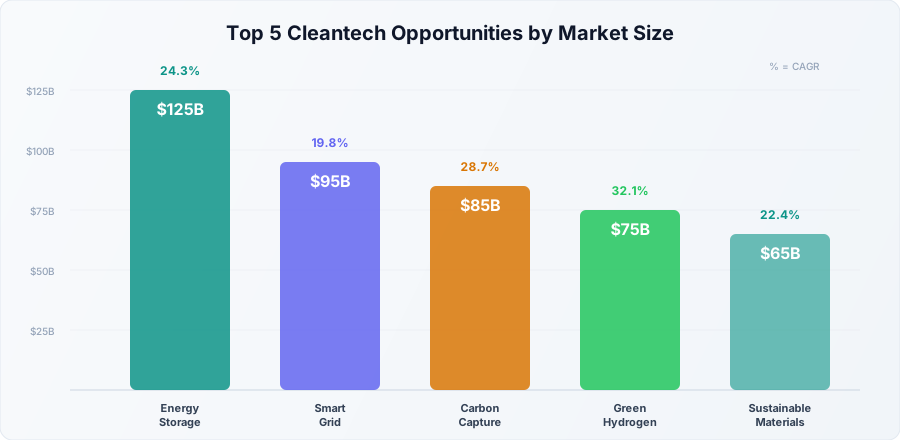
Top 5 Commercial Opportunities
The following five subsectors represent the areas where AI-driven analysis identifies the strongest alignment between technological maturity, market demand, and available capital. Each has moved beyond early-stage research into active commercialization, with multiple viable pathways for licensing, startup formation, or strategic partnerships. Innovators entering these spaces benefit from established supply chains, clear regulatory tailwinds, and growing customer demand -- factors that materially reduce go-to-market risk compared to earlier-stage cleantech domains.
1. Advanced Energy Storage
Energy storage sits at the nexus of nearly every clean energy transition pathway, from grid-scale renewable integration to electric vehicle range extension. The subsector has matured rapidly as lithium-ion costs have fallen, but significant innovation opportunities remain in next-generation chemistries, solid-state designs, and long-duration storage architectures that can bridge multi-day gaps in renewable generation. Several storage-focused startups have achieved billion-dollar valuations in recent funding rounds, signaling strong investor conviction in the sector's growth trajectory.
- One of the largest and fastest-growing cleantech subsectors
- Strong double-digit compound annual growth projected through 2030
- Key applications:
- Grid-scale storage
- EV batteries
- Portable electronics
- Multiple unicorn-stage companies have emerged from this space
2. Carbon Capture Technology
Carbon capture has shifted from a niche industrial process to a central pillar of climate strategy, propelled by both regulatory mandates and the emergence of voluntary carbon markets that create direct revenue streams for capture operators. Direct air capture technologies, while still early in their cost-reduction curve, have attracted outsized venture investment as governments establish procurement commitments and tax credits that de-risk early deployments. For researchers with novel sorbent materials, membrane technologies, or process engineering approaches, the commercial pathway has never been more clearly defined.
- Rapid market expansion driven by regulatory requirements and carbon pricing
- Among the highest growth rates in all of cleantech
- Key applications:
- Industrial emissions
- Direct air capture
- Carbon utilization
- Early-stage funding rounds in this space have been exceptionally large
3. Green Hydrogen Solutions
Green hydrogen -- produced via electrolysis powered by renewable energy -- has emerged as a critical decarbonization pathway for sectors that are difficult to electrify directly, including heavy industry, long-haul shipping, and aviation. Government hydrogen strategies in the EU, Japan, South Korea, and the United States have created multi-billion-dollar demand signals that are pulling private capital into the sector at an accelerating rate. Innovators working on electrolyzer efficiency, hydrogen storage, and fuel cell technology are finding receptive markets and strategic partners eager to lock in supply agreements.
- Exceptionally high projected growth rate among cleantech subsectors
- Key applications:
- Industrial processes
- Transportation
- Energy storage
- Multiple successful exits and IPOs have validated the commercial model
4. Smart Grid Technology
As renewable energy penetration increases, the electrical grid requires fundamental modernization to manage intermittent generation, bidirectional power flows, and distributed energy resources. Smart grid technologies -- encompassing advanced sensors, AI-driven load balancing, demand response platforms, and grid-edge computing -- address this need and represent a large, rapidly growing market. The commercialization success rate for smart grid innovations is notably high relative to other cleantech subsectors, reflecting strong utility demand and well-established procurement processes.
- Large established market with steady double-digit growth
- Key applications:
- Grid optimization
- Demand response
- Renewable integration
- High commercialization success rates driven by clear utility demand
5. Sustainable Materials
The sustainable materials sector spans biodegradable plastics, low-carbon construction materials, and circular economy technologies that reduce waste and resource extraction. Consumer and regulatory pressure on single-use plastics, embodied carbon in buildings, and supply chain sustainability has created strong pull-through demand for innovation in this space. Technology transfer from university materials science labs has been particularly active, with licensing deals providing meaningful revenue streams for institutions and researchers alike.
- Solid growth driven by regulatory pressure and consumer demand
- Key applications:
- Biodegradable plastics
- Green construction
- Circular economy
- Active licensing market with significant deal values
Market Entry Analysis
Timing a cleantech market entry correctly is one of the most consequential strategic decisions an innovator can make. Enter too early and you face underdeveloped supply chains, skeptical customers, and a funding environment that may not yet support your capital requirements. Enter too late and incumbents have already locked up key partnerships, driven down margins, and established the industry standards that new entrants must conform to. AI-powered analysis helps resolve this tension by continuously monitoring the regulatory, technological, and market readiness signals that indicate when a window is opening or closing.
Timing Factors
-
Regulatory Environment
- EU Green Deal implementation
- US IRA funding availability
- Carbon pricing mechanisms
-
Technology Readiness
- Manufacturing scalability
- Cost competitiveness
- Performance benchmarks
-
Market Readiness
- Customer adoption rates
- Infrastructure availability
- Supply chain maturity
Success Patterns in Cleantech
Our AI analysis of hundreds of cleantech ventures reveals consistent patterns that distinguish commercially successful innovations from those that stall in the development phase. These patterns are not guarantees, but they represent the characteristics most strongly correlated with successful licensing, acquisition, or independent scaling. Understanding these patterns allows innovators to stress-test their own commercialization plans and identify gaps before they become obstacles. For a structured approach to evaluating your technology's readiness, consider using a TRL assessment framework to benchmark your progress against these success indicators.
Winning Characteristics
-
Strong IP Protection
- Multiple patent families
- Freedom to operate
- Strategic filing strategy
-
Clear Cost Advantage
- Meaningful cost reduction over incumbent solutions
- Scalable manufacturing
- Supply chain optimization
-
Strategic Partnerships
- Industry collaborations
- Research institutions
- Government agencies
Common Pitfalls
-
Market Timing
- Too early: infrastructure not ready
- Too late: market saturation
-
Scale-up Challenges
- Manufacturing complexity
- Cost overruns
- Supply chain issues
-
Value Proposition
- Unclear differentiation
- Limited market need
- Poor positioning
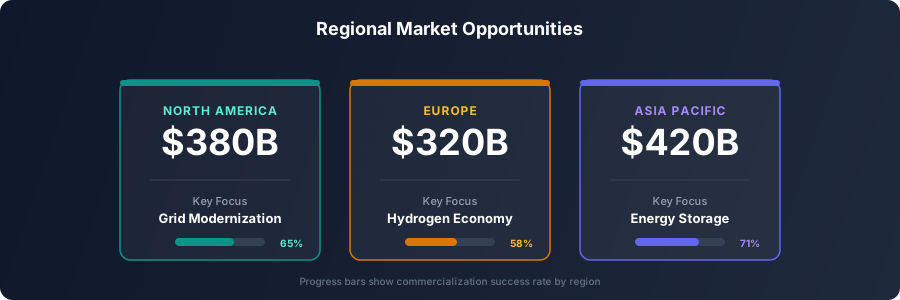
Regional Cleantech Opportunities and Policy Landscape
The cleantech opportunity varies significantly by region, shaped by distinct policy frameworks, energy market structures, and industrial bases. North America benefits from the Inflation Reduction Act's production tax credits and direct-pay mechanisms, which have catalyzed domestic manufacturing investment in batteries, solar, and hydrogen. Europe's Green Deal and Carbon Border Adjustment Mechanism are creating strong incentives for decarbonization across heavy industry, while the EU's hydrogen strategy is driving demand for electrolyzer technology. The Asia Pacific region, led by China's dominance in solar and battery manufacturing, represents the largest cleantech market by volume, with India and Southeast Asia emerging as high-growth deployment markets. Innovators should carefully evaluate regional policy stability, intellectual property enforcement, and market access conditions when selecting their initial commercialization geography.
North America
- Largest policy stimulus package for clean energy in history (IRA)
- Key focus: Grid modernization and domestic manufacturing
- Strong venture capital ecosystem for cleantech startups
Europe
- Carbon border adjustment creating demand for low-carbon industrial processes
- Key focus: Hydrogen economy and industrial decarbonization
- Robust public-private partnership frameworks
Asia Pacific
- Dominant manufacturing base for solar, batteries, and EVs
- Key focus: Energy storage and deployment scale
- Rapidly growing domestic demand in emerging markets
Investment Landscape
The cleantech investment landscape has matured considerably over the past several years, with dedicated climate funds, crossover investors from technology, and sovereign wealth funds all competing for high-quality deals. This capital abundance has shortened fundraising timelines for ventures with strong technical differentiation and clear commercial pathways, but it has also raised expectations around market intelligence and go-to-market readiness at every funding stage. Innovators who can articulate their market position with data-driven precision consistently outperform those relying on technology narratives alone.
Funding Sources
-
Venture Capital
- Growing pool of climate-dedicated VC funds at early and growth stages
- Average deal sizes have increased substantially
- Investors increasingly expect AI-driven market validation
-
Government Grants
- Significant research and demonstration funding available globally
- Programs increasingly favor commercially oriented proposals
- Competitive success rates reward strong commercialization plans
-
Corporate Investment
- Strategic investments from industrial corporations seeking decarbonization solutions
- Joint ventures providing market access and manufacturing scale
- Large average deal sizes reflecting corporate commitment
Commercialization Strategy Recommendations
Translating cleantech innovation into commercial success requires a disciplined, staged approach that balances technical development with market validation. The most successful cleantech ventures follow a remarkably consistent playbook: they achieve technical proof points early, validate willingness-to-pay with real customers before scaling, and build partnerships that provide both capital and market access. The recommendations below reflect patterns observed across successful cleantech commercializations and are designed to help innovators avoid the most common failure modes.
1. Technology Development
- Focus on scalability from the earliest design stages
- Prioritize cost reduction as a first-order design constraint
- Build strong IP portfolio with strategic patent coverage
2. Market Entry
- Start with a beachhead market where your advantage is most pronounced
- Build reference customers who can validate performance claims
- Develop detailed case studies documenting measurable outcomes
3. Partnership Strategy
- Identify strategic partners who provide market access, not just capital
- Build industry relationships through conferences and pilot programs
- Leverage research networks for credibility and technical collaboration
4. Funding Strategy
- Match funding instruments to your development stage
- Build investor relationships well before you need to raise
- Prepare data-driven pitch materials with credible market analysis
Success Metrics to Track
Tracking the right metrics at each stage of commercialization ensures that your team stays focused on the activities that most directly drive commercial outcomes. Early-stage ventures should emphasize technical performance milestones and initial customer validation, while growth-stage companies need to demonstrate unit economics and scalable demand. Establishing these metrics early also builds investor confidence by providing objective evidence of progress against plan.
-
Technical Metrics
- Performance benchmarks against incumbent solutions
- Cost targets relative to market willingness-to-pay
- Scale-up milestones from lab to pilot to production
-
Market Metrics
- Customer adoption velocity and retention
- Revenue growth rate and pipeline coverage
- Market share within target segments
-
Financial Metrics
- Burn rate relative to milestones achieved
- Gross margin trajectory as production scales
- Customer acquisition cost and lifetime value
Frequently Asked Questions
What are the fastest-growing cleantech sectors in 2025?
AI-driven analysis points to five standouts: advanced energy storage, carbon capture, green hydrogen, smart grid technology, and sustainable materials. Carbon capture and green hydrogen show some of the highest projected growth rates across all of cleantech, while energy storage ranks among the largest and fastest-growing subsectors with strong double-digit compound annual growth projected through 2030.
How big is the global cleantech market?
Global cleantech investment has reached the trillion-dollar scale, and projected growth rates significantly outpace the broader economy through 2030. The Asia Pacific region, led by China's dominance in solar and battery manufacturing, represents the largest cleantech market by volume, while patent applications in clean energy and sustainability have surged year over year.
What is driving cleantech investment growth?
Several converging forces are at work: tightening carbon regulations across major economies, rapidly declining costs for renewable energy and storage, and a surge of institutional capital seeking climate-aligned returns. Government stimulus, corporate net-zero commitments, and policy frameworks like the EU Green Deal and US Inflation Reduction Act are also accelerating deployment and capital flows.
Which cleantech sector has the highest commercialization success rate?
Smart grid technology shows notably high commercialization success rates relative to other cleantech subsectors. This reflects strong utility demand and well-established procurement processes, which reduce go-to-market risk. The sector spans advanced sensors, AI-driven load balancing, demand response platforms, and grid-edge computing within a large, rapidly growing market.
How do regional policies affect cleantech opportunities?
Opportunities vary significantly by region. North America benefits from the Inflation Reduction Act's production tax credits and direct-pay mechanisms. Europe's Green Deal and Carbon Border Adjustment Mechanism incentivize industrial decarbonization and hydrogen demand. Asia Pacific leads in manufacturing scale. Innovators should evaluate regional policy stability, IP enforcement, and market access when choosing a launch geography.
What makes a cleantech innovation commercially successful?
AI analysis of hundreds of cleantech ventures identifies consistent winning characteristics: strong IP protection with multiple patent families and freedom to operate, a clear cost advantage with scalable manufacturing, and strategic partnerships that provide market access. Common pitfalls include poor market timing, scale-up and manufacturing challenges, and an unclear value proposition or weak differentiation.
How Commercify Can Help
Our AI-powered platform helps cleantech innovators navigate the complexity of commercialization by providing data-driven insights at every stage of the journey. Rather than relying on manual research and intuition, Commercify enables teams to make strategic decisions grounded in real-time market intelligence.
- Analyze market opportunities with AI-powered market intelligence
- Identify optimal timing for market entry based on regulatory and competitive signals
- Connect with strategic partners and potential licensees
- Develop comprehensive go-to-market strategy tailored to your technology
- Track success metrics against industry benchmarks
Next Steps
-
Assess Your Innovation
- Use our AI Market Analysis tool
- Get instant market insights
- Identify key opportunities
-
Develop Your Strategy
- Create commercialization plan
- Build financial model
- Define milestones
-
Start Your Journey
- See plans & pricing
- Access expert network
- Accelerate your success
Join the cleantech revolution with data-driven insights and AI-powered strategy. Start your journey today with Commercify.