TRL Assessment: A Practical Guide

Technology Readiness Levels Explained: A Practical Guide to TRL Assessment
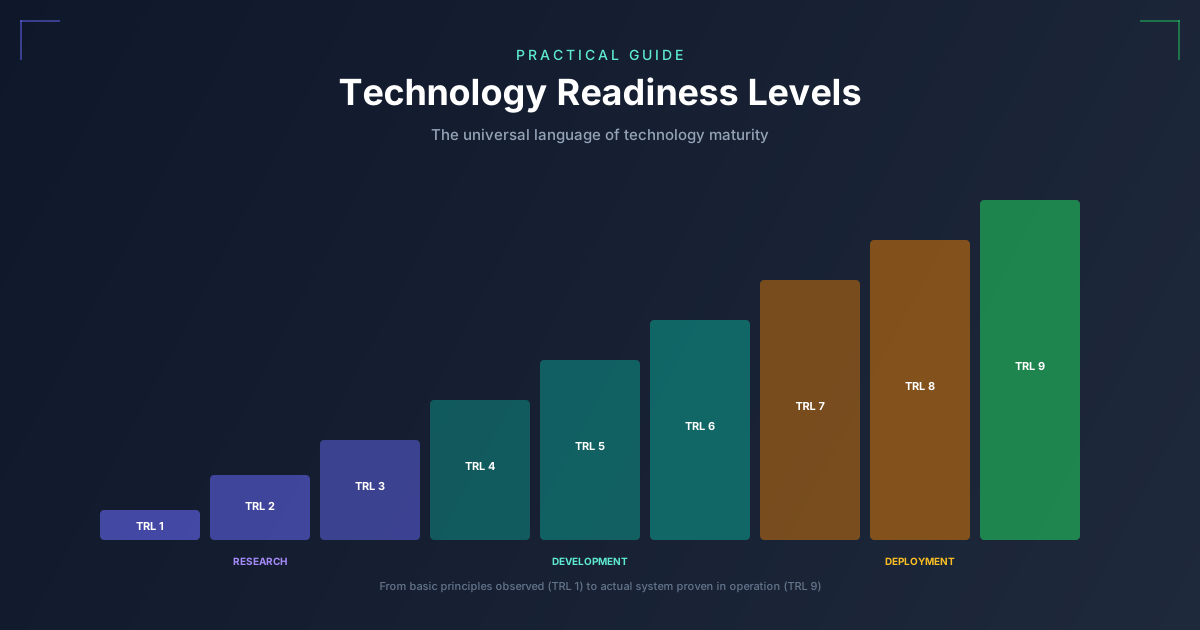
TRL assessment is the process of measuring how mature a technology is, from basic research all the way to proven operational deployment. It uses a systematic 9-level scale: TRL 1-3 covers basic research (discovery and early validation), TRL 4-6 covers applied research and development (demonstration and validation), and TRL 7-9 covers system development and deployment (qualification and operations). Originally developed by NASA, it has become the standard way to communicate a technology's readiness to investors, grant programs, and potential partners.
When NASA developed the Technology Readiness Level (TRL) framework in the 1970s, they were trying to solve a fundamental problem: how do you communicate the maturity of a technology in a way that everyone understands?
Today, TRL assessment has become the universal language of technology commercialization. Investors ask about your TRL. Grant applications require TRL estimates. Potential partners want to know where you are on the scale before committing resources.
Yet despite its ubiquity, TRL assessment remains widely misunderstood. Researchers routinely overestimate their technology's readiness. Investors encounter projects claiming TRL 6 that are barely at TRL 3. And founders waste time and capital pursuing commercialization activities inappropriate for their actual stage.
Part of our Complete Tech Transfer Process guide — a ten-stage operator's playbook covering the broader workflow this article fits into.
This guide provides a practical framework for accurately assessing your technology's readiness—and understanding what it takes to advance to the next level.
What Are Technology Readiness Levels?
Technology Readiness Levels are a systematic measurement system that assesses the maturity of a technology from basic research (TRL 1) to proven system in operational environment (TRL 9). Originally developed for aerospace applications, TRLs have been adopted across defense, energy, healthcare, and commercial technology development.
The framework serves multiple purposes:
For researchers and innovators: TRLs help you understand what development stage you're at and what activities are needed to advance.
For funders and investors: TRLs provide a standardized way to assess technology risk and appropriate investment timing.
For organizations: TRLs enable portfolio management across technologies at different stages of development.
For partners: TRLs set expectations about what integration or productization will require.
The nine levels break into three broad categories:
- TRL 1-3: Basic Research (Discovery and early validation)
- TRL 4-6: Applied Research and Development (Demonstration and validation)
- TRL 7-9: System Development and Deployment (Qualification and operations)
Let's examine each level in detail.
TRL 1: Basic Principles Observed and Reported
Definition: Scientific research begins to be translated into applied R&D. Basic physical principles are observed and reported.
What it means: You've identified a phenomenon or principle that could potentially be useful, but you haven't yet explored whether it can be applied practically. This is the realm of fundamental science—observation and hypothesis.
Evidence required:
- Published peer-reviewed papers describing the phenomenon
- Documented scientific observations
- Theoretical frameworks explaining the underlying principles
Real-world examples:
- Discovery that a particular protein interacts with a disease pathway
- Observation that a material exhibits unusual quantum properties
- Identification of a mathematical principle that could improve computation
Common mistake: Claiming TRL 2 or 3 when you're still exploring basic science. If you're not yet investigating specific applications, you're at TRL 1.
What it takes to advance: Begin conceptualizing how the basic principles could be applied to practical problems. Identify potential applications and begin exploring their feasibility.
TRL 2: Technology Concept Formulated
Definition: Invention begins. Practical applications are identified and explored, but no experimental proof or detailed analysis exists.
What it means: You've moved from observation to ideation. You've identified potential applications of the basic principles and begun speculating about how they might be achieved. However, you haven't yet tested whether your concept actually works.
Evidence required:
- Documentation of proposed applications
- Preliminary analysis of how principles could be applied
- Identification of key technical challenges
- Initial literature review of related approaches
Real-world examples:
- Proposing that the protein interaction could be targeted for drug development
- Hypothesizing that the quantum properties could enable better sensors
- Designing an algorithm based on the mathematical principle
Common mistake: Confusing brainstorming with concept formulation. TRL 2 requires documented analysis, not just ideas.
What it takes to advance: Design and conduct experiments to validate (or invalidate) your concept. Move from speculation to evidence.
TRL 3: Analytical and Experimental Critical Function Proof-of-Concept
Definition: Active R&D is initiated. Analytical and laboratory studies prove the concept's critical function and potential.
What it means: You've demonstrated that your concept actually works in a controlled laboratory setting. This isn't a full prototype—it's focused proof that the core technical principle functions as predicted.
Evidence required:
- Laboratory data demonstrating the critical function
- Experimental results validating key assumptions
- Analysis showing the concept performs as theorized
- Documentation of experimental conditions and reproducibility
Real-world examples:
- In vitro studies showing the drug candidate affects the target protein
- Lab demonstration that the sensor detects the target signal
- Software simulation showing the algorithm achieves predicted performance
This is the critical transition from science to technology. Many innovations stall here because moving beyond requires different skills, resources, and funding than basic research.
Common mistake: Declaring TRL 4 based on lab proof-of-concept. TRL 4 requires component validation, not just principle validation.
What it takes to advance: Begin integrating your proof-of-concept into component-level demonstrations. Move from isolated experiments to testing components that could be part of a larger system.
TRL 4: Component Validation in Laboratory Environment
Definition: Basic technological components are integrated to establish that the pieces will work together.
What it means: You've moved beyond proving the principle works—now you're proving that technology components function together. This is still in a laboratory setting with idealized conditions, but you're testing actual components rather than isolated experiments.
Evidence required:
- Integrated component testing results
- Demonstration that multiple technical elements function together
- Performance data under controlled laboratory conditions
- Documentation of component interfaces and integration approach
Real-world examples:
- Prototype circuit board integrating sensor, processor, and communication elements
- Drug formulation studies showing stability and delivery characteristics
- Software system demonstrating core modules working together
Common mistake: Calling something TRL 4 when you've only tested the components in isolation. TRL 4 specifically requires integration testing.
What it takes to advance: Move from laboratory conditions to more realistic environments. Begin testing components in settings that approximate real-world conditions.
TRL 5: Component Validation in Relevant Environment
Definition: Basic technological components are integrated for testing in a simulated or relevant environment.
What it means: Your components work together, and now you've tested them in conditions closer to real-world use. The environment is "relevant" but not yet operational—it simulates key aspects of the final deployment context.
Evidence required:
- Test results from relevant environment testing
- Documentation of how the test environment approximates operational conditions
- Performance data showing system behavior under realistic conditions
- Identification of issues discovered in relevant environment testing
Real-world examples:
- Medical device tested in simulated physiological conditions
- Outdoor testing of sensor components in representative weather
- Software tested with realistic data loads and user scenarios
The gap between TRL 5 and TRL 6 is where many technologies fail. Moving from relevant environment to prototype system requires significant engineering and integration work.
Common mistake: Claiming TRL 6 because components worked well in relevant testing. TRL 6 requires a prototype of the complete system, not just validated components.
What it takes to advance: Integrate validated components into a complete system prototype. This often requires significant engineering resources and is where many research projects require industry partnership or substantial funding.
TRL 6: System/Subsystem Model or Prototype Demonstrated in Relevant Environment
Definition: A representative model or prototype system is tested in a relevant environment.
What it means: You now have a prototype that represents the final system—not just components, but an integrated system that looks and functions like the eventual product. This prototype has been tested in conditions that simulate operational use.
Evidence required:
- Working prototype with representative form and function
- Test data from relevant environment demonstration
- Performance comparison to target specifications
- Documentation of any gaps between prototype and final system
Real-world examples:
- Alpha version of software deployed to beta testers
- Medical device prototype tested in preclinical studies
- Engineering prototype tested in simulated field conditions
TRL 6 is often described as "looking like the final product." It's a significant milestone because it demonstrates that the technology can be implemented as a complete system.
Common mistake: Considering something TRL 6 when it's actually a lab demonstration dressed up as a prototype. True TRL 6 requires representative functionality, not just appearance.
What it takes to advance: Move from relevant environment to operational environment. This means testing in actual field conditions with real users or in conditions identical to deployment.
TRL 7: System Prototype Demonstrated in Operational Environment
Definition: The prototype is near or at planned operational system level. The system is ready for demonstration in an operational environment.
What it means: Your prototype has been demonstrated in the actual operational environment—not simulated conditions, but real-world deployment scenarios. This is the first true field test of the complete system.
Evidence required:
- Field test results from operational environment
- User feedback from operational testing
- Documentation of system performance vs. requirements
- Identification of any modifications needed for final deployment
Real-world examples:
- Clinical trials demonstrating safety and efficacy
- Pilot deployment with paying customers
- Field testing by end users in actual operational scenarios
TRL 7 is the "prove it really works" stage. Many technologies encounter unexpected issues when moving from controlled testing to real-world deployment.
Common mistake: Declaring TRL 7 based on limited or controlled operational testing. True TRL 7 requires substantial evidence from real operational conditions.
What it takes to advance: Complete the final design and demonstrate the system is ready for full deployment. Address any issues identified during operational testing.
TRL 8: Actual System Completed and Qualified
Definition: Technology is proven to work in its final form under expected conditions.
What it means: You've completed development and the system has been qualified through testing and demonstration. This is the final system—not a prototype—and it's been proven to meet all requirements.
Evidence required:
- Complete system meeting all specifications
- Qualification testing documentation
- Regulatory approvals (if applicable)
- Manufacturing readiness for production
Real-world examples:
- FDA-cleared medical device ready for commercial distribution
- Certified aerospace component ready for integration
- Production software release deployed to customers
TRL 8 represents commercial readiness. The technology is ready for deployment; what remains is scaling production and distribution.
Common mistake: Claiming TRL 8 when qualification testing is incomplete or regulatory approval is still pending.
What it takes to advance: Deploy the system in its intended operational environment and demonstrate sustained successful operation.
TRL 9: Actual System Proven in Operational Environment
Definition: Technology is successfully deployed in operational mission conditions.
What it means: Your technology is in use, performing its intended function in actual operational conditions. This is proven technology with a track record of successful deployment.
Evidence required:
- Operational deployment data
- Track record of successful mission performance
- Documentation of any operational issues and resolutions
- Evidence of sustained operational success
Real-world examples:
- Medical device in routine clinical use
- Deployed software with active user base
- Operational system with documented mission success
TRL 9 is true technology maturity. The technology has proven itself in real-world use over meaningful timeframes.
Industry-Specific TRL Frameworks
While the core TRL scale is universal, different industries have adapted it to their specific contexts. Understanding these adaptations is important for accurate assessment.
Pharmaceutical and Biotechnology TRLs
The pharmaceutical industry often maps TRLs to clinical development stages:
| TRL | Pharmaceutical Stage |
|---|---|
| 1-2 | Target identification and validation |
| 3 | Lead discovery and optimization |
| 4 | Preclinical development (in vitro) |
| 5 | Preclinical development (in vivo) |
| 6 | IND-enabling studies, Phase 1 clinical trials |
| 7 | Phase 2 clinical trials |
| 8 | Phase 3 clinical trials, NDA submission |
| 9 | FDA approval and commercial launch |
Key differences: Pharmaceutical development has longer timelines (10-15 years from TRL 3 to TRL 9) and higher failure rates. The transition from TRL 5 to TRL 6 (preclinical to clinical) is particularly challenging due to IND requirements.
Medical Device TRLs
Medical devices follow a similar but distinct path:
| TRL | Medical Device Stage |
|---|---|
| 1-2 | Concept and clinical need identification |
| 3 | Proof-of-concept bench testing |
| 4 | Component-level design verification |
| 5 | Subsystem testing with simulated use |
| 6 | Full system verification and validation |
| 7 | Clinical trials (IDE studies for Class III) |
| 8 | 510(k)/PMA clearance/approval |
| 9 | Commercial distribution and post-market surveillance |
Key differences: Regulatory pathway (510(k) vs. PMA) significantly affects the TRL 6-8 transition. Design controls and quality system requirements influence the entire development process.
Software and AI/ML TRLs
Software development adapts TRLs to account for the iterative nature of software:
| TRL | Software/AI Stage |
|---|---|
| 1-2 | Algorithm concept and research |
| 3 | Algorithm proof-of-concept (sandbox) |
| 4 | Module development and unit testing |
| 5 | Integration testing with synthetic data |
| 6 | Beta testing with real data |
| 7 | Limited production deployment |
| 8 | Full production deployment |
| 9 | Sustained production with proven performance |
Key differences: Software can iterate rapidly through TRLs. However, AI/ML systems face additional validation challenges related to data quality, model robustness, and edge cases.
Hardware and Manufacturing TRLs
Hardware development closely follows the original aerospace model:
| TRL | Hardware Stage |
|---|---|
| 1-2 | Basic science and concept |
| 3 | Component-level proof-of-concept |
| 4 | Breadboard validation in lab |
| 5 | Brassboard validation in relevant environment |
| 6 | Engineering model prototype |
| 7 | Field testing of qualification unit |
| 8 | Production unit qualified |
| 9 | Production deployment |
Key differences: Manufacturing readiness is a critical parallel track. A technology might be TRL 8 technically but not ready for volume production without additional manufacturing development.
Clean Technology and Energy TRLs
The Department of Energy has adapted TRLs for energy technology:
| TRL | Clean Tech Stage |
|---|---|
| 1-2 | Basic science research |
| 3 | Proof-of-concept |
| 4 | Bench-scale demonstration |
| 5 | Pilot-scale demonstration |
| 6 | Engineering-scale demonstration |
| 7 | Demonstration at scale in relevant environment |
| 8 | First commercial plant/installation |
| 9 | Commercial operation at scale |
Key differences: Scale is critical in energy technology. Moving from TRL 5 to TRL 7 often requires large capital investments in pilot plants and demonstrations.
Common TRL Assessment Mistakes
Mistake 1: Conflating Different Aspects of Readiness
A technology might be at different TRLs for different aspects:
- Technical performance: TRL 6
- Manufacturing readiness: TRL 3
- Regulatory readiness: TRL 4
Report the limiting TRL, or separately assess each dimension.
Mistake 2: Overweighting Publication vs. Application
Published peer-reviewed research is TRL 1-3 level evidence. Having papers doesn't mean you're ready for commercialization.
Mistake 3: Lab Demonstration ≠ Prototype
A laboratory demonstration of principle is TRL 3-4. A prototype is TRL 6. The gap requires significant engineering work that many researchers underestimate.
Mistake 4: Ignoring the Environment
TRL 5+ specifically requires testing in relevant or operational environments. Continuing to test in laboratory conditions doesn't advance TRL beyond 4.
Mistake 5: Conflating R&D Progress with Commercialization Progress
You can make significant R&D progress without advancing TRL if that progress doesn't demonstrate increased readiness for deployment. TRL advancement requires specific evidence of maturity.
Mistake 6: Claiming Higher TRL Based on Similar Technologies
Your technology is assessed on its own merits. Even if similar technologies are at TRL 9, your implementation starts at TRL 1 unless you have specific evidence for your system.
How to Use TRL Assessment Strategically
For Funding Applications
Different funding sources target different TRL ranges:
- Basic research grants (NSF, NIH R01): TRL 1-3
- SBIR/STTR Phase I: TRL 3-4 advancing to TRL 4-5
- SBIR/STTR Phase II: TRL 4-5 advancing to TRL 6-7
- Seed/Angel investment: TRL 4-6
- Series A venture capital: TRL 6-7
- Strategic corporate investment: TRL 7-8
Understanding your TRL helps you target appropriate funding sources and set realistic expectations.
For Partnership Discussions
Potential partners want to understand what's left to do. Accurate TRL assessment helps set expectations:
- TRL 4-5: Partner for co-development
- TRL 6-7: Partner for pilot/demonstration
- TRL 8-9: Partner for distribution/commercialization
Overestimating TRL leads to partnerships that fail when the actual work required becomes clear.
For Commercialization Planning
Each TRL transition requires different resources:
| Transition | Key Requirements |
|---|---|
| 3 → 4 | Engineering capabilities, component development |
| 4 → 5 | Relevant testing facilities, realistic test conditions |
| 5 → 6 | Significant engineering investment, prototype development |
| 6 → 7 | Operational partners, field testing resources |
| 7 → 8 | Regulatory affairs, manufacturing development |
| 8 → 9 | Sales and marketing, customer support, scale production |
Understanding these requirements helps you plan resource needs and timelines.
Conducting Your TRL Assessment
Here's a practical process for assessing your technology's readiness:
Step 1: Document Your Evidence
For each TRL level, list the specific evidence you have:
- What testing have you done?
- In what environment?
- What were the results?
- Is the evidence documented and reproducible?
Step 2: Identify the Highest Fully-Demonstrated Level
You're at TRL X if you have complete evidence for TRL X and below. Partial evidence for TRL X+1 doesn't count—you're not there yet.
Step 3: Consider All Dimensions
If different aspects of your technology are at different TRLs, report the limiting factor or assess dimensions separately.
Step 4: Get External Validation
Your assessment is inevitably biased. Have someone with commercialization experience review your evidence and challenge your assessment.
Step 5: Be Honest
Overestimating TRL hurts you more than it helps. It leads to mismatched expectations, failed partnerships, and wasted resources.
Frequently Asked Questions
What is a Technology Readiness Level (TRL)?
A Technology Readiness Level is a systematic measurement of how mature a technology is, from basic research at TRL 1 to a proven system in an operational environment at TRL 9. NASA developed the framework in the 1970s, and it has since been adopted across defense, energy, healthcare, and commercial technology development as a standardized way to communicate technology maturity.
What are the 9 TRL levels?
The nine levels group into three categories. TRL 1-3 is basic research, covering observed principles, formulated concepts, and proof-of-concept. TRL 4-6 is applied research and development, covering component validation in lab and relevant environments and a prototype demonstrated in a relevant environment. TRL 7-9 is system development and deployment, covering operational prototype, qualified system, and proven operational deployment.
What TRL do investors expect?
Investor expectations vary by funding stage. Seed and angel investors typically target TRL 4-6, Series A venture capital targets TRL 6-7, and strategic corporate investment targets TRL 7-8. Basic research grants such as NSF and NIH R01 fund TRL 1-3, while SBIR/STTR Phase I and II programs support advancement from TRL 3-4 up to TRL 6-7.
How do you advance from one TRL to the next?
Each transition requires specific evidence of increased maturity, not just R&D progress. Advancing from proof-of-concept to component validation requires integration testing. Moving to relevant and operational environments requires testing outside the lab. Later transitions need prototype development, field testing, regulatory affairs, manufacturing development, and finally scaled production with sales and support.
What is the most common TRL assessment mistake?
The most common mistake is overestimating readiness. Researchers routinely claim a higher TRL than their evidence supports, such as confusing a lab demonstration of principle (TRL 3-4) with a working prototype (TRL 6). Other frequent errors include overweighting publications, ignoring the testing environment, and conflating R&D progress with genuine commercialization progress.
How do you determine your technology's TRL?
Document the specific evidence you have at each level, including what testing you have done, in what environment, and whether results are reproducible. You are at TRL X only when you have complete evidence for TRL X and below, since partial evidence for the next level does not count. Consider all dimensions, get external validation, and be honest.
Assess Your Technology's Readiness
Understanding your technology's TRL is the first step in planning your commercialization journey. Our interactive TRL Assessment Tool guides you through a structured evaluation of your technology and provides personalized recommendations for advancing to the next level.