12-Slide Pitch Deck for University Spinouts

The 12-Slide Pitch Deck Template for University Spinouts and Deep Tech Startups
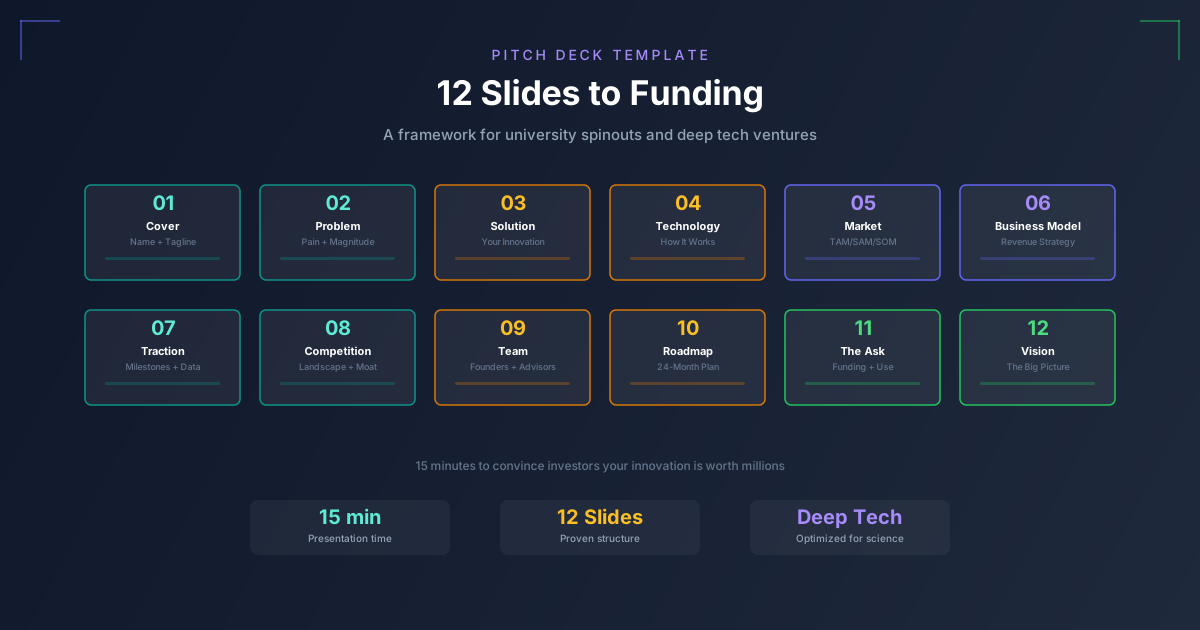
A university spinout pitch deck should follow a 12-slide framework designed for a 15-20 minute presentation: title and opening hook, the problem, your solution, technology and IP, market opportunity, business model, traction and validation, go-to-market strategy, competitive landscape, team, financial projections and ask, and a closing vision. Unlike a typical startup pitch, it must address technical risk, IP defensibility, longer timelines, and academic credentials, since the technology itself is the product. Lead with impact rather than technology, and back claims with evidence investors can assess.
You've spent years developing breakthrough research. Your technology could change an industry—or create an entirely new one. But when you stand in front of investors, you have just 15 minutes to convince them your deep tech innovation is worth millions in funding.
The challenge for university spinouts and deep tech founders is distinct from typical startups. You're not pitching a mobile app or SaaS product. You're pitching science that needs to be translated into a business—often in markets that don't fully exist yet, with timelines that stretch years into the future.
Investors who fund deep tech understand this. They're looking for different things than consumer tech investors. But you still need to tell a compelling story that addresses their concerns while showcasing the transformative potential of your technology.
This guide provides a 12-slide framework specifically designed for university spinouts and deep tech ventures, along with examples, common mistakes, and tips for compelling delivery.
Why Deep Tech Pitches Are Different
Before diving into the slides, let's understand what makes pitching university research and deep tech ventures fundamentally different:
1. The Technology is the Product
In consumer tech, technology is usually a means to an end—the app or platform is what users care about. In deep tech, the technology itself is often the primary innovation. You're pitching a novel approach, not just a better implementation.
2. Longer Timelines
Deep tech ventures often take many years to reach significant revenue. Investors need to believe in both the technology trajectory and your team's ability to navigate a long journey.
3. Technical Risk Dominates Early Stages
While market risk dominates most startup investments, deep tech ventures face significant technical risk—will the science actually work at scale? Addressing this credibly is essential.
4. Market Creation vs. Market Capture
Many deep tech innovations create new markets rather than competing in existing ones. This requires a different approach to market sizing and competitive positioning.
5. IP as Competitive Moat
Patents and trade secrets are often the primary defensibility for deep tech ventures. This makes IP strategy central to the investment thesis.
6. Academic Credentials Matter
Investors look for world-class expertise on deep tech teams. Your academic credentials and research track record are assets, not just background.
The 12-Slide Framework
This framework is designed for a 15-20 minute presentation, leaving time for Q&A. Each slide has a specific purpose and key elements.
The example lines under each slide are hypothetical, written to show structure and tone. Company names, customer counts, and performance numbers in them are placeholders; any market or industry statistic you put on a real slide should come from a source you can name.
Slide 1: Title and Opening Hook
Purpose: Capture attention and establish what you do in 10 seconds.
Key Elements:
- Company name and logo
- One-line description that a non-expert can understand
- Powerful visual or image that represents your technology
- Compelling statistic or hook that establishes significance
Example Opening Hooks:
Bad: "We're developing quantum sensor technology for industrial applications."
Good: "Every year, undetected pipeline leaks cost operators $[X] billion [your sourced figure]. Our quantum sensors detect leaks 100x faster than current technology—before they become disasters."
Bad: "Our platform uses machine learning for drug discovery."
Good: "Bringing one new drug to approval costs an estimated $2.6 billion once failures and the cost of capital are counted. We're cutting that dramatically using AI that has already predicted 3 FDA-approved compounds."
(The $2.6 billion is a real, citable estimate: DiMasi, Grabowski & Hansen, Journal of Health Economics, 2016, in 2013 dollars. The company claim is hypothetical. Every number in your hook should be either your own data or sourced like this.)
Common Mistakes:
- Leading with technology instead of problem/impact
- Academic jargon that alienates non-technical investors
- Vague claims that don't differentiate
- Cluttered slides that distract from your opening words
Deep Tech Tip: Your opening sets the frame. Start with impact, not technology. Even deep tech investors are people—engage their emotions before their analytical minds.
Slide 2: The Problem
Purpose: Establish that you're solving a significant problem worth solving.
Key Elements:
- Clear articulation of the problem in business/human terms
- Quantification of the problem's impact (dollars, lives, efficiency)
- Evidence that the problem is real and persistent
- Why existing solutions fail
Structure Your Problem Statement:
- Who has the problem? (Be specific about the customer segment)
- What is the problem? (In concrete, measurable terms)
- Why does it exist? (Technical or systemic root cause)
- Why now? (What's changed that makes solving it possible or urgent?)
Example:
"Electric vehicle motors depend on rare earth magnets, and China accounts for 91% of global refined output of magnet rare earths (IEA, 2026). That concentration is a supply chain vulnerability for every EV maker. Current alternatives sacrifice performance—until now."
Common Mistakes:
- Problems that are "nice to solve" rather than "must solve"
- Problems so large and vague they don't feel addressable
- Problems that don't connect to real customer pain and budgets
- Problems the audience doesn't believe exist
Deep Tech Tip: For truly novel technologies, investors may question whether the problem is real or whether current solutions are "good enough." Include evidence: customer quotes, market research, industry reports.
Slide 3: Your Solution
Purpose: Explain what you've built and why it's different.
Key Elements:
- Clear, jargon-free explanation of your solution
- How your approach is fundamentally different from current solutions
- Key insight or breakthrough that enables your approach
- Visual representation (diagram, photo, demo screenshot)
The Grandmother Test:
Can you explain your solution so your grandmother would understand? If not, simplify. Investors who don't understand what you do can't invest confidently.
Example Structures:
"We've developed [technology approach] that [key capability]. Unlike [current solutions], our approach [differentiation] because [technical insight]."
"Our platform uses [technical approach] to [business outcome]. We achieve this through [2-3 key innovations] that took [years/publications] to develop."
Visual Suggestion:
The best solution slides include a simple visual:
- Product photo or rendering
- Architecture diagram
- Before/after comparison
- Demo screenshot
Common Mistakes:
- Deep technical details that obscure the key message
- Claiming to do everything for everyone
- No visual representation—all text
- Explanation that assumes technical knowledge
Deep Tech Tip: Investors will ask deep technical questions—but not on this slide. The solution slide is about the "what" and the big-picture "why it's different." Save details for Q&A and technical deep-dives.
Slide 4: Technology and IP
Purpose: Establish technical credibility and defensibility.
Key Elements:
- Core technical approach (simplified)
- Key innovations that differentiate you
- IP status (patents filed, granted, key claims)
- Development stage (TRL or equivalent)
For University Spinouts:
- License terms (exclusive? field-of-use restrictions?)
- Founding team's relationship to the research
- Continued university collaboration (if any)
- Any government rights (Bayh-Dole considerations)
Example:
"We have exclusive, worldwide license to 5 patents covering [core technology], with 3 additional applications pending. Our lead inventor Dr. [Name] has [publications] in [field] and continues as Chief Scientist."
What Investors Want to Know:
- Is this defensible? Can competitors copy it?
- Does the science actually work?
- How long until someone else figures this out?
- Is the IP clean? Any ownership disputes?
Common Mistakes:
- Overcomplicating technical explanations
- Patents pending on broad concepts without specific claims
- Ignoring IP that might create freedom-to-operate issues
- Assuming investors understand your field
Deep Tech Tip: Be honest about what's proven versus what's projected. Investors investing in deep tech understand technical risk—they want to assess it accurately, not hear unrealistic claims.
Slide 5: Market Opportunity
Purpose: Establish that the market is large enough to support a venture-scale outcome.
Key Elements:
- TAM (Total Addressable Market): Total market for all relevant products/services
- SAM (Serviceable Addressable Market): Portion you can technically serve
- SOM (Serviceable Obtainable Market): Realistic near-term target
- Market growth trends and drivers
Deep Tech Market Sizing Approaches:
For Existing Markets (Technology Substitution):
- Start with current market size for incumbent solutions
- Define your addressable segment
- Apply adoption curve assumptions
For New Markets (Category Creation):
- Bottom-up from customer pain and willingness to pay
- Proxy from related markets
- Value chain analysis
Example:
"The industrial gas detection market is $5B (TAM), with refineries and chemical plants representing $1.2B (SAM). We're initially targeting Gulf Coast refineries representing $150M (SOM), with first customers in Q2."
Common Mistakes:
- Top-down only ("1% of a $100B market")
- Markets so large they don't feel targeted
- No clear path from SOM to SAM
- Markets that don't exist yet with no evidence they will
Deep Tech Tip: If you're creating a new category, spend extra time on the "why now" and show analogies to market creation in related fields. Investors need to believe the market will materialize.
Slide 6: Business Model
Purpose: Explain how you'll capture value from the market opportunity.
Key Elements:
- Revenue model (licensing, product sales, SaaS, services)
- Pricing approach and rationale
- Unit economics (customer acquisition cost, lifetime value)
- Margin structure
Common Deep Tech Business Models:
Technology Licensing:
- Pros: Capital-efficient, leverages others' distribution
- Cons: Smaller share of value, less control
- Best for: Platform technologies, enabling tools
Direct Product/Device Sales:
- Pros: Higher margins, direct customer relationship
- Cons: Capital-intensive, need sales/support infrastructure
- Best for: Specialized applications, regulated markets
SaaS/Platform:
- Pros: Recurring revenue, scalable
- Cons: Customer acquisition challenges, support needs
- Best for: Software-enabled solutions, data products
Hybrid Models:
- Device + consumables (razors/blades)
- Platform + services
- License + royalty
Example:
"We sell our sensor systems for $50K with annual service contracts of $10K. Our cost is $15K per unit giving us 70% hardware margins. Pilot customers convert to full deployment at 80%."
Common Mistakes:
- No clear monetization strategy
- Pricing not tied to customer value
- Business model doesn't match market expectations
- Unit economics that don't work at scale
Deep Tech Tip: Early-stage deep tech companies often don't have validated unit economics. Be honest about what's validated versus projected, and explain your assumptions.
Slide 7: Traction and Validation
Purpose: Provide evidence that your technology works and customers want it.
Key Elements:
- Technical milestones achieved
- Customer validation (LOIs, pilots, contracts)
- Partnerships and collaborations
- Key metrics and growth trajectory
Types of Traction for Deep Tech:
Technical Traction:
- TRL advancement
- Key experiments completed
- Performance benchmarks achieved
- Publications and peer validation
Commercial Traction:
- Letters of intent
- Paid pilot projects
- Development agreements
- Early revenue
Team Traction:
- Key hires
- Advisory board additions
- Grant awards
Example:
"We've advanced from TRL 4 to TRL 6 in 12 months, achieved 98% detection accuracy in field trials, and have LOIs from 3 Fortune 500 oil companies representing $4M in potential first-year revenue."
Common Mistakes:
- No evidence of customer interest
- Only academic validation without commercial signal
- Metrics that don't matter (social media followers, general interest)
- Omitting important milestones
Deep Tech Tip: If you're pre-revenue (most early deep tech), show evidence of customer pull: conversations, LOIs, development agreements, industry advisory board. Investors need to believe customers will pay.
Slide 8: Go-to-Market Strategy
Purpose: Explain how you'll acquire customers and scale.
Key Elements:
- Target customer profile
- Sales and distribution approach
- Key partnerships for market access
- Geographic/segment expansion plan
Deep Tech GTM Considerations:
Beachhead Strategy:
- Which customer segment will adopt first?
- Why are they least resistant to change?
- How will you dominate this segment before expanding?
Sales Approach:
- Enterprise sales (direct, relationship-based)
- Channel partners (OEMs, distributors)
- Licensing to established players
Regulatory Path:
- FDA, EPA, or other approvals needed
- Timeline and cost implications
- Impact on GTM strategy
Example:
"We're targeting Gulf Coast refineries and chemical plants through direct enterprise sales, with our CEO leading initial customer development. Year 2, we'll expand to chemical plants through partnership with [major industrial supplier]."
Common Mistakes:
- No focus—trying to sell to everyone
- No evidence you can actually reach customers
- Ignoring long sales cycles common in deep tech
- No clear path from early adopters to mainstream
Deep Tech Tip: Demonstrate that you understand the long sales cycles and relationship-based selling common in your industry. Show you have industry connections, not just technology.
Slide 9: Competitive Landscape
Purpose: Show you understand the competitive environment and why you'll win.
Key Elements:
- Key competitors and alternatives
- Differentiation framework
- Defensibility of your advantage
- Why you'll win
Addressing "We Have No Competition":
This is never true, and claiming it signals naivety. Even breakthrough technologies compete with:
- Incumbent approaches (the status quo)
- Alternative technologies pursuing similar goals
- Customers doing nothing / living with the problem
Framework Approaches:
2x2 Matrix: Position yourself favorably on the two dimensions that matter most to customers.
Feature Comparison: Show key capabilities where you excel.
Approach Comparison: Contrast technology approaches and their implications.
Example:
"Current leak detection relies on manual inspection (slow, expensive) or basic sensors (miss 40% of leaks). Quantum sensing competitors [Company A, B] are 3+ years behind our TRL and lack our manufacturing partnership with [Industrial Giant]."
Common Mistakes:
- "We have no competitors"
- Straw man competitors that aren't real threats
- Feature comparisons that miss what customers actually value
- Ignoring well-funded competitors or big company R&D
Deep Tech Tip: Address the "why not [big company]?" question. If your technology is valuable, why won't a large company with resources develop it? Your answer is your defensibility story.
Slide 10: Team
Purpose: Demonstrate you have the people to execute.
Key Elements:
- Founding team with key backgrounds
- Relevant experience and achievements
- Key advisors and their roles
- Critical hires planned
For University Spinouts:
- Lead inventor's role and commitment
- Industry executives on team or advisory board
- Plan to build commercial capabilities
- University resources still available
What Investors Look For:
Technical Excellence: World-class expertise in the core technology
Commercial Experience: Someone who's built and sold products/companies
Industry Relationships: Access to customers and partners
Fundraising Experience: Ability to raise future rounds
Execution Track Record: Evidence of ability to deliver
Example:
"Our CEO [Name] commercialized [similar technology] at [Company], generating $100M revenue. Our CTO [Name] is the lead inventor with [X] patents and [Y] publications. Advisor [Name] is former VP at [Target Customer Company]."
Common Mistakes:
- All academics, no commercial experience
- No industry relationships
- Lead inventor not committed to company
- Missing critical roles with no plan to fill
Deep Tech Tip: If your team is academically heavy, acknowledge it and show your plan. Industry advisory boards, part-time executives, and specific hiring plans signal awareness of what's needed.
Slide 11: Financial Projections and Ask
Purpose: Show you've modeled the business and state clearly what you're raising.
Key Elements:
- 3-5 year financial projections (revenue, key expenses, profitability)
- Key assumptions driving projections
- Funding ask (amount and use of funds)
- Expected milestones from this funding
Projection Approach:
Deep tech investors expect and accept high uncertainty, but they want to see you've thought through the model:
- What drives revenue? (customers × price × units)
- What drives costs? (R&D, sales, manufacturing)
- What are the key milestones to de-risk?
- When do you expect profitability?
The Ask:
State clearly:
- How much you're raising
- Type of instrument (equity, SAFE, convertible)
- What you'll accomplish with the funding
- When you'll need to raise again
Example:
"We're raising $3M to advance from TRL 6 to TRL 8 and close our first 3 enterprise customers. This will position us for a $15M Series A in 18 months to scale manufacturing and expand sales."
Common Mistakes:
- Projections without underlying assumptions
- Hockey stick growth without credible explanation
- Ask not matched to milestones
- No clarity on runway and next raise
Deep Tech Tip: For pre-revenue companies, focus projections on milestones and key metrics rather than precise revenue forecasts. Investors know early revenue projections are speculative.
Slide 12: The Closing Vision
Purpose: End with the inspiring potential of your technology.
Key Elements:
- The world if you succeed
- Scale of impact possible
- Path to massive outcome
- Clear call to action
This is Your Moonshot Slide:
After 11 slides of details, end with the big picture. Why does this matter? What does the world look like if you're wildly successful?
Example:
"We're building the infrastructure for quantum sensing to become as ubiquitous as GPS. Our technology will prevent environmental disasters, improve manufacturing efficiency, and enable new applications we can't yet imagine. Join us."
Closing Strong:
End with a clear call to action. What do you want from this meeting?
- "We'd love to discuss how [Firm] can partner in our vision."
- "I'd welcome the opportunity to answer your questions and explore fit."
- "Our round closes in 4 weeks. I'd be excited to have [Firm] join."
Delivery Tips for Technical Founders
Great content with poor delivery fails. Here's how to present effectively:
Tell a Story, Not a Lecture
Investors hear pitches constantly. Stories stick; data dumps don't.
Story Structure:
- Situation (the world before your technology)
- Complication (the problem that must be solved)
- Resolution (your solution and its impact)
Practice, But Don't Over-Rehearse
Know your content cold, but sound conversational, not scripted. Practice until it feels natural, then stop.
Manage Time Ruthlessly
If you have 15 minutes, plan for 12. Leave room for questions and conversation. Rushing through 30 slides in 15 minutes is death.
Read the Room
Are investors engaged? Confused? Skeptical? Adjust in real-time. If they're confused about the technology, slow down. If they're excited about traction, expand.
Answer Questions Directly
Technical founders often over-explain. When asked a question, answer it directly, then provide context if needed. If you don't know, say so.
Prepare for Deep Dives
Deep tech investors will want to go deep on technology, IP, and scientific validity. Have supplementary slides and materials for these discussions.
Common Mistakes to Avoid
The "Technology Looking for a Problem" Pitch
Starting with how cool your technology is rather than the problem it solves. Lead with customer pain.
The Academic Seminar
Treating the pitch like a conference presentation with comprehensive methodology. Be selective and accessible.
The "Everything Pitch"
Claiming your technology solves 17 different problems for 9 different markets. Focus on one compelling beachhead.
The Dismissive Competition Slide
"We have no competition" or comparing yourself only to weak alternatives. Acknowledge real competitors and explain your advantage.
The Team Without Operators
All academics with no one who's built and sold products. Show how you'll build commercial capabilities.
The Murky Ask
Unclear what you're raising, why, and what it will achieve. Be specific about the funding, milestones, and runway.
Frequently Asked Questions
How many slides should a university spinout pitch deck have?
This framework uses 12 slides, designed for a 15-20 minute presentation that leaves time for Q&A. The slides cover the title and opening hook, problem, solution, technology and IP, market opportunity, business model, traction, go-to-market, competitive landscape, team, financial projections and ask, and a closing vision.
What should a deep tech pitch deck include?
Each of the 12 slides has a specific purpose. Beyond the core narrative, deep tech decks should cover IP status and defensibility, development stage such as TRL, technical and commercial traction, and a clear funding ask tied to milestones. For university spinouts, also address license terms, the lead inventor's role, and Bayh-Dole government rights.
What do investors look for in a university spinout?
Investors look for world-class technical expertise, commercial experience from someone who has built and sold products, industry relationships granting access to customers, fundraising ability, and an execution track record. They also assess whether the IP is defensible and clean, whether the science works, and whether customers will actually pay for the solution.
How is a deep tech pitch different from a typical startup pitch?
In deep tech the technology itself is often the product, not just a means to an end. Timelines often stretch many years, technical risk dominates early stages, and many ventures create new markets rather than capturing existing ones. IP is the primary competitive moat, and academic credentials are assets rather than just background.
How should a deep tech founder size their market?
Show TAM, SAM, and SOM with a clear path between them. For existing markets undergoing technology substitution, start from the incumbent market size, define your addressable segment, and apply adoption assumptions. For new categories, build bottom-up from customer pain and willingness to pay, use proxies from related markets, and emphasize the "why now."
What are the most common pitch deck mistakes to avoid?
Common mistakes include leading with technology instead of the problem, treating the pitch like an academic seminar, claiming the product solves everything for everyone, dismissing competition by saying you have none, building a team without commercial operators, and presenting a murky ask. Be specific about the funding amount, milestones, and runway.
Build Your Pitch Deck
A compelling pitch deck is essential for fundraising, partnership discussions, and grant applications. Our Pitch Deck Builder tool provides templates, examples, and guidance specifically designed for university spinouts and deep tech ventures.
Additional Resources
Looking for more pitch deck templates and fundraising resources? The Startup Project offers 200+ free resources, including pitch deck templates, financial models, and business canvases.